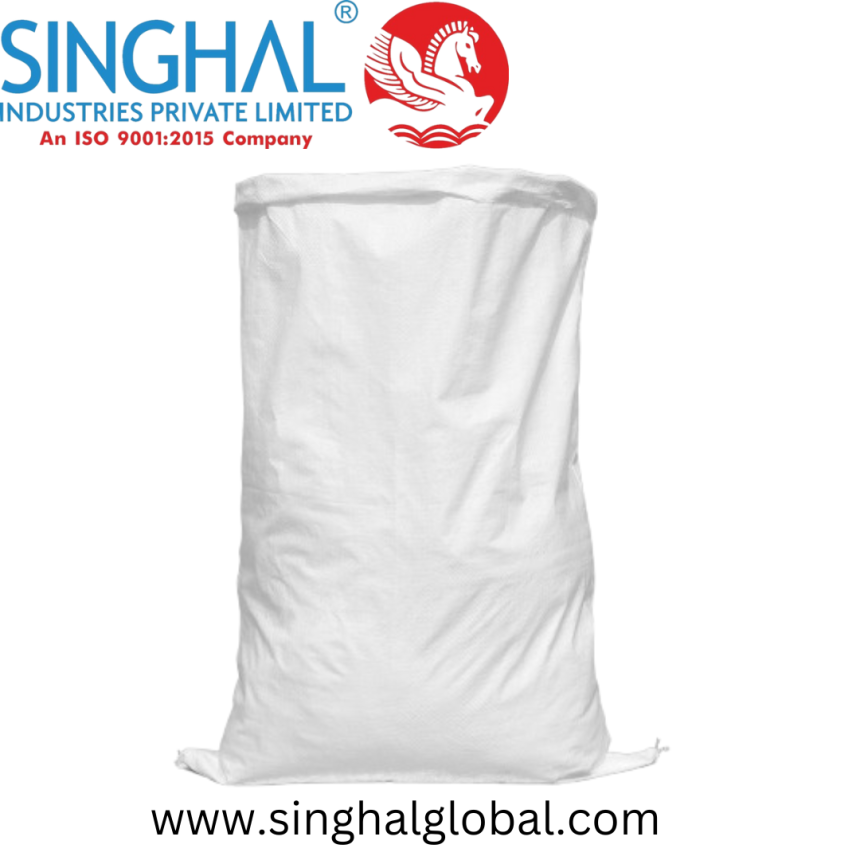

Revolutionizing Storage: The Versatility of HDPE Bags Today
HDPE Bags
In its quest for efficiency and sustainability, the industrial world is forever on the move, seeking out better packaging solutions. For a long time, different kinds of materials have been used, starting from jute and paper to thick fabrics and different plastics, but hardly any have come close to what High-Density Polyethylene (HDPE) bags can accomplish in terms of strength, lightweight construction, and being cost-effective. Actually, this seemingly simple piece of woven plastic is a wonder of polymer engineering, quietly changing the ways in which commodities—from grains and fertilizers to cement and chemicals—are stored, transported, and delivered all over the supply chain worldwide. Today, its use goes far beyond merely holding the goods; it is a vital part of the supply chain.
HDPE is a thermoplastic polymer that is made from the monomer ethylene. Because of its high strength-to-density ratio, the "high-density" part of the name refers to the fact that the material is very strong even though it is very light. The molecular structure of Polythene bags 50 kgis highly crystalline with very little branching in the polymer chains. This tight, linear structure is what gives the material its characteristic properties: rigidity, opacity, high tensile strength, and very good resistance to chemicals. Thus, it is an excellent material for the handling of large quantities, especially in situations where moisture, pests, and temperature changes may be a problem, which makes it very different from Low-Density Polyethylene (LDPE), that is softer and more flexible and is generally used for making thin films.
An HDPE bag production process is quite complicated and fully automatic, in essence, changing the raw plastic pellets into a woven fabric of definite strength and stability. The process is started by extrusion when HDPE resin is heated until it melts and then it is pressed through a die to get very thin tapes or ribbons. Afterwards, these tapes are stretched to get the polymer molecules aligned, thus their tensile strength is very much increased—a process called molecular orientation. After that these strong and uniform tapes are woven on circular looms into a tubular fabric. The woven structure is what makes it possible for the bag to have such a great load-bearing capacity and resistance to tearing. In the end, the tubular fabric is cut to the required size, and the bottom is either sewn or closed with the help of heat. In case of some specific uses, an inner liner that is mostly made of LDPE is installed so that an additional layer of moisture protection is provided and thus, dry and intact powdered goods can be stored.
For example, 50 kg bags Singhal Industries Pvt Ltdpackaging is heavily and rigorously employed in the bulk commodity sector. There, the bags face the challenge of holding up against significant static and dynamic loads during stacking, shipping, and handling. The need for containers that are capable of carrying substantial weights in a reliable manner is unceasing, thus the agricultural, feed, and construction industries utilize items such as the specialized Polythene bags 50 kg as their staples. The heavy-duty bags which these industries employ are only intended to hold the weight, but at the same time, they have to be able to resist the different kinds of stresses caused by being dropped, dragged, and stacked in high piles for a long time. The source of this robustness is directly the high tensile strength of the woven HDPE material, a feature which most of the competing materials cannot match unless a great increase in material thickness and, therefore, price is made.
The long life and very low reactivity of HDPE to chemicals are the main reasons why it has become a revolution storage medium. In contrast to natural fibers which lose their strength due to the presence of moisture, sunlight, and biological agents, HDPE is very resistant to mildew, rot, and most of the commonly used chemicals such as mild acids and alkalis. Besides that, if the material is for use in open-air storage, the manufactures resort to the addition of UV stabilizers to the polymer during the production stage. These stabilizers make the bags less vulnerable to photodegradation caused by solar radiation, thus the material is prevented from getting brittle and early failure takes place less often when it is used for storing fertilizer or seed outdoors. The outstanding durability is directly translated into less product losses and supply chain reliability being improved for the end-user.
An HDPE bags manufacturers near me performance depends largely on the manufacturer's quality control and precision. Companies that produce large volumes of reliable packaging products are aware that just one weak seam or an inconsistent weave can cause the whole thing to fail in carrying the industrial goods. The quest for dependable suppliers typically results in choosing certain regional partners and the search for specialized products is not only about material but also about source like when referring to the widely known 50 kg bags Singhal Industries Pvt Ltd or similar industry leaders. Good quality production ensures that the woven density, tape width, and seam strength are always at or above the level of the load ratings that have been specified, a very important requirement for fields such as food processing and pharmaceuticals where the packing is of great importance.
HDPE bags are more than just containers; they signify a major breakthrough in polymer technology that is being used in industrial logistics. The revolution of the bags is not due to a sudden, single invention but to the relentless and versatile performance across all sectors that are in need of durable, cheap, and safe bulk storage. HDPE is a new standard that has been set very high by these sacks starting from the 50 kg bags which are the basis of global agricultural trade to the specialized, printed ones that are used for packing the chemical powders of high-value. The woven HDPE bag, being the core, indispensable component, with its simple design, will be there to ensure the integrity of the goods from the point of manufacture to the hands of the final consumer as global trade keeps on growing and supply chains get more and more complex.
Question: Who is the largest supplier of HDPE Bags?
Answer: One of the main suppliers of HDPE Bags is Singhal Industries Private Limited which is a packaging material supplier to the whole world with the offering of various packaging solutions.
Question: Who is the largest exporter of HDPE Bags?
Answer: The leading exporter of HDPE Bags is different in various locations. But a company like Singhal Industries Private Limited has been a significant exporter of top-notch HDPE Bags to diverse international markets.
Question: Who is the largest manufacturer of HDPE Bags?
Answer: As a matter of fact, there are numerous big-scale manufacturers all over the globe and one leader that is famous for both quality and production capacity is Singhal Industries Limited.
Question: What are HDPE Bags made of?
Answer: The source material for HDPE Bags is High-Density Polyethylene. It is a plastic polymer which features its high strength-to-density ratio.
Question: What are the main uses of HDPE Bags?
Answer: They primarily perform the function of packaging of various products. The list of the same is food grains, fertilizers, chemicals, cement, and general retail goods.
Question: Are HDPE Bags recyclable?
Answer: Yes, HDPE is mostly identified as Recycling Code 2 and is offered to the recyclers in most regions of the world.
Question: What does HDPE stand for?
Answer: HDPE is a shortened form of High-Density Polyethylene.
Question: What is the difference between HDPE and LDPE Bags?
Answer: To put it briefly, HDPE bags are somewhat thinner, stronger, and more opaque (e.g., grocery store bags), whereas LDPE bags are softer, more flexible, and more transparent (e.g., dry-cleaning bags).
Question: Are HDPE Bags waterproof?
Answer: Definitely, HDPE is water-resistant by design, therefore, the bags are perfect for water and moisture protection of the products.
Question: Can HDPE Bags be customized?
Answer: Definitely, as for HDPE bags, purchasers may stipulate the size, color, printing, and lamination for their needs.
Flower Box Stand for Opening Ceremony and Condolences
Flower Box Stand for Opening Ceremony and Condolences


Looking for Tax Debt Relief Services in Canada? Read This Guide
Discover how tax debt relief services work in Canada, from CRA payment arrangements and ta...