
أَعُوذُ بِاللّٰهِ مِنَ الشَّيْطَانِ الرَّجِيمِ
بِسۡمِ ٱللهِ ٱلرَّحۡمَـٰنِ ٱلرَّحِيمِ
In the name of ALLAH, the Most Gracious, the Most Merciful
Surviving Ten Literary Titans
What Ten Literary Giants Demand of Generation Z and the Global Citizen?
Abstract
This essay "Surviving Ten Literary Titans: What Ten Literary Giants Demand of Generation Z and the Global Citizen?" explores the transformative psychological, philosophical, and social impact of ten foundational literary and philosophical figures: Fyodor Dostoevsky, Leo Tolstoy, Franz Kafka, Virginia Woolf, Albert Camus, Friedrich Nietzsche, George Orwell, Jane Austen, Ernest Hemingway, and Gabriel García Márquez. Drawing from the viral literary adage that one does not merely read these authors but "survives" them, this paper examines how their works dismantle human comfort zones, challenge inherited illusions, and confront existential dread. Finally, it situates their collective legacy within the digital age, arguing that engaging with these demanding masters offers an essential antidote to modern hyper-stimulation for Generation Z and imparts vital lessons in critical thinking, empathy, and moral agency for the contemporary global citizen.
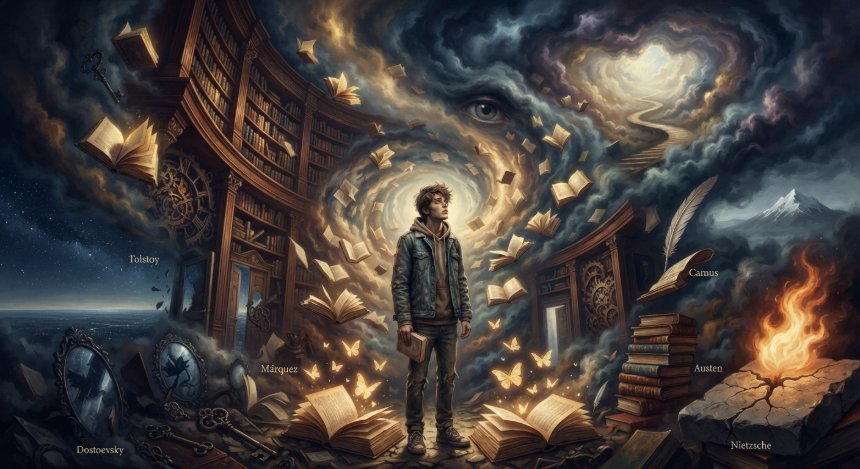
In an era of infinite scrolling and bite-sized entertainment, we often treat reading as a passive escape. We pick up a book to unwind, detach from reality, and safely observe someone else’s life from a comfortable distance. Yet, a popular literary adage warns us that not all writers offer such hospitality: "Dostoevsky exposes you. Tolstoy widens you. Kafka unsettles you. Woolf slows you down. Camus frees you. Orwell warns you. Austen reads you better than you read yourself. Hemingway strips you bare. Nietzsche dares you. Márquez enchants you. You don't read these people. YOU SURVIVE THEM."
To "survive" an author means to undergo an intellectual and emotional trial. These ten figures do not merely tell stories; they dismantle your comfort zones, challenge your inherited beliefs, and permanently alter how you perceive the world. Exploring their collective works reveals a profound map of the human condition—and offers an urgent survival guide for modern readers, particularly Generation Z and aspiring global citizens.
The journey begins in the depths of the human psyche with two Russian masters. Fyodor Dostoevsky (1821–1881) was a Russian novelist and psychological pioneer whose masterpieces, like Crime and Punishment and The Brothers Karamazov, explore extreme human suffering, morality, and spiritual redemption. He refuses to let readers hide behind polite social masks, dragging our darkest impulses and capacity for guilt into the light. Where Dostoevsky drills inward, Leo Tolstoy (1828–1910) expands outward. A Russian literary giant famed for sprawling epics like War and Peace and Anna Karenina, Tolstoy captured sweeping historical events alongside the quiet, everyday realities of human conscience and family life. He widens our moral capacity, forcing us to trade narrow self-absorption for radical empathy.
Once our inner lives are laid open, two modernist innovators disrupt how we experience reality and time. Franz Kafka (1883–1924) was a German-speaking Bohemian writer whose surreal fiction, such as The Metamorphosis and The Trial, coined the term "Kafkaesque." He unsettles us by trapping isolated individuals inside claustrophobic labyrinths, holding up a mirror to modern alienation and faceless bureaucracy. Conversely, Virginia Woolf (1882–1941), a pioneering English modernist author, rescues us from the frantic pace of external clocks. Through novels like Mrs Dalloway and To the Lighthouse, she mastered stream-of-consciousness writing to capture the fleeting nature of time, memory, and inner thought, slowing us down until we notice the quiet currents of existence.
Having dismantled our sense of security and time, two existential thinkers confront us with the terrifying weight of freedom. Albert Camus (1913–1960) was a French-Algerian philosopher and Nobel laureate whose works, including The Stranger and The Myth of Sisyphus, champion Absurdism. By staring into an indifferent universe, he frees us with the liberating realization that we can revolt against meaninglessness and create our own joy. Friedrich Nietzsche (1844–1900), a radical German philosopher who challenged traditional religion and morality, pushes this challenge further. Works like Thus Spoke Zarathustra introduced the Übermensch and dared individuals to abandon herd mentality, endure the discomfort of self-overcoming, and forge their own moral values.
While philosophers challenge our existential footing, three sharp-eyed realists strip away our social and linguistic illusions. George Orwell (1903–1950) was an English novelist and essayist best known for 1984 and Animal Farm. As a fierce critic of totalitarianism, political propaganda, and the corruption of truth, he warns us how easily manipulated language can enslave human thought. Operating on a domestic stage, Jane Austen (1775–1817) was a celebrated English novelist whose sharp, witty books, like Pride and Prejudice and Emma, dissected 19th-century marriage, class, and human self-deception. With razor-sharp irony, she reads our hidden vanity better than we read ourselves. Ernest Hemingway (1899–1961), an American Nobel laureate famous for his minimalist, "iceberg" writing style, then takes honesty to its stylistic extreme. Novels like The Old Man and the Sea explore courage, stoicism, and loss, stripping away sentimental melodrama until only unvarnished reality remains.
Finally, after surviving this rigorous deconstruction, Gabriel García Márquez (1927–2014) steps in to restore our sense of wonder. A Colombian Nobel laureate who popularized magical realism, he wove mythical elements into Latin American history and family sagas in classics like One Hundred Years of Solitude. Márquez enchants us, reminding us that logic and cynicism do not hold a monopoly on truth, and that magic, love, and memory can outlast even the heaviest histories.
For modern readers—especially Generation Z—engaging with these ten giants is more than an academic exercise; it is an act of quiet rebellion. Gen Z is coming of age in a hyper-connected, algorithm-driven world characterized by constant stimulation, curated online identities, and pervasive existential anxiety. Modern digital culture rewards instant gratification and surface-level outrage, leaving little room for slow contemplation or deep ambiguity. In this landscape, Virginia Woolf’s deliberate pacing rebels against the tyranny of the short-form video feed, while Jane Austen and Fyodor Dostoevsky pierce through the curated perfection of social media to demand authentic human vulnerability.
Conclusion: Lessons for the Global Citizen
Beyond generational divides, surviving these literary titans imparts essential lessons for anyone striving to be a conscious global citizen in an interconnected, turbulent world. First, Tolstoy and Márquez teach us borderless empathy—the understanding that human dignity, grief, and wonder transcend geography, culture, and language. Second, Orwell, Kafka, and Austen instill intellectual vigilance, reminding global citizens to question political propaganda, resist dehumanizing systems, and recognize their own biases before judging others. Finally, Camus, Nietzsche, and Hemingway model moral courage—the duty to stand firm in truth, reject passive conformity, and construct meaning even when global crises feel overwhelming.
Ultimately, we do not read these writers to escape our lives, nor do we read them to emerge unscathed. We read them because easy entertainment leaves us unchanged, whereas difficult art makes us whole. By surviving these ten masters, modern readers and global citizens alike gain the clarity, resilience, and compassion required not merely to endure the modern world, but to actively shape it for the better.