
أَعُوذُ بِاللّٰهِ مِنَ الشَّيْطَانِ الرَّجِيمِ
بِسۡمِ ٱللهِ ٱلرَّحۡمَـٰنِ ٱلرَّحِيمِ
In the name of ALLAH, the Most Gracious, the Most Merciful
Where to find A Conscious Heart?
(Intikhab-e-Dil-e-Arif-e-Zamana)
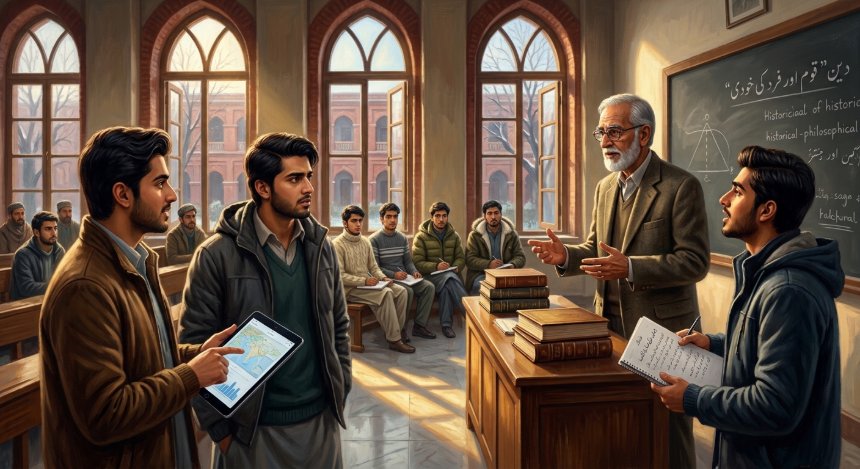
Government Gordon College is a century-and-a-quarter-old educational institution in the city, long recognized as a cradle of political consciousness and a nursery for statesmen in the region. For the teaching and pursuit of history, philosophy, and political science, it has always been a favored center for faculty and students alike. It was the onset of winter; a political science class was underway, and the discussion revolved around the political and intellectual dilemmas of the modern age. Professor Siddiqui, adjusting his glasses with thick volumes stacked on the desk before him, was engaged in a lively debate with three of his brightest students: Zaid, a devotee of history and Iqbal’s philosophy; Kashif, who habitually viewed every event through the lens of modern psychology; and Rafe, a representative of Generation Z, iPad in hand, who evaluated everything from the perspective of the digital world and the future.
The crisp winter sunlight streamed through the classroom windows. Swiping a finger across his iPad screen, Rafe opened the discussion. "Sir, today’s human being knows everything. The entire world has shrunk onto the palm of our hand; in the blink of an eye, we witness events happening thousands of miles away in real time. So, can’t we all call ourselves the sages or the Arif-e-Zamana—the 'Conscious Observers'—of the modern era?"
Professor Siddiqui smiled, looking at Rafe over the rim of his spectacles, and replied, "Rafe, you have touched upon a profoundly significant term. In literary and intellectual tradition, an Arif-e-Zamana refers to a person of insight and awareness who deeply comprehends the temper of their era, the affairs of the world, and the demands of time. Yet the real question is: while keeping abreast of the outer world, what prevents one from looking inward to attain self-realization (Irfan-e-Zat)? In this fast-paced digital age, every adult man and woman must become a true observer of their time; because today, under the cover of the ordinary person’s heedlessness, malicious, unscrupulous, and usurping forces across the globe are gambling with the destiny of all humanity. The common person suffers the consequences of these designs, yet tragically remains oblivious. This heedlessness is not merely regrettable—it is catastrophic."
Kashif, ever eager to untangle the knots of human behavior and psychology, spoke up immediately. "Sir, why do human beings become so helpless and heedless? Is there an inherent flaw in human nature itself?"
"Not at all, Kashif!" Professor Siddiqui said, gesturing toward the books on his desk. "Human beings are the finest masterpiece of the Almighty’s creation. The Creator of the Universe Himself bore witness to this dignity:
'We have certainly created man in the best of stature.' (Surah At-Tin: 4)..
And then He taught humanity the supplication for clarity, inner expansion, and truthful expression:
'My Lord, expand for me my breast [with assurance], and ease for me my task, and untie the knot from my tongue that they may understand my speech.' (Surah Ta-Ha: 25–28)"...
Zaid, who had been taking notes intently, looked up and asked, "Sir, if human beings are created in the finest of molds, where does this inner tug-of-war between good and evil come from?"..
Professor Siddiqui rose from his chair and walked over to the whiteboard. "Zaid, this foundational philosophy of human agency and choice is articulated with supreme clarity in the Holy Quran. In human history, the very first test of choice began with the story of Prophet Adam (peace be upon him), when the deception of Iblis (Satan) created a profound trial: one path led astray through temptation, while the other demanded remembrance of the Almighty’s warning. Through human frailty, he slipped in that moment; yet when the subsequent choice of remorse and return arrived, he rejected despair and stubbornness, choosing repentance instead and turning humbly toward the Lord of the Universe. Affirming this human freedom and accountability, the Holy Quran lays out the two paths before humankind:---
'Indeed, We guided him to the way, be he grateful or be he ungrateful.' (Surah Al-Insan: 3)..
Scripture and prophetic wisdom also reveal that the true seat and center of all choice is the human heart. As the Almighty declares:
'And know that Allah intervenes between a man and his heart.' (Surah Al-Anfal: 24)
And the Holy Prophet (peace be upon him) illuminated this delicate state of the human heart, saying:
'Verily, the hearts of all the sons of Adam are between the two fingers out of the fingers of the Compassionate Lord as one heart. He turns that to any (direction) He likes.' Then Allah’s Messenger (peace be upon him) prayed: 'O Allah, Turner of the hearts, turn our hearts to Thine obedience.' (Sahih Muslim: 6750)..
Alongside this, the sources of light and darkness are unmistakably distinguished:
'Allah is the ally of those who believe. He brings them out from darknesses into the light. And those who disbelieve—their allies are Taghut (false deities and tyrannical forces). They take them out of the light into darknesses. Those are the companions of the Fire; they will abide eternally therein.'(Surah Al-Baqarah: 257)..
Therefore, every believer and every conscious observer of the age ought to make this Quranic prayer a constant invocation for steadfastness and inner illumination:
'My Lord, cause me to enter a sound entrance and to exit a sound exit and grant me from Yourself a supporting authority.' (Surah Al-Isra: 80)"...
Kashif picked up the thread from a psychological angle. "Sir, modern psychology says much the same—that human beings are not prisoners of their circumstances, and that true agency lies in our response. This reminds me of a remarkable scene in American author John Steinbeck’s masterpiece, East of Eden."
"Precisely, Kashif," Professor Siddiqui affirmed. "In that memorable scene, a character named Lee speaks to Mr. Hamilton and Adam Trask about an ancient Hebrew word whose true essence he spent years striving to understand. That word was Timshel—which translates to Thou Mayest, meaning 'You have a choice.' How remarkable it is that the entire philosophy of human existence can sometimes be distilled into a single word. Unpacking its depth, Lee explains that Timshel does not mean a person will always triumph, nor does it promise a life free from sorrow, cruelty, or harsh trials; rather, its true meaning is that no matter how severe and unforgiving the circumstances may be, a human being always retains the choice over their response, their decisions, and their ability to keep hope alive."..
Zaid’s eyes lit up. "Sir! That is the exact choice illustrated in our Eastern literary tradition by the parable of the fly and the moth. On one side is the fly, drawn to worldly filth and fleeting pleasures; on the other is the moth, willingly sacrificing itself upon the flame of truth. Two paths always lie open before us: either we become captives to the transient glitter of this world and base desires, or, intoxicated with love for the Divine, we choose the path of devotion and obedience to the Noble Master, Prophet Muhammad (peace be upon him). The decision rests entirely in our hands: whether to seek light and truth, or to accept living under the reign of darkness. And when a person resolves to choose gratitude and light, the Poet of the East, Allama Iqbal, points toward the practical manifestation and ultimate destination of this choice:--
'Through the power of love, elevate every lowly soul,
Illuminate the world with the radiant name of Muhammad (peace be upon him).'"
Professor Siddiqui nodded with a warm smile. "Well said, Zaid! Iqbal’s message is unmistakably clear: the surest remedy for dispelling the intellectual, moral, and social darkness engulfing the world lies in love for the Holy Prophet (peace be upon him) and adherence to his noble example. When a person kindles the flame of this love within their heart, they not only rise above their own spiritual lows, but their very existence becomes a beacon of guidance for the entire age."
That day, a newcomer seated in the back row raised his hand and asked permission to speak. At Professor Siddiqui’s nod, he spoke up:
"Sir, we students are standing right on the threshold of practical life. Tomorrow, some of us will enter business, while others will join the civil service or politics. How does this 'choice' test us in practical life?"
Professor Siddiqui grew serious and replied, "My son, in truth, every human being must confront the fundamental question of what constitutes the center and purpose of their existence—who their true Lord is, and upon what principle they will live. The Creator of the Universe made the ultimate purpose of human creation crystal clear:--
'And I did not create the jinn and mankind except to worship Me.' (Surah Adh-Dhariyat: 56)
Once this purpose is established, practical life tests our choices at every turn. In the arena of livelihood, we face the decision of whether to earn lawful sustenance (Rizq-e-Halal) with patience and integrity, or to pursue unlawful shortcuts driven by greed—even though the Almighty has made an unfailing promise to those who practice mindfulness and trust in Him:
'And whoever fears Allah—He will make for him a way out, and will provide for him from where he does not expect. And whoever relies upon Allah—then He is sufficient for him.' (Surah At-Talaq: 2–3)"..
At this, a quiet student—who was notably active in student politics outside the classroom—asked, "Sir, how should this be understood in the context of our state and politics?"
Professor Siddiqui smiled and said, "My son, in the very same way, many among us face the trial of how to conduct ourselves when granted wealth, status, or authority. At this delicate juncture too, the Holy Quran guides humanity away from arrogance and corruption toward balance, benevolence, and the eternal welfare of the Hereafter:
'But seek, through that which Allah has given you, the home of the Hereafter; and [yet], do not forget your share of the world. And do good as Allah has done good to you. And desire not corruption in the land.' (Surah Al-Qasas: 77)
For when those in positions of power choose oppression and tyranny, the immutable law of nature is set into motion, as Allama Iqbal warned:
'Beware, O tyrants! Severe are the retributions of Nature.'"
Kashif nodded thoughtfully. "And Sir, don't the different seasons of a human life also unfold under this same law of nature?"
"Indeed, Kashif!" Professor Siddiqui replied. "Nature itself demands that human life unfold across purposeful stages, each calling for its own rightful choice. There is the season of seeking knowledge—the very stage you are in right now—where one must set aside trivial distractions to dedicate oneself wholeheartedly to learning. Next comes youth, which calls for grounding oneself in constructive action, hard work, and forward momentum. Then arrives the threshold of maturity—the crossroads of forty years—a sacred station to pause and reflect, where a person seeks deeper cognizance of God through reason, experience, and inner sight, chartingly defining the course for the remainder of life’s journey."
A deep silence fell over the classroom. Zaid spoke in a low, reflective voice, "Sir, when we look at the state of our society and country, despair and helplessness seem to surround us on every side. What is a person to do in such times?"
Professor Siddiqui walked over to the window, where sunlight shimmered on the ancient trees of the college campus. In a measured tone, he said, "Zaid, perhaps this is the very insight most vital to understanding our collective anguish and social reality today. We are living through an era where helplessness, division, and pain seem to have drained life of many of its vibrant colors. Clouds of pessimism and hopelessness hang heavy on every horizon. Yet the truth remains that all is not lost; we still hold the agency to choose something, to change something, and to save something. For:
Darkness reigns where there is no light,
Dawn only breaks when a flame burns within the heart.
History bears witness that the greatest trial any nation or society faces is what it chooses in its darkest hour: hatred or humanity, despair or hope, cowardly silence or genuine courage?"
Pointing toward his iPad, Rafe chimed in, "Sir, what’s fascinating is that even prominent philosophers in the West and across the globe are sensing this crisis of modernity. Just yesterday, I was reading the writings of the Russian philosopher Aleksander Dugin."
"You have pointed to something very pertinent, Rafe!" Professor Siddiqui said, turning back toward the class. "This urgent call to awaken from spiritual slumber is echoing across civilizations today. Amid the intellectual onslaught of the digital age, even contemporary thinkers like the Russian philosopher Aleksandr Dugin are appealing to the West to untangle itself from the terminal crisis of secular modernity—a worldview built upon the rejection of sacred tradition—and to revert to its foundational Christian roots and values. In truth, this profound diagnosis is not confined to Christianity alone; it carries a universal truth applicable to all world religions. Whether through the church, the temple, or the mosque, humanity’s true salvation lies in shunning the hollow materialism of modernity and returning to the timeless, sacred traditions of Divine guidance."
Then, gesturing toward the entire classroom with quiet passion, Professor Siddiqui concluded, "Children! In today’s digital age, you cannot afford to remain silent spectators. When the world has shrunk onto the palm of your hand, remember that it is in your name that governance is exercised. Today, as Pakistan approaches eighty years since its creation, this moment of reckoning stands before us with heightened urgency. For decades, we have persistently turned away from and violated that foundational covenant—the establishment of an ideal Islamic welfare state modeled after the State of Medina—in whose name this country was achieved. Yet the real question is not one of despair, but of returning to the right path: when and how we reclaim our true purpose. Just as Prophet Adam (peace be upon him) chose repentance and return after his lapse, we too, as a nation, still possess the power of collective reflection, reform, and renewal.
If only today, every influential tier of the state of Pakistan—whether in the corridors of politics or public administration, holding the scales of justice, shaping public discourse as the pulpit and megaphone of the national pulse, or steering the national economy and treasury—would see themselves seated upon the pedestal of an Arif-e-Zamana and strive to prove worthy of it; and if only all of us, in our individual and collective lives, would choose to kindle the lamp within rather than compromise with the darkness, living with dignity under the sovereignty of the Almighty. If only!"
The bell rang to mark the end of the lecture, yet inside that historic classroom of Gordon College, a new lamp had already been kindled in the heart of every student—the lamp of the conscious heart's choice.