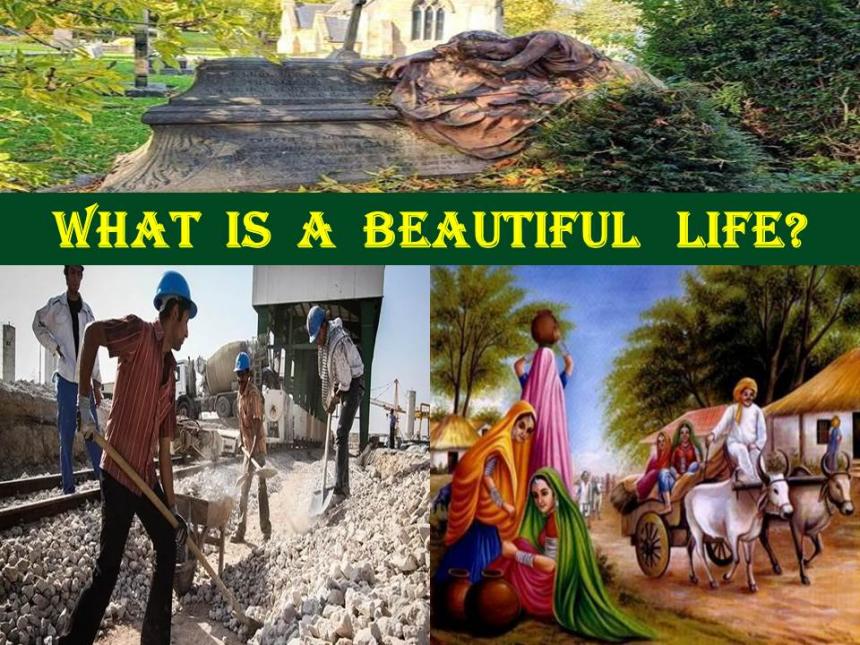

What is A Beautiful Life?
A beautiful life is a deeply personal state of fulfillment that combines inner peace, meaningful relationships, and a sense of purpose. When we sense the reaching of a stage in life where one seeks a peaceful and easy refuge, free from weariness and inner conflict. The period following mature age is the final stage of a person's natural life, known as old age; and death follows thereafter. This write up "What is A Beautiful Life?" is an opinion wrt the poetic expressions from Urdu and English.
أَعُوذُ بِاللّٰهِ مِنَ الشَّيْطَانِ الرَّجِيمِ
بِسۡمِ ٱللهِ ٱلرَّحۡمَـٰنِ ٱلرَّحِيمِ
In the name of ALLAH, the Most Gracious, the Most Merciful
What is A Beautiful Life?
A beautiful life is a deeply personal state of fulfillment that combines inner peace, meaningful relationships, and a sense of purpose. It isn't defined by wealth or perfection, but by an appreciation for small joys, resilience through hardship, and alignment with your core values.A beautiful life is a deeply personal state of fulfillment that combines inner peace, meaningful relationships, and a sense of purpose. It isn't defined by wealth or perfection, but by an appreciation for small joys, resilience through hardship, and alignment with your core values.
A beautiful life is achieved by cultivating loving, supportive relationships with family, friends, and community. It is finding joy in simple, everyday moments—like enjoying a morning cup of coffee or a quiet walk. It is about pursuing passions and embracing challenges as opportunities for personal growth rather than seeing them as setbacks. The beautiful life is embracing both the joys and sorrows of life, recognizing that the full emotional spectrum is what makes the human experience valuable.
Defining a beautiful life means self-reflection. Instead of seeking a flawless existence, philosophies often emphasize the Journey of 'Self-Discovery'. Albert Einstein famously stated that the "mysterious" is the source of all true art and science, suggesting that a life of beauty invites us to explore the unknown and live fearlessly. A beautiful life often arises when you take active steps to replace disempowering routines with actions that align with your highest values.
In the following; let's discuss the concept wrt few literary works from across the globe. Munir Niazi (9 April 1928 – 26 December 2006) was a prominent, unique and influential Pakistani poet in Urdu and Punjabi. He is considered one of the most important and stylistic poets of Urdu literature in the twentieth century. Munir Niazi composed ghazals and poems in both Urdu and Punjabi languages and achieved equal excellence in both. A special kind of mystery, loneliness, fear, beauty and lamentation are prominent in his poetry. In one of his verse (Urdu); he says that:-
"O Munir! I want at the end of this life; A life that is not as difficult as this was" (may be wishing for Beautiful Easy Life).
The essence of the verse from one of his heart-touching poem (gazal) is the intense desire for peace, flow and freedom from the bitterness of life as he saw during the past part of his life. This reflects the intellectual maturity of the poet and the feeling of this turn of life where a person, free from fatigue and conflict, finds a peaceful and easy support.
By saying this verse, Poet Munir Niazi has interpreted a vast majority of people; whose life is a story of struggle and ups and downs. If we ask the elderly, they will often describe the past as difficult; and they will also express "disgust with a difficult life." In the story of life, every day the sun brings a new day and the daily heat, aimless running and heart full of suffering, makes a person tired. And it is a natural process to have a "longing for ease" in his heart.
So it is not a unique case for any person to desire fluidity and peace in life instead of complications. When we are aging; we all know that the "end of life" is death; and the poet's desire for a period after the long experiences of life, happiness, successes; or failures and confusions of life, is perhaps a reference to the life of the grave.
The period of the grave comes after the last part of a person's earthy life, which is called old age. After this comes death, and everyone enters the life of the grave. The period after youth is called old age. The body becomes weak. The hair turns white. After death, the world ends. The soul leaves the body. The person is placed in the grave. This is called the world of intermission. Here the first stage of the effect of deeds begins. So, is the poet Munir Niazi mentioning comfort in the grave in this poem? And if so, do we know that the comfort of life after death depends on the deeds done in the life of this world?
Why and How to Have A “Beautiful, Easy Life”?
So let’s take a look at the “easy life” of a busy, successful person in the modern digital age in the year 2026 and know what a life would be like that would not be difficult at the “end of life” but would be pleasant; comfortable and peaceful. So first of all, let's see what the famous American President Richard Nixon said about it, some fifty years ago. In an interview he said "the most unhappy people in the world are those who live in water places — the French South Coast, Newport, Palm Springs, Palm Beach — parties every night, golf every afternoon, drinking too much, talking too much, thinking too little. Retired, no purpose." He further says that "what life means is purpose; There is a goal, a battle, a struggle - even if you don't win it."
Fifty years ago, life was not as fast-paced as it is today and as easy as it is today; it was not easy to achieve then; yet what the humans wanted then and what is the desire of the human's today? "An easy life;" but how will this "easy life" is achieved? Richard Nixon, seeing the flashes of Western civilization decades ago, said that "endless leisure without struggle is not heaven - it is the slow death of meaning."
In today's digital age, quietly leaving a social media platform; giving up without trying; and dreams of early retirement or life without hard work, and endless net surfing; and in this era of leisure-seeking; and reel scrolling on social media... Nixon's saying reminds us that "fighting life is what keeps the soul alive." So let's stop and think, "What keeps us in the "battle" right now - even when we are tired?"
Here I would like to remind the readers of the lesson of the poem "Don't Quit" by the famous American poet "Edgar Albert Guest" where the poet said that "When things get tough, as they sometimes do; When fatigue is overwhelming you; And you want to rest, do so; But do not give up". What is this lesson of living? For more discussion on this poem, click on this link:
https://blogs.bangboxonline.com/posts/poem-dont-quit-by-edgar-albert-guest
The famous British poet of the English language, Alfred Tennyson, has written an immortal poem "Crossing the Bar" i.e. "Crossing the border" of death. And in the poem, the expression "sunset" is that time of the end of the day, which is used to symbolize death. The end of life should be a peaceful one, rather than a noisy or sad farewell, that is, a hope to meet and speak to God face to face. The poem makes death a calm, unwavering acceptance, seeing it as a return to the place from which it came rather than a cause for fear. Click on this link to read the details of this poem.
https://blogs.bangboxonline.com/posts/poem-crossing-the-bar-by-alfred-lord-tennyson
Life is swimming across a River of Fire
Henry Charles Bukowski was a German-American poet, novelist, and short story writer; he once wrote that "the most important thing is how well you walk through the fire". We can say with this in mind that if this life is a river of fire and a difficult, arduous and difficult journey; but the natural virtue of man will be how he walks through it?
In his 1943 work The Glass Bead Game, the famous Nobel Prize-winning author Hermann Hesse (a German citizen) writes at one point that “The theory you desire—that ultimate and perfect belief that alone gives wisdom—does not exist. Nor should you desire any such perfect theory, my friend. Rather, you should desire the fulfillment of your own being. That divine essence resides within you, not in ideas and books. Truth is lived, not taught.”
This means that rigid rules and flawless textbooks cannot give you true wisdom. On the contrary, you should develop your inner self, live a real life and discover the truth through your daily actions." This earthly life is just a testing ground; where we humans have to live the journey of this life with the desire to meet our Creator, Allah Subhanahu Wa Ta'ala, at the end of it. From this perspective, this life becomes a journey of love.
All of us know that the story of love and affection is not easy and achieving the destination of this path of passion is not easy. If this journey of life is to meet Allah Subhanahu Wa Ta'ala, then the path is difficult. It is like a river of fire that one has to pass through. And it requires complete surrender that one has to erase oneself in order to traverse this path. The term "river of fire" is a symbol of the intensity, heat and suffering of love, and "swim through" is a metaphor for the fact that one cannot reach a destination without being destroyed in it, without erasing oneself.
The journey of life is "love with Allah Subhanahu Wa Ta'ala" because its destination is the Creator and Owner. It is a meeting with the whole; and the difficulties and hardships of life illustrate the reality of its path; its meaning would be that the path of love or affection for Allah Almighty cannot be an easy one or a bed of roses, but it is a difficult stage where one has to face tests and difficulties at every step.
Closing Words
A “beautiful life” is a practical, personally meaningful synthesis of flourishing domains across several stages of life. The message of the last and true book of Allah Subhanahu Wa Ta'ala, the guidance of the Quran Al-Hakim, is: "Say: “Take on Allah’s colour.”[137] And whose colour is better than Allah’s? It is Him that we serve." (Surah Al-Baqarah, 138).
And further guidance is given as follows: "And I (Allah) created the jinn and mankind only for My worship". (Surah Al-Dhariyat, 56).
The message of the Glorious Quran is that this world that is in front of us and whatever comes to our knowledge, we should accept it without hesitation; rather, the guidance is that we should contemplate the universe, travel, investigate, use our intellect and thoughts and see what happened to the civilizations before us. The methodology of the Quran is unusually based on observation and experience; and it constantly draws attention to observable reality. So why not give clear instructions about how to live life. In the Quran, Allah Almighty has given clear instructions on how to live life so that the next life of tomorrow is easy.
In order to improve the life after death (the Hereafter), a person should do good deeds. Obey the obligatory prayers and acts of worship. Such One should do charitable works whose benefits will continue even after death, such as building a mosque or digging a well. One should remember Allah frequently and keep asking for forgiveness for one's sins. The requirement is that one should sincerely repent for the mistakes committed with fellow humans, fulfill the rights of others, and live by following the commands of Allah Almighty.






WinUSA Legit: A Complete Guide to Understanding the Platform and Its S...
WinUSA Legit: A Complete Guide to Understanding the Platform and Its Services
