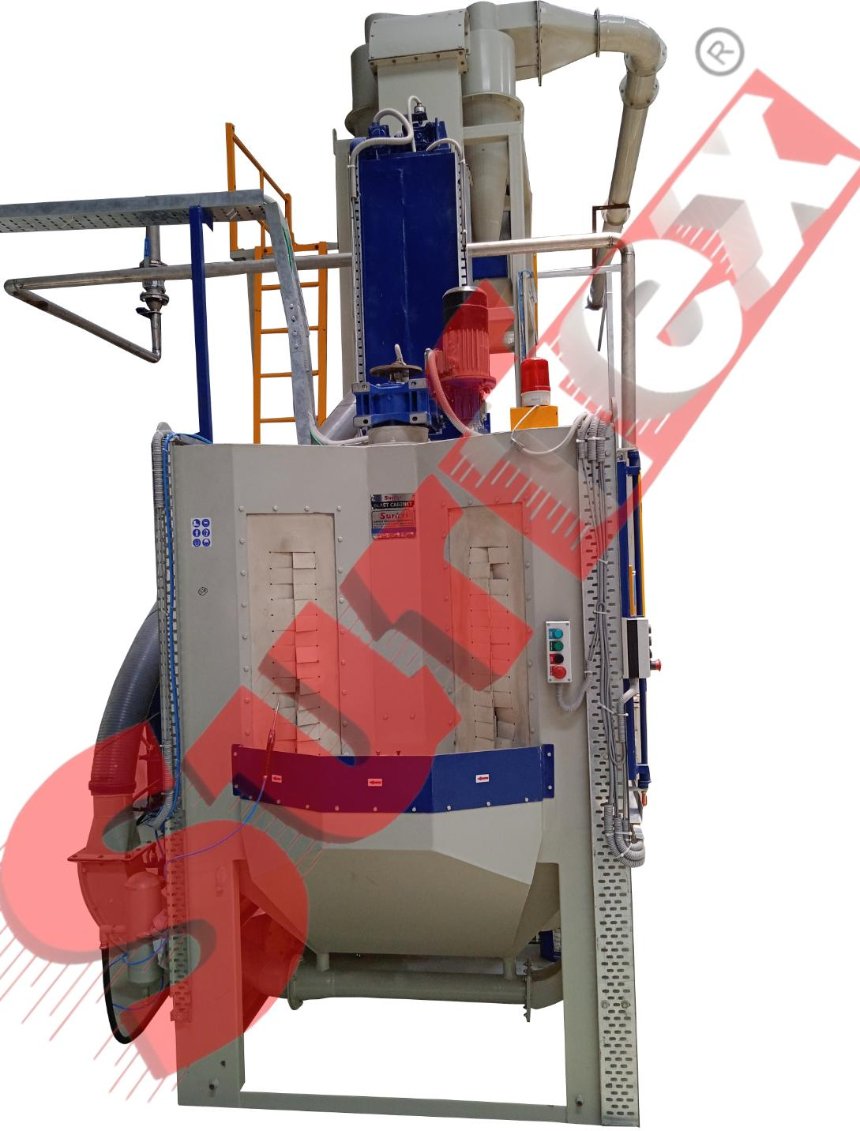

Wet shot peening achieves the same Almen intensity as dry shot peening
Shot peening is a cornerstone cold-working process used across aerospace, automotive, power generation, and heavy manufacturing sectors to enhance the fatigue strength and stress-corrosion cracking resistance of critical metal components.
How Wet Shot Peening Matches Dry Almen Intensity While Elevating Surface Integrity
Shot peening is a cornerstone cold-working process used across aerospace, automotive, power generation, and heavy manufacturing sectors to enhance the fatigue strength and stress-corrosion cracking resistance of critical metal components. By bombarding a component’s surface with spherical media (steel shot, ceramic beads, or glass beads), the process introduces uniform compressive residual stresses into the surface layer, effectively arresting micro-crack propagation. Shot Blasting Machine, Shot Blasting Machine Manufacturers, Robotic Shot Peening Machine, shot peening machine, Robotic Shot Peening Machine Manufacturers , shot blasting machine manufacturers in india , shot peening machine manufacturers in india, shot peening machine manufacturers, Roll Etching Machine Manufacturers, Shot Peening, Roller Conveyor Type Shot Blasting Machine
Traditionally, dry shot peening has served as the industrial benchmark. However, a persistent technical misconception has lingered: that wet shot peening—a process where media is suspended in a liquid carrier (typically water with rust inhibitors) and propelled via slurry pumps or compressed air injection—is somehow softer, less aggressive, or incapable of achieving the rigorous Almen intensity standards required by stringent aerospace and industrial specifications.
Recent advancements in slurry delivery dynamics, fluid flow control, and high-velocity slurry guns have shattered this paradigm. Wet shot peening achieves the exact same Almen intensity as dry shot peening, but with superior surface finish outcomes, elimination of airborne dust hazards, and extended media lifespans.
https://sfecindia.net/shot-peening-machine.html
https://sfecindia.net/robotic-shot-peening-machine.html
Deconstructing Almen Intensity: The Physics of ImpactTo understand how wet peening matches dry peening, one must first examine how peening intensity is measured and controlled. Almen intensity is not a measurement of the kinetic energy of a single particle, but rather a measure of the energy transfer capacity of the entire peening stream against a standardized spring steel strip (the Almen strip, categorized into N, A, and C strips).
When a stream of media strikes an Almen strip clamped to a solid block, the localized plastic deformation on one side causes the strip to bow or arc upward. The arc height is measured using an Almen gauge after reaching saturation—the point at which doubling the exposure time increases the arc height by no more than 10%.
The mechanics governing this arc height are dictated by Newton’s laws of motion:
- Mass (m): The density and size of the peening media.
- Velocity (v): The speed at which the media impacts the target.
- Impact Angle: The vector trajectory of the media relative to the component surface.
In a wet shot peening system, the media is suspended in liquid, creating a slurry. Critics historically argued that the fluid film surrounding the media dampens the impact energy. While a fluid boundary layer does exist, modern wet peening engineering overcomes this through optimized injection pressures, specialized convergent-divergent nozzles, and precise volumetric slurry-to-air ratios. By tuning pump pressure and compressed air assist, wet systems accelerate the slurry particles to identical exit velocities as dry systems, transferring the precise amount of kinetic energy required to achieve the target Almen arc height—whether it is a delicate 4A intensity or a heavy-duty 18C intensity.
Comparing Dry and Wet Delivery MechanismsParameterDry Shot PeeningWet Shot PeeningMedia PropellantCompressed air onlyLiquid slurry (water + inhibitors) with/without air assistAlmen Intensity RangeLow to extremely high (N, A, C strips)Low to extremely high (Fully capable of matching dry strips)Surface Finish (Ra)Higher roughness; micro-pits possibleSmoother finish; uniform blending of surface texturesDust GenerationHigh; requires robust dust collection systemsZero airborne dust; containment within a closed-loop fluid circuitMedia Breakage RateHigher due to dry inter-particle and wall collisionsLower due to hydraulic cushioning and lubricationWhile both systems can hit the exact same Almen saturation curve, the way they deliver the media creates distinct operational differences.
In dry systems, media is accelerated through pneumatic siphon or direct pressure pots. The high-speed dry impacts often lead to media fracturing, generating dust and irregular fragment shapes that can embed into the target component's surface, creating potential corrosion initiation sites.
In contrast, wet shot peening utilizes water as a continuous fluid matrix. The fluid cushions the media during internal transport and dampens secondary collisions within the nozzle, drastically reducing media breakdown. As a result, ceramic beads and stainless steel shot maintain their spherical geometry longer, ensuring consistent Almen intensity over extended operational cycles without erratic degradation.
Overcoming the Fluid Cushion MythThe most common point of skepticism among quality assurance engineers is the "hydrodynamic cushion" effect. The theory suggests that the liquid film on the media or the component surface absorbs a fraction of the impact energy, reducing the cold-working effect.
Empirical studies and surface residual stress profiling (using X-ray diffraction, or XRD) demonstrate that this effect is negligible when systems are properly engineered:
- Transient Contact Dynamics: Upon high-velocity impact, the fluid film is instantaneously displaced at the microscopic point of contact. The solid media makes direct metal-to-metal (or media-to-metal) contact with the substrate, inducing the required plastic deformation and compressive residual stress profile.
- Depth of Compression: Residual stress depth profiles (depth vs. micro-hardness/compressive stress) achieved via wet peening mirror those of dry peening at identical Almen intensities. The depth of the compressive layer depends primarily on media mass and velocity, both of which are fully controllable in wet systems.
- Saturation Rate: Wet peening systems reach Almen saturation curves within comparable timeframes to dry systems when slurry concentration and flow rates are optimized.
Achieving equivalent Almen intensity is only part of the equation. Wet shot peening introduces transformative secondary benefits that make it increasingly preferable for high-precision components:
1. Superior Surface Finish and Reduced Ra ValuesDry shot peening often leaves a relatively rough surface profile, sometimes necessitating secondary finishing or polishing operations to remove micro-notches that could act as stress risers. Wet shot peening produces a significantly smoother, more polished surface finish (lower Ra and Rz values) while still delivering the deep compressive stresses required. The fluid helps wash away debris and prevents smeared metal flakes from redepositing on the surface.
2. Elimination of Embedded ContaminantsIn aerospace and medical manufacturing, ferrous contamination or media embedment is a critical failure point. Wet peening continuously flushes the component clean during the peening action, eliminating the risk of dust redeposition and cross-contamination.
3. Environmental Safety and Health ComplianceDry peening generates hazardous fine metallic dust (especially when processing titanium, magnesium, or aluminum), posing severe explosion risks (combustible dust) and occupational health hazards like silicosis or heavy metal toxicity. Wet shot peening completely eliminates airborne dust at the source, creating a safer operator environment and reducing regulatory compliance burdens.
Industrial Implementation and Process ControlTransitioning or specifying wet shot peening requires rigorous control parameters, just like dry peening. Operators must monitor:
- Slurry Concentration: Maintaining the precise ratio of media to liquid (by weight or volume) to ensure consistent mass flow rate through the nozzle.
- Nozzle Wear and Stand-off Distance: Just as in dry systems, fluid velocity profiles degrade if nozzle geometry erodes over time.
- Inhibitor Concentration: Ensuring rust inhibitors are maintained in the water circuit to protect both the machine components and the ferrous/non-ferrous workpieces from flash rusting.
Closed-loop filtration systems in modern wet peening machines automatically separate fractured media from viable media and debris, ensuring that slurry density remains stable throughout multi-hour production runs.
ConclusionThe engineering consensus is clear: wet shot peening is not a compromise. It delivers the exact same mechanical hardening, fatigue life extension, and Almen intensity as traditional dry shot peening, backed by superior surface finish quality, cleaner metallurgical results, and enhanced operator safety. As industries demand tighter tolerances, cleaner processing environments, and extended component lifespans, wet shot peening stands out as a fully mature, high-performance surface treatment technology.



What Is the Difference Between Generic Viagra and Brand-Name Viagra?
Doctors prescribe Viagra after assessing a patient's medical history, current medications,...

QuickBooks Tool Hub Quick Fix My Program: How to Use It & Fix Common E...
Learn how to use QuickBooks Tool Hub Quick Fix My Program to quickly resolve company file...

What Logistics Challenges Arise During Plant Inauguration Events in In...
Planning a plant inauguration in India? Discover key logistics challenges involving venue...