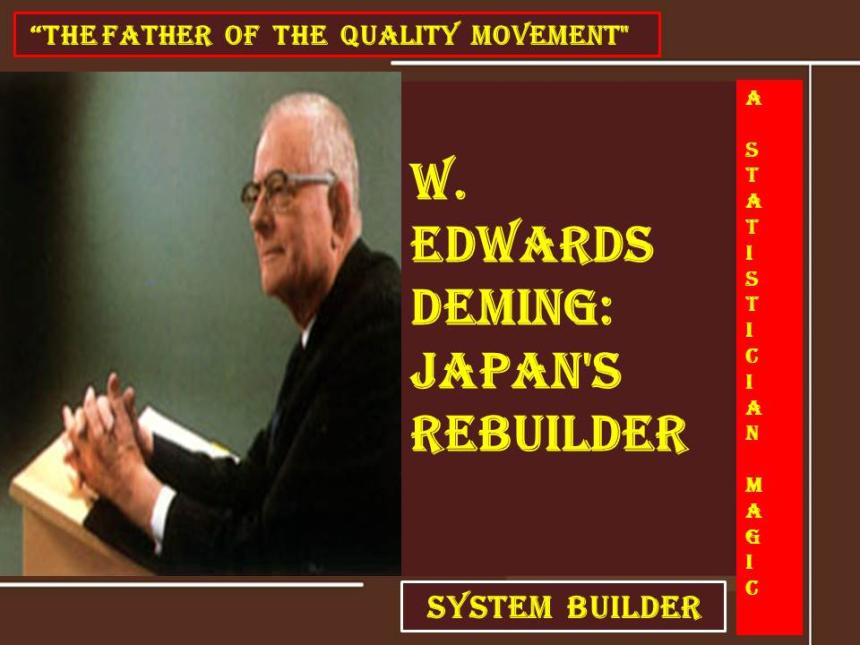

W. Edwards Deming: Japan's Rebuilder
W. Edwards Deming (1900–1993) was an American statistician who revolutionized Japanese industry post-WWII, transforming it from a reputation for cheap, shoddy goods into a global manufacturing powerhouse. W. Edwards Deming outlined management philosophy for quality, productivity, and competitive position. This write up aims at recommending lessons for the organizational leaders working in systematic model.
بِسۡمِ ٱللهِ ٱلرَّحۡمَـٰنِ ٱلرَّحِيمِ
In the name of ALLAH, the Most Gracious, the Most Merciful
W. Edwards Deming: Japan's Rebuilder
W. Edwards Deming (1900–1993) was an American statistician who revolutionized Japanese industry post-WWII, transforming it from a reputation for cheap, shoddy goods into a global manufacturing powerhouse. By teaching statistical process control and management philosophy, he helped Japan adopt a culture of continuous quality improvement, leading to the renowned Deming Prize.
W. Edwards Deming was a brilliant statistician; who while studying causes for failure of massive engineering projects' during a span of 50 years; realized one terrifying truth; "Individual incompetence is almost never the actual problem". The "Key Contributions and Impact" from W. Edwards Deming's Quality Movement on Japan's growth may be stated as follows:-
Post-War Reconstruction: In 1950, Deming was invited to Japan by the Union of Japanese Scientists and Engineers (JUSE) to instruct engineers and executives on quality control methods.
Shift in Management: Deming focused on systems, rather than worker mistakes, teaching that improving quality would automatically reduce costs, scrap, and rework.
The Deming Prize: Established in 1951, this prize is awarded annually to companies that excel in quality management, serving as a testament to his influence on Japanese industrial quality.
The 14 Points: He introduced his "14 Points for Management," a philosophy focusing on long-term commitment, continuous improvement, and the elimination of fear in the workplace.
The book "Out of the Crisis" (1982) by W. Edwards Deming is a seminal management text outlining a philosophy for quality, productivity, and competitive position. It introduces Deming’s 14 Points for Management, emphasizing statistical process control, long-term planning, and abandoning short-term numerical goals to prevent industrial decline. The "14 Points" for Management from Deming’s book "Out of the Crisis", are actually key principles as shown below:-
Establish constancy of purpose for improvement.
Adopt the new philosophy—stop accepting poor quality.
Stop dependence on inspection to achieve quality.
End the practice of awarding business based on price alone.
Constantly improve the system of production and service.
Institute training on the job.
Institute leadership, not supervision.
Drive out fear.
Break down barriers between departments.
Eliminate slogans and targets for the workforce.
Eliminate quotas.
Remove barriers to pride of workmanship.
Institute a vigorous program of education.
Put everyone to work to accomplish the transformation.
Validity for a Systematic Process
W. Edwards Deming has said that “Every system is perfectly designed to get the results it gets.” A system is defined as an interdependent group of items, people, or processes working together toward a common purpose. The prerequisites for achieving a common purpose are as follows:
Stating and sharing a clear aim with the team. Without aim, there is no purpose thus "No System".
Balancing each component of the system, as an action in one part will affect other parts of the system. This involves improving the overall system performance, not just the performance of individual components.
Focusing on the processes rather than the outcome, as better the process is understood, the better, the outcomes are.
Success have always been the highest priorities for any organization or system. At the heart of any organization's quality of output / product, is in-built capacity for quality improvement. Dr. W. Edwards Deming, the father of quality improvement, suggested that subject matter knowledge is not sufficient for managing team, and it must be complemented by “profound knowledge.” While organizational professionals are subject matter experts in the areas of expertise, such knowledge alone is inadequate to produce improvements in the delivery of systems objectives and goals. Deming's profound knowledge is a management theory that provides a framework for improvement and transformation of a system. The system of profound knowledge consists of four components that interact with each other: appreciation for a system, knowledge about variation, theory of knowledge, and psychology (Pic below).
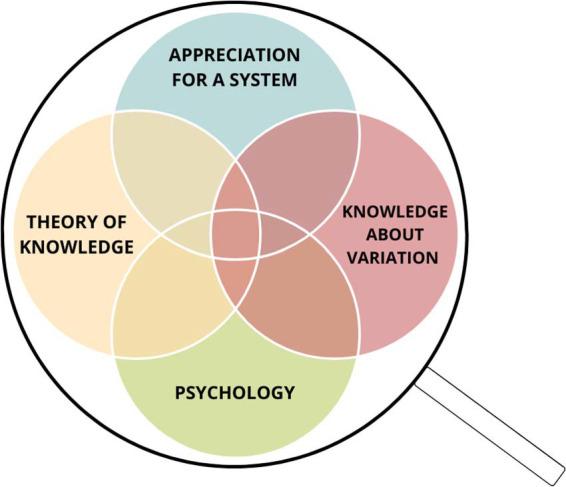
Edwards Deming's System of Profound Knowledge is a management theory that provides comprehensive framework for organizational transformation, detailed in his book "The New Economics". It is an integrated system of thought designed to move organizations from traditional management to a systemic focus, comprising four pillars: Systems Thinking, Knowledge of Variation, Theory of Knowledge, and Psychology.
Appreciation of a System (Systems Thinking): Understanding that an organization is a set of interdependent components acting together to achieve a common aim. Management must optimize the whole system, not just individual parts.
Knowledge of Variation: Recognizing that variation is natural in every process. It focuses on distinguishing between common causes (internal, stable) and special causes (external, unusual) of variation to improve quality, as seen in www.jimleonardpi.com.
Theory of Knowledge: Acknowledging that management action should be based on a deliberate theory or prediction, not just data alone. It emphasizes that there is no knowledge without theory, often applying the PDSA (Plan-Do-Study-Act) cycle, according to SPC for Excel.
Psychology: Understanding human nature, motivation, and interaction to create a positive work environment, reduce fear, and foster intrinsic motivation for quality work, notes.
W. Edwards Deming Quotes
Edwards Deming's famous quote can be attributed as "It is not enough to do your best, you must know what to do, and then do your best". This famous quote by W. Edwards Deming emphasizes that effort alone is insufficient for success; it must be coupled with knowledge, strategy, and understanding the correct processes. Deming, a management consultant known for influencing Japan's post-war economic rise, argued that working hard in the wrong direction is wasteful. The critical component is to know how to improve the system or process. It is often applied to business leadership to encourage education, data-driven decision-making, and structural improvement over merely pushing employees to work harder.
Another W. Edwards Deming’s quote, "A bad system will beat a good person every time," emphasizes that even the most talented, hardworking employees cannot succeed in a flawed, dysfunctional organizational system. He argued that performance is primarily dictated by system design, not individual effort, and that leaders must focus on improving systems, not blaming people. The structure within which people work is the primary determinant of performance, frequently negating the best efforts of talented individuals. When workers try harder within a broken system, it often causes more damage. Instead of seeking to punish or blame employees, management should focus on improving the processes that drive results. A good system, in contrast, empowers employees to do their best work, improves productivity, and boosts morale. This quote highlights the need for systemic change rather than relying on heroic individual efforts.
Another quote as "It is not necessary to change. Survival is not mandatory;" is a famous quote attributed to management consultant W. Edwards Deming. It emphasizes that while adaptation is not forced, failure to evolve and change will lead to the demise of a company, organization, or individual. It acts as a reminder that change is essential for long-term relevance. It also enforces that in any organization, the leaders and managers must adhere to the principles of management and shall show observance to them.
The "Four Pillars of Management" are said to be "Planning, Organizing, Leading and Controlling". In the context of organizations; the four pillars of management essentially means that "clarity comes first, effort second". The organizational leaders must have clear vision transmitted in very details, to all the team members, from top to bottom. The combined team efforts will only bear fruit, when all the members are clearly making efforts in the same direction with same enthusiasm and willful coordination.
Conclusion
W. Edward Deming's was initially ignored in the USA; however success in Japan made him an international authority. American companies, facing stiff competition from high-quality Japanese products, began adopting his methods in the 1980s. He is revered as the "Father of the Quality Movement." W. Edwards Deming rebuilt Japan's post-war manufacturing empire from scratch; argued that we obsess over individual performance and completely ignore the environment.
We normally rely on a massive QA team to catch errors right before a product launches to the public. We think finding bugs at the end of the pipeline is proof of a strong safety net. W. Edwards Deming advocated "systematic approach" to problem solving. He advised to "Stop blaming the individual. Assume that 94% of all failures belong to the system, not the person. Fix the broken deployment pipelines, the chaotic sprint planning, and the impossible communication silos first. Focus purely on improving the underlying process that generates the numbers. Optimize the workflow, not the raw output. Build quality directly into the code from day one. Cease dependence on mass inspection to achieve quality. Make every single developer / worker responsible for automated testing before the merge. Drive out fear completely. Make it psychologically safe for the absolute lowest-level junior developer / worker to point out a massive architectural flaw without any threat of retaliation.
At the end, one would say W. Edwards Deming's advocacy for quality in management and leadership are as relevant in 2026 as they were in 1982. Leaders will only gain from thoroughly appreciating these points and using them as they lead increasingly complex organisations. No system can afford failures and best ways and means to eliminate or avoid problems or errors leading to failure are to adhere with methods preached by W. Edwards Deming. His quote, "A bad system will beat a good person every time," shall be displayed in all organizations working on systematic model.


What Is Chakra Healing? Benefits, Techniques, and What to Expect
What Is Chakra Healing? Benefits, Techniques, and What to Expect


Why Custom Shipping Boxes Are Essential for Safe and Efficient Deliver...


6 Potato Varieties to Grow in Your East Bay Garden
Discover 6 potato varieties that thrive in East Bay gardens, plus planting tips and where...
