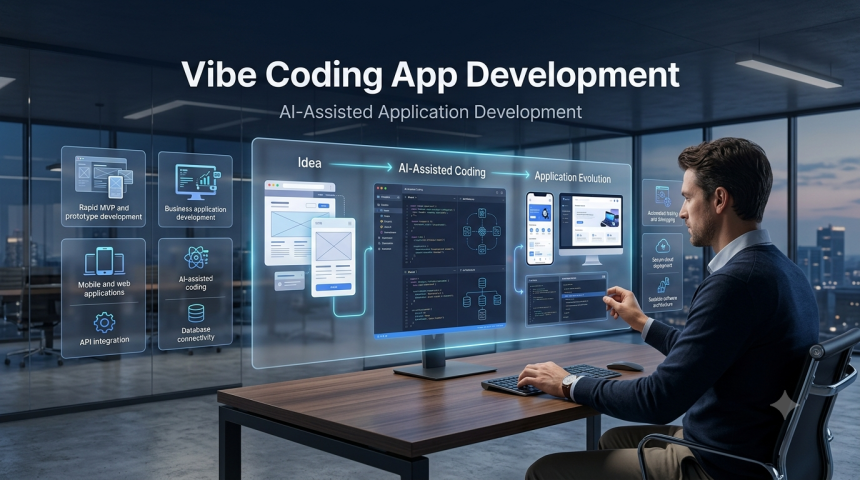

Vibe Coding App Development: Building Smarter Apps Faster Today
AI-powered Vibe Coding App Development that transforms ideas into modern, scalable apps through smart code generation, rapid prototyping, automation, and intelligent development tools.
Introduction
Application development is evolving as businesses look for faster ways to transform ideas into reliable digital products. Artificial intelligence is now becoming part of the development workflow, helping teams generate code, explore interfaces, automate repetitive tasks, and accelerate application iterations. Vibe coding represents this shift toward a more AI-assisted development experience, where developers can work with intelligent tools while maintaining control over architecture, functionality, and quality. Rather than replacing conventional engineering practices, this approach can complement them by reducing repetitive development work and allowing teams to spend more time on product decisions, user experience, security, and technical strategy.
Planning an Application Before Development Begins
Successful AI-assisted application development starts with clear planning rather than immediately generating code. The project should begin with a well-defined understanding of its users, business objectives, functional requirements, workflows, technology environment, and expected scalability. A detailed application roadmap helps developers determine which features should be built first and which can be introduced later. This is particularly valuable for startups and organizations developing MVPs because early versions can remain focused without creating unnecessary technical complexity. Defining the application architecture, user journeys, API requirements, database structure, and deployment environment in advance also gives AI-assisted development tools clearer boundaries within which they can be used effectively.
Migration Planning for Existing Applications
Businesses upgrading legacy applications need a carefully structured migration strategy before introducing new development methods. Migration planning involves understanding the existing architecture, dependencies, databases, third-party services, authentication mechanisms, and technical limitations. Developers should identify which components can be retained, modernized, replaced, or redesigned. A phased migration can reduce operational disruption by moving functionality progressively rather than attempting a complete transformation at once. Application modernization may also provide an opportunity to improve performance, simplify outdated workflows, introduce responsive interfaces, and prepare the system for cloud-based infrastructure. When AI-assisted development is incorporated into modernization, human developers should continue to validate architectural decisions and ensure that newly generated components remain compatible with the existing ecosystem.
Data Migration and Information Integrity
Data is one of the most important considerations when an application moves to a new technology stack or platform. Data migration should begin with an assessment of existing records, formats, relationships, duplicates, incomplete values, and legacy structures. Developers can then establish appropriate transformation and validation rules before transferring information into the new environment. Backup procedures and recovery plans are essential because migration errors can affect business operations and customer trust. After migration, teams should verify record counts, relationships, permissions, and application behavior against the original system. A controlled data migration process ensures that modernization does not compromise the accuracy or availability of important business information.
Building Reliable Integrations and APIs
Modern applications rarely operate independently. They commonly communicate with payment platforms, cloud services, customer relationship systems, analytics tools, authentication providers, communication platforms, and internal databases. Strong API integration therefore needs to be considered during the architecture stage. Developers should define how systems exchange information, handle authentication, manage errors, and respond to service interruptions. AI-assisted development can help accelerate repetitive integration code and generate supporting components, but integrations still require careful technical review. Developers must verify API contracts, data formats, timeout behavior, rate limits, and failure scenarios. Well-designed integrations create a connected application ecosystem while reducing unnecessary complexity between services.
How Vibe Coding App Development Supports Faster Iteration
The biggest practical advantage of Vibe Coding App Development is its ability to support rapid experimentation while keeping developers involved in important technical decisions. Teams can use AI-assisted tools to explore interface concepts, generate application components, refine functions, and test different implementation approaches more quickly. This can shorten the distance between an initial product idea and a functional prototype. However, speed should not become the only objective. Developers still need to examine generated code, evaluate maintainability, confirm business logic, and make sure the application follows established engineering standards. Combining AI productivity with human expertise creates a development workflow that is both flexible and controlled.
Security Must Remain a Core Development Priority
Security cannot be treated as an optional stage after application development is complete. Applications may process personal information, business records, payment-related data, credentials, and other sensitive information, making secure architecture essential from the beginning. Developers should consider authentication, authorization, encryption, secure API communication, input validation, session management, dependency security, and access controls throughout the project. AI-generated code should receive the same security scrutiny as manually written code because generated solutions may contain implementation weaknesses or inappropriate assumptions. Regular security reviews, dependency updates, vulnerability scanning, and secure coding practices help create a stronger foundation for applications developed with AI-assisted workflows.
Testing AI-Assisted Applications Thoroughly
Testing becomes especially important when development speed increases. A rapidly created feature is useful only when it behaves correctly under real-world conditions. Application testing should cover functionality, usability, performance, compatibility, integration behavior, and security. Automated testing can help teams repeatedly validate critical functions whenever changes are introduced. Developers should also perform manual reviews of important workflows because automated tests cannot always identify confusing user experiences or unexpected business scenarios. Continuous testing throughout development is more effective than waiting until the final stage to identify defects. Combining automated tools, human code review, and realistic user scenarios can significantly improve application reliability.
Challenges Businesses Should Consider
AI-assisted application development can introduce challenges if it is adopted without appropriate engineering controls. Generated code may require refactoring, documentation, optimization, or correction before it is suitable for production. Complex business rules can also be misunderstood when requirements are vague or incomplete. Maintaining consistency across a large application may become difficult if different components are generated without a unified architecture. There can also be concerns involving security, third-party dependencies, technical debt, and long-term maintainability. These challenges do not eliminate the value of AI-assisted development, but they demonstrate why experienced developers, clear requirements, version control, code review, and structured development practices remain important.
Best Practices for Sustainable AI-Assisted Development
A sustainable development workflow should treat AI as a productivity tool rather than an independent software engineer. Teams should establish coding standards, architecture guidelines, documentation practices, testing requirements, and review procedures before large-scale development begins. Prompts and requirements should be specific enough to communicate expected behavior clearly, while developers should review generated output before integrating it into production code. Version control should be used to track changes and simplify rollback when necessary. Teams should also prioritize modular architecture so individual components can be tested, improved, or replaced without disrupting the entire application. These practices help businesses gain development speed without sacrificing software quality.
Business Benefits of Modern AI-Assisted App Development
When implemented responsibly, AI-assisted development can provide several practical advantages for businesses. Faster prototyping allows product teams to validate concepts earlier, while accelerated coding can help developers dedicate more time to architecture and customer-focused improvements. Rapid iterations can also make it easier to respond to changing market requirements and user feedback. For organizations modernizing existing software, AI-assisted development can support selected upgrades without requiring every application component to be rebuilt from scratch. Over time, the combination of automation, reusable components, intelligent development tools, and experienced engineering can improve development efficiency while supporting scalable digital products.
Conclusion
AI is changing how development teams approach application design, implementation, testing, and modernization. The most effective strategy is not simply to generate software faster, but to combine AI-assisted productivity with sound architecture, secure development, reliable integrations, accurate data migration, and comprehensive testing. Businesses that establish clear requirements and maintain human oversight can use modern development techniques to experiment faster while building applications designed for long-term use. With the right planning and engineering discipline, AI-assisted application development can help organizations transform ideas into dependable digital experiences while creating a flexible foundation for future innovation.
Hospital Curtain Track Suppliers in India & Operation Theatre Technici...

Golden Touch Fusion CBD: How They Work, Expected Results, and Where to...
Introduction Golden Touch Fusion CBD Gummies are marketed as a cannabidiol (CBD) suppleme...
Oil and Grease Paper Price Trend Q2 2026 | Price Trends, Forecast, Cha...

Cotton Yarn Price Trend Q2 2026 | Price Trends, Forecast, Chart, Price...