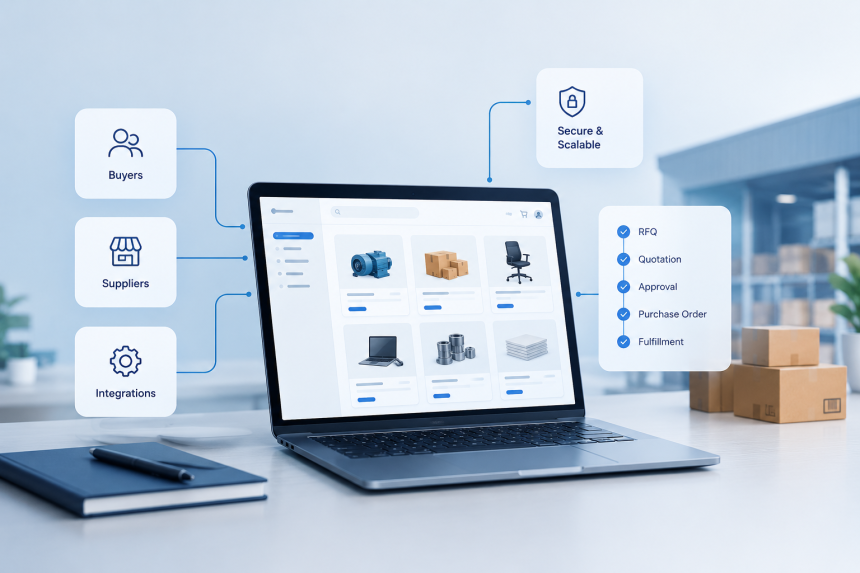

B2B Marketplace Platform Development: Key Considerations for Enterprise Businesses
A practical guide to B2B marketplace platform development, covering enterprise pricing, multi-vendor management, procurement workflows, system integrations, scalability, security, and future-ready architecture.
B2B marketplace platform development is fundamentally different from building a standard ecommerce store. Enterprise buyers often work with negotiated pricing, multiple stakeholders, purchase orders, approval chains, contracts, and complex fulfillment rules.
The platform must support these processes without creating operational friction. It also needs to connect with the systems that already run the business, including ERP, CRM, PIM, WMS, payment, and procurement platforms.
For enterprise businesses, the goal is not simply to launch another digital storefront. It is to build a connected commerce infrastructure that can support buyers, suppliers, internal teams, and future business models.
Technology decisions should follow the marketplace model, not the other way around.
Before development begins, businesses should define who will participate in the marketplace, how suppliers will be onboarded, how buyers will purchase, and how the platform will generate revenue.
An enterprise B2B marketplace may support:
- Manufacturers selling through distributors
- Multiple suppliers serving corporate buyers
- Wholesale purchasing
- Procurement networks
- Industry-specific supplier ecosystems
- Direct and third-party inventory on the same platform
Each model creates different requirements for catalog management, pricing, commissions, fulfillment, payments, and user permissions.
A clear business model helps determine the platform architecture and prevents expensive changes later.
A B2B buyer does not always follow a simple product page → cart → checkout journey.
Enterprise purchasing may involve product specifications, bulk quantities, negotiated prices, RFQs, approvals, purchase orders, and payment terms.
A capable B2B marketplace platform should support workflows such as:
Product discovery → RFQ → quote → negotiation → approval → purchase order → fulfillment → invoicing
RFQ and negotiation capabilities are particularly important when product prices depend on quantity, contracts, buyer segments, or supplier-specific terms. Modern B2B marketplace implementations commonly include these workflows alongside multi-vendor catalogs and enterprise purchasing controls.
The platform should also allow businesses to configure workflows instead of hard-coding every process.
Enterprise accounts rarely have a single user.
A procurement organization may have buyers, managers, finance teams, administrators, and approvers using the same marketplace account. Each user may require different permissions.
The platform should therefore support:
- Organization-level accounts
- Multiple users per business
- Role-based permissions
- Approval limits
- Department-level purchasing
- Spending controls
- Buyer-specific catalogs and pricing
This structure gives enterprises control over who can view products, request quotes, place orders, approve purchases, or manage account information.
It also creates a more realistic representation of how enterprise procurement works.
Integration should be treated as a core architecture decision, not a post-launch feature.
A B2B marketplace may need to exchange data with ERP, CRM, PIM, WMS, payment, tax, shipping, and procurement systems. API-based integration can enable real-time synchronization of products, inventory, orders, customer data, and pricing.
For example, an enterprise marketplace could use:
PIM → product data
ERP → orders, finance, inventory
CRM → customer and account data
WMS → fulfillment and stock
Payment systems → transactions and settlement
API-first architecture also makes it easier to add new systems as the marketplace grows.
For organizations using established procurement environments, integration may extend to EDI, punchout catalogs, or procurement platforms. The marketplace should fit into existing purchasing workflows instead of forcing buyers to abandon them.
B2B pricing is rarely universal.
The same product may have different prices based on customer contracts, order volume, geography, currency, or buyer group.
A B2B marketplace platform should therefore support:
- Customer-specific pricing
- Contract pricing
- Volume-based pricing
- Tiered discounts
- Bulk ordering
- Supplier-specific catalogs
- Regional catalogs
- Multiple currencies
- Product-level attributes and specifications
Catalog architecture matters just as much. Enterprise marketplaces can contain thousands or millions of SKUs, with product information coming from multiple suppliers and systems.
A strong PIM and catalog management layer helps maintain consistency while allowing suppliers to manage their own product data.
Multi-vendor management introduces another layer of complexity.
Each supplier may have different products, inventory, pricing, shipping rules, fulfillment processes, and performance targets.
The platform should provide centralized controls for supplier onboarding, verification, catalog approval, commissions, orders, settlements, and performance monitoring.
Supplier self-service portals can further reduce operational overhead. Vendors can manage listings, inventory, orders, and other marketplace activities without depending on the marketplace operator for every update.
This becomes especially important as the number of sellers increases.
Enterprise marketplace development requires more than functional features.
The underlying architecture needs to handle high transaction volumes, large catalogs, multiple integrations, and concurrent users while maintaining predictable performance.
API gateways, modular services, caching, asynchronous processing, database optimization, and cloud-ready infrastructure can help create a scalable foundation.
Security also needs to be designed into the platform. Role-based access, secure APIs, audit trails, encryption, authentication, and appropriate compliance controls should be considered during architecture planning.
Observability is equally important. Teams should be able to monitor API performance, failed integrations, order processing, inventory synchronization, and other critical workflows.
Enterprise marketplace requirements change.
New suppliers may join. New regions may be added. Procurement workflows may evolve. Businesses may introduce new payment methods, storefronts, product categories, or fulfillment models.
An API-first and modular architecture makes these changes easier to manage. Headless commerce can also separate the customer experience layer from core commerce services, giving enterprises more flexibility across web, mobile, partner portals, and other digital channels.
AI can add another layer of capability through intelligent search, recommendations, product discovery, analytics, and operational insights. However, these capabilities should complement a solid commerce foundation rather than compensate for weak marketplace architecture.
Successful B2B marketplace platform development starts with understanding enterprise operations, not simply selecting ecommerce software.
The platform needs to handle complex pricing, multi-user accounts, supplier management, RFQs, procurement workflows, payments, fulfillment, and enterprise integrations. At the technical level, scalability, security, API connectivity, and extensibility are equally important.
For enterprise businesses, the right B2B marketplace platform becomes more than a sales channel. It can serve as a connected layer between buyers, suppliers, internal systems, and digital commerce operations.
The strongest implementations are built around the organization's actual procurement and commercial workflows, with an architecture capable of evolving as those requirements grow.


How Can Childcare Centres Maintain Cleaner Playrooms and Rest Areas?

Polyester Industrial Yarn Price Trend Q2 2026 | Price Trends, Forecast...




Academic Excellence in AI and Data Science Engineering | HOD's Desk at...
