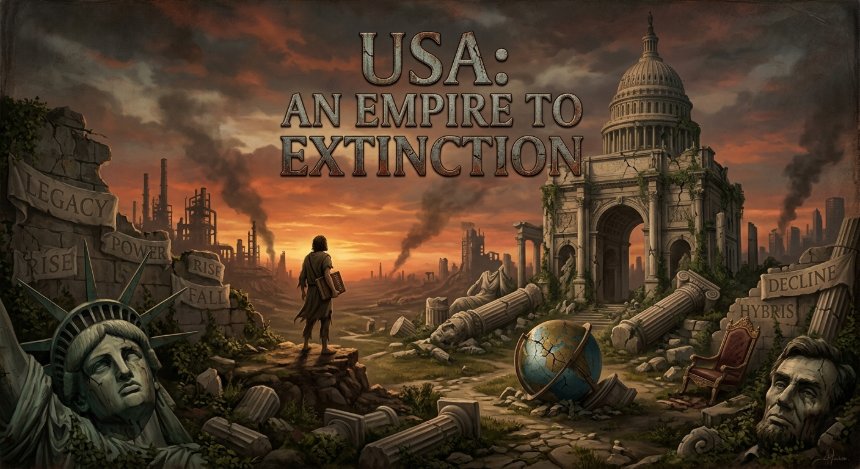

USA: An Empire to Extinction
This paper examines the contemporary socioeconomic, political, and geopolitical crises in the United States through the dual lenses of classical political philosophy and structural international relations theory. It argues that the visible degradation of American public discourse and the erosion of its global hegemony are not accidental anomalies, but the systemic consequences of a fractured information ecosystem, institutionalized educational inequities, and a profound domestic wealth disparity. The paper concludes that the survival of democratic governance and global stability depends entirely on restoring a shared factual consensus, economic equity, and intellectual responsibility.
أَعُوذُ بِاللّٰهِ مِنَ الشَّيْطَانِ الرَّجِيمِ
بِسۡمِ ٱللهِ ٱلرَّحۡمَـٰنِ ٱلرَّحِيمِ
In the name of ALLAH, the Most Gracious, the Most Merciful
USA: An Empire to Extinction
Declining Institutions and Fragmented Realities: Analyzing the Crisis of Modern American Governance
Abstract:
This paper examines the contemporary socioeconomic, political, and geopolitical crises in the United States through the dual lenses of classical political philosophy and structural international relations theory. It argues that the visible degradation of American public discourse and the erosion of its global hegemony are not accidental anomalies, but the systemic consequences of a fractured information ecosystem, institutionalized educational inequities, and a profound domestic wealth disparity. Drawing upon Plato’s critique of timocratic decay, the paper frames the current ideological shift as an inversion of the classical hierarchy, where reason (logos) is subordinated to tribal passion and honor-seeking (thumos). This internal collapse is reinforced by what Marguerite Yourcenar identified as the "systemic manufacturing of ignorance," which alienates citizens from physical reality and leaves them vulnerable to corporate and populist exploitation. Finally, the paper traces how these domestic dysfunctions intersect with imperial overstretch to transition the United States from a post-Cold War unipolar hegemon into a declining empire. The paper concludes that the survival of democratic governance and global stability depends entirely on restoring a shared factual consensus, economic equity, and intellectual responsibility.
Introduction
One day, historians will look back on this period in American history not just with severe embarrassment, but with complete incomprehension. They will query how the wealthiest and one of the most technologically advanced societies in human history allowed its public discourse to degrade into hyper-polarization, institutional dysfunction, and a real-world iteration of an ideological Idiocracy. This collapse of civic health is not an accident of fate. It is the predictable consequence of an information crisis, systemic educational erosion, economic despair, and a profound philosophical deviation from the core values of reason and historical truth.
The Fragmentation of a Shared Reality
At the core of the current American crisis is the collapse of a shared factual consensus. The democratization of the internet, while revolutionary, coincided with the rise of algorithmic profit models specifically engineered to maximize user engagement through outrage. Social media platforms and hyper-partisan media networks have successfully fractured public discourse into insular echo chambers. In these digital spaces, objective truth is routinely subordinated to tribal loyalty. This fragmentation has been accelerated by the sharp decline of local journalism, which historically anchored communities in shared regional realities. Without a common baseline of facts, democratic debate becomes structurally impossible, replaced instead by perpetual culture wars that paralyze the legislative process.
The Educational Disconnect and the Manufacturing of Ignorance
The paradox of an immensely rich society suffering from pervasive anti-intellectualism stems from systemic inequality and structured civic failure. While the United States possesses the world’s premier research universities, its K-12 public education framework is deeply fractured, largely because school funding relies heavily on local property taxes. This disparity leaves vast segments of the population without robust training in media literacy, history, or critical thinking.
Writing in Les Yeux Ouverts (1980), Marguerite Yourcenar delivered an astonishingly prophetic critique of modern education and social decay that diagnoses this exact failure. Decades before the explosion of algorithmic internet culture, the proliferation of ultra-processed foods, and intense political polarization, she condemned the ignorance reigning in modern democracies, noting that it seems willed by the system itself.
Rather than treating education as a factory line to produce specialized economic cogs, Yourcenar outlined an education of connectedness, critical distance, and visceral reality. She argued that a true education must instill an euro-centric consciousness—teaching children that they exist within a delicate universe whose resources they must spare—while dismantling national mythologies by exposing how every country mendaciously arranges its history to flatter its collective pride. Instead, the modern framework cultivates a specialized, systemic ignorance, leaving citizens highly vulnerable to corporate advertising impostures and anti-establishment populist movements that reframe expertise as an elitist conspiracy.
Economic Despair Amid Unprecedented Wealth
The assertion that America is the world's richest nation masks a stark internal reality: gross domestic product (GDP) does not measure societal well-being. Decades of deindustrialization, stagnant real wages, soaring healthcare costs, and hollowed-out manufacturing towns have shattered the American middle class. This intense wealth inequality does not reflect the lived experience of ordinary citizens, fostering a pervasive sense of betrayal and despair. When the traditional political apparatus fails to guarantee upward mobility or basic stability, voters lose faith in democratic norms. This environment provides fertile ground for populist movements that promise to disrupt the status quo, even if those movements openly reject traditional rules of governance.
The Unipolar Illusion and the Mechanics of Imperial Overstretch
The structural decline of the United States as a global empire cannot be separated from the strategic illusions that followed the end of the Cold War. In the 1990s, political theorists prematurely celebrated the "End of History," framing the United States as a permanent, unipolar hegemon destined to anchor a liberal international order. However, this unipolar moment contained the seeds of its own exhaustion. By substituting the Socratic restraint of logos with a timocratic obsession with global dominance, the American empire entered a textbook cycle of imperial overstretch.
This geopolitical transition from unipolar leader to declining empire is driven by three intersecting structural failures:
- The Financial and Human Cost of Strategic Hubris: The pursuit of endless, un-winnable "forever wars" in the Middle East and Central Asia drained trillions of dollars from domestic infrastructure and social systems. This massive diversion of capital hollowed out the nation's economic core while failing to achieve its stated democratic objectives abroad.
- The Rise of Asymmetric and Multipolar Competitors: While the U.S. remained bogged down in costly counter-insurgency operations, emerging powers—most notably China—capitalized on global economic frameworks to build massive industrial, technological, and regional military capabilities. The unipolar system has rapidly fractured into a multipolar reality, where American economic sanctions and military threats carry diminishing leverage.
- The Erosion of Soft Power and Legitimacy: A superpower's hegemony relies not just on raw military force (hard power
), but on institutional legitimacy and moral authority (soft power). Decades of unilateral interventions, systemic violations of international sovereignty, and visible domestic chaos have shattered the myth of American exceptionalism, turning former allies into cautious pragmatists and rivals into overt adversaries.
The Philosophical Contradiction: Thumos vs. Reason
This domestic decay and imperial overstretch are mirrored in the philosophical degradation of the political ruling class, which increasingly prioritizes thumos over logos. In classical political thought, thumos—the spirited part of the soul associated with passion, strength, and pride—is an essential human element, but one that Plato warns must be strictly subordinated to reason (logos) and the pursuit of the true and the good. Modern populist rhetoric has inverted this hierarchy, elevating thumos and the "will to fight" as the primary heart of great civilization.
By prioritizing honor, dominance, and tribal passion over objective truth, this strain of thought steers society away from an aristocracy of virtue toward a timocracy—the first of the corrupt polities identified in Plato’s Republic. It is not a cure for civilizational ailment, but a manifestation of the disease itself, mirroring the corrupt, unbridled egalitarian tendencies that Plato warns lead to the collapse of democracies.
The Myth of the "Isolated West" and Geopolitical Mythmaking
The breakdown of intellectual responsibility and the elevation of thumos inevitably corrupts how the nation projects power abroad, leading to a dangerously Eurocentric account of history. Modern political rhetoric frequently relies on the myth of an "Isolated West," treating ancient Greece as an exclusive, insulated ancestral inheritance completely detached from its eastern neighbors. History is flattened into a crude, binary caricature reminiscent of pop-culture battlefields, framing Western civilization as fundamentally opposed to an "anti-civilizational" East.
This ideological mythmaking erases centuries of profound cultural contact, trade, diplomacy, and intellectual cross-pollination. The Achaemenid Persian Empire was a vast, multicultural world where Greek thinkers routinely traveled, and the very birth of Greek philosophy occurred precisely at these Eastern crossroads. Reducing this complex history to military invasions is not historical analysis; it is an exercise in political self-sabotage that alienates global allies. Just as historical regimes have exploited myths of national humiliation to legitimize exclusion, the deliberate construction of civilizational enemies normalizes dehumanization and mass violence, advancing a dangerous narrative where global conflict appears inevitable.
Conclusion
The trajectory of the American superpower is the structural consequence of an information ecosystem that monetizes division, an unequal educational framework that manufactures ignorance, and a political class that has abandoned classical reason for tribal passion. Whether this period represents a permanent decline or a temporary aberration depends entirely on the nation's capacity to restore economic equity, rebuild intellectual responsibility, and re-establish a shared factual reality. Without deliberate systemic intervention, the profound incomprehension of future historians will remain entirely justified.
Vigortrix: A Complete Guide to Its Features and Potential Benefits
What Is Vigortrix Male Enhancement? Vigortrix is a dietary supplement marketed for adult...


Hotel Econômico São José do Rio Preto-SP Centro Cidade: Encontre Hospe...
Solvarex Review: What Makes This Formula Stand Out?
What Is Solvarex? Solvarex is a dietary supplement designed to support general metabolic...