
The Gates of Maluka
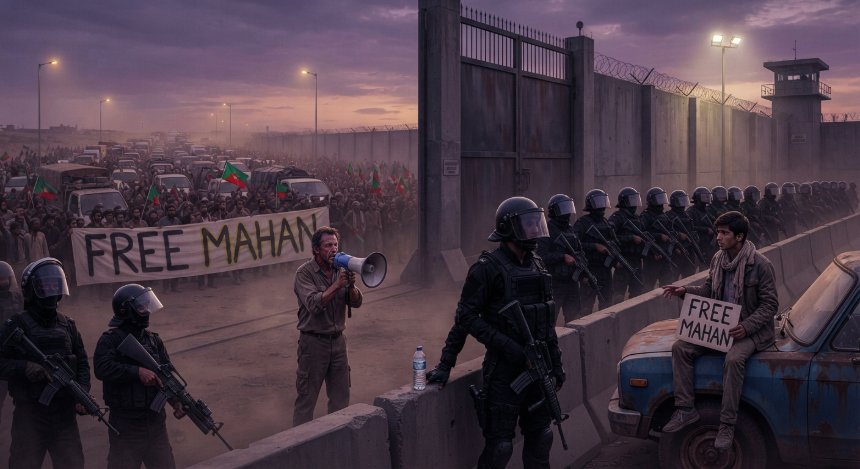
Storytelling is an important tool because it builds emotional connections, helps people remember information, and fosters empathy. Fiction is defined as any creative literary or narrative work that portrays imaginary characters, settings, and events. In the Banana Republic of Maluka the iron gates of the City were designed to keep the chaos of the realm out, but they could not stop the noise coming from a massive sea of humans carrying flags surged across a highway, led by a defiant Governor, demanding the immediate release of Mahan, the populist leader, from his high-security cell. This write up is a fictional story based upon the countless happenings in history.
أَعُوذُ بِاللّٰهِ مِنَ الشَّيْطَانِ الرَّجِيمِ
بِسۡمِ ٱللهِ ٱلرَّحۡمَـٰنِ ٱلرَّحِيمِ
In the name of ALLAH, the Most Gracious, the Most Merciful
The Gates of Maluka
In the Banana Republic of Maluka, the iron gates of the high command in Garrison City were designed to keep the chaos of the realm out, but they could not stop the noise.
Inside the high-ceilinged briefing room, Commander Kael sat at the head of a mahogany table, staring at a bank of muted flat-screen monitors. On the left screen, thousands of protesters under the banner of the Citizens' Action League were choking the mountain roads of the Border Province, their demands for economic accountability swelling into a deeper chant for political autonomy. On the middle screen, a massive sea of flags surged across a highway in the Western Territory, led by a defiant Governor Julian, demanding the immediate release of Mahan, the populist leader, from his high-security cell. On the right screen, grainy footage from across the sea showed the flash of interceptor missiles over Zul.
To the untrained eye, they were three entirely separate crises. To the Commander, they were a singular, terrifying sound: the shattering of a monopoly.
"The narrative is fracturing, sir," said Captain Vane, clicking through a slide deck of intelligence briefs. "For seventy years, we controlled the translation of resistance in Maluka. We told the public who the enemy was, when to feel solidarity, and when to obey. But the wires have crossed."
Vane brought up a map highlighting the sudden, unauthorized circuits of digital solidarity. "When the high command activated military protocols under the Mecca Alliance to counter the forces in Zul, we expected the usual compliance. Instead, the streets are rejecting it. The public is asking why council scrutiny was bypassed for a regional entanglement. Even worse—the people of the Border Province are releasing statements of solidarity with Zul independently of our capital."
Commander Kael leaned back, his fingers interlaced. "We have spent generations sanctifying the Border Province's historic resistance against external rule. It is a pillar of our state identity."
"Precisely, sir," Vane replied, his voice dropping to a cautious murmur. "But now that the people under our own administration are organizing independently, they are using our own vocabulary against us. When they demand accountability, our media calls it sedition. The public sees the contradiction. They are realizing that we love the language of defiance—provided it is performed by someone else, somewhere else."
Kael stood up and walked to the window, looking out toward the manicured lawns of the garrison. The establishment of Maluka had always managed dissent by keeping it siloed. They had co-opted the traditional ideological leaders with concessions and out-maneuvered the traditional left. But this was different. Mahan’s absolute refusal to submit from behind bars had turned his imprisonment into a mirror. It dramatized the vast, hollow gulf between authority maintained by institutional coercion and legitimacy derived from popular support.
"The Governor of the Western Territory is still marching?" Kael asked.
"Julian’s convoys are growing, sir," Vane reported. "They aren't just contesting Mahan's arrest anymore. They are contesting our right to dictate the country’s leadership. And with the conflict in Zul, the local factions there are publicly thanking our citizens who oppose our military interventions. They are drawing a line between the population and us."
That was the true subversion. Political recognition was no longer descending from governments; it was circulating horizontally between the governed. The state of Maluka was being bypassed entirely. The high command still possessed the tanks, the diplomatic credentials, and the bureaucratic machinery of state power. But ownership of the national conscience was slipping through its fingers.
"We can deploy more guards to the capital," Kael said, though the words felt heavy, mechanical, and increasingly obsolete. "We can restrict the digital feeds. We can enforce order."
Captain Vane looked at the screens, where the faces of protesters in the mountains, the valleys of the West, and the war-torn coast across the sea seemed to blur into a single, collective indictment.
"We can enforce control, sir," Vane said quietly, turning off the projector. "But control is no longer manufacturing consent. Our greatest miscalculation wasn't teaching them the language of resistance."
He paused, looking at the Commander.
"It was assuming we would forever control its translation."
The rumble of Governor Julian’s convoy could be heard long before it was seen at the outer checkpoints of Garrison City.
A hundred miles of asphalt lay behind them, a dust-choked spine stretching from the Western Territory straight to the high command's front door. What had started six days prior as a modest cluster of vehicles had snowballed into an unstoppable, roaring glacier of steel, trucks, and humanity. There were rusted flatbeds carrying farmers from the agrarian valleys, sleek sedans from the provincial tech hubs, and roaring motorbikes driven by the youth who had only ever known the high command’s restrictions.
At the head of the column, riding in an open-top utility vehicle, was Governor Julian. His sleeves were rolled up, his face lined with the exhaustion of the road, but his eyes remained locked on the looming concrete barricades ahead.
Inside the briefing room, Captain Vane zoomed the satellite feed onto the lead vehicle. "Julian’s convoy has officially reached the western perimeter, sir. Local security forces are refusing to deploy the spike strips. They say the crowd is too dense. If we open the primary security gates to let our supply trucks out, the momentum of that crowd will carry them right past the outer wall."
Commander Kael didn't look at the screen. He kept his eyes on the window, where the low, rhythmic thrum of thousands of chanting voices was beginning to vibrate against the glass panes of the garrison.
"He’s brought the whole West with him," Kael muttered.
"Not just the West, sir," Vane corrected, tapping his tablet to bring up a fresh set of aerial coordinates. "Look at the tail end of the column. Logistical support trucks from the Border Province just joined them at the junction. The Citizens' Action League is feeding Julian's marchers. They are sharing fuel, water, and communication networks."
The wires weren't just crossing digitally anymore—they were fusing physically on the highway. By blocking the roads in the mountains and marching on the capital from the plains, the two distinct territories had effectively created a pincer movement of popular defiance, all unified by the singular demand painted on a mile-long fabric banner stretching across the trucks: FREE MAHAN.
Julian’s vehicle pulled up to within twenty feet of the heavily armed guard towers. The garrison soldiers, clad in black riot gear and holding automatic rifles, stood frozen behind concrete blast walls. They had been trained to fight foreign adversaries, but looking out through their visors, they saw their own cousins, their own classmates, and their own provincial leaders looking back at them.
Julian picked up a megaphone, his voice cutting cleanly through the roaring engines.
"Soldiers of Maluka!" Julian’s voice echoed off the concrete fortifications. "We do not come here to fight you. We come to remind those sitting inside those air-conditioned offices that the sovereignty of this republic belongs to the people standing on this asphalt! You cannot lock a nation's conscience in a cell and expect the rest of us to remain quiet cogs in your machine. Open the gate! let Mahan speak, and let Maluka decide its own destiny!"
A deafening roar erupted from the miles of vehicles behind him, thousands of horns blaring in unison, a wall of sound that slammed directly into the iron gates of Garrison City.
Inside, Commander Kael felt the floorboards tremble slightly under his boots. The illusion of absolute control was evaporating in real time.
"Sir?" Captain Vane asked, his hand hovering over the red alert console. "The guards at the gate are asking for instructions. Do we authorize the defensive dispersion protocols?"
Kael looked at the screens one last time—at the mountain blockade, the shipping lanes of Zul, and the ocean of people surrounding his fortress. He knew that the moment a single tear-gas canister was fired or a single shot echoed down that highway, the final thread of their institutional legitimacy would snap forever.
"No," Kael said softly, his voice hollow. "Hold the line. Do not engage."
He turned away from the window, realizing that the language of resistance had left the textbook and was now rewriting the geography of Maluka outside his door.
Corporal Tariq’s hands were sweating inside his tactical gloves, making it difficult to maintain a steady grip on his standard-issue assault rifle.
He stood behind a reinforced concrete blast wall at the Western Gate of Garrison City, his visor down, blocking out the glare of the setting sun but amplifying the sound of his own heavy breathing. Through the thick plexiglass of his helmet, the world outside was a shifting blur of green and red flags, swirling dust, and a sea of roaring engines that stretched all the way to the horizon.
Twenty feet away, Governor Julian was still speaking into the megaphone. Every word bounced off the concrete tower, vibrating right through Tariq’s combat boots.
Through his tactical earpiece, the command network was a chaotic mess of static and anxious voices. “All units, hold positions. Dispersion protocols are on standby. Do not engage unless explicitly ordered by Commander Kael.”
Tariq adjusted his stance, his eyes scanning the front line of the convoy. That was when his heart dropped.
Sitting on the hood of a rusted blue pickup truck just behind the Governor’s vehicle was a young man wearing a faded Western Territory jacket, holding a hand-painted sign that read FREE MAHAN. He had a dusty cloth wrapped around his neck and was shouting alongside the crowd.
It was Asif. Tariq’s childhood friend.
A sudden rush of dizziness hit Tariq. The uniform he wore, the high command he served, and the iron gates he was ordered to defend had always felt like an abstract duty—a job that paid the bills and brought prestige to his family in the provinces. For years, the high command had told them that the garrison was the only thing standing between Maluka and absolute chaos. They were the guardians of order.
But looking at Asif’s dust-streaked face, the narrative shattered. The boy he had grown up with, the friend he had climbed mango trees with in the valleys of the West, wasn't an insurgent. He wasn't a threat to the realm. Asif was a bright mind who had watched his family’s savings evaporate under skyrocketing costs, whose friends had been detained for posting political opinions online, and who simply wanted a say in who led his country.
“Tariq, look at the sector four boundary,” muttered Corporal Raza from the blast wall next to him, his voice trembling slightly over their private squad channel. “The crowd is pushing against the outer chain-link. If they breach it, what do we do? Do we actually fire on them?”
Tariq looked at Raza. Through the tint of Raza's visor, he could see the same paralyzing fear. Raza’s family lived in the Border Province, where the Citizens' Action League had shut down the mountain highways. They weren't just guarding a gate; they were standing at the edge of a mirror, looking at their own blood and their own past.
“I don't know,” Tariq micro-whispered back, his finger deliberately resting far away from the trigger guard of his rifle. “I don't think I can.”
The roar of the crowd swelled again as a massive group of marchers from the Border Province link-up arrived at the front, passing out water bottles to the people near the guard towers. One elderly man walked right up to the concrete barrier, completely ignoring the barrels of the automatic weapons pointed at him, and placed a single bottle of water on top of the concrete wall, right in front of Tariq.
The man looked up, meeting Tariq’s eyes through the dark visor. He didn't look angry. He looked tired. He looked like the elders from their village back home.
“All units,” the earpiece suddenly crackled, the voice of the central dispatcher breaking the tension. “Commander Kael has denied dispersion protocols. Repeat, do not engage. Hold the line.”
Tariq let out a long, ragged breath he hadn't realized he was holding. He looked back at his childhood friend Asif, who was now waving a flag, swept up in the historic momentum of the glacier of steel outside.
Slowly, deliberately, Tariq reached out and lowered the barrel of his rifle, letting it hang by its tactical sling against his chest. He didn't step back from the line, but he no longer stood as a weapon of the high command. He stood as a witness. The gates of Garrison City were still closed, but as Tariq watched the ocean of his fellow citizens refuse to back down, he knew the locks had already been broken from the inside.
The dust kicked up by the thousands of idling engines began to settle under the heavy, purple light of the Malukan sunset. In that momentary lull between Governor Julian’s speeches, the roaring chant of the crowd ebbed into a low, rhythmic hum.
Asif shifted his weight on the hood of the blue pickup truck, uncapping a plastic water bottle. As he tilted his head back to drink, his eyes casually scanned the line of silent, black-clad figures standing behind the concrete blast wall. To him, they were a monolithic wall of state power—unfeeling, armed, and absolute.
Then, his gaze locked onto the guard standing directly by the primary gate pillar.
Tariq did not move. He stood perfectly still, but his rifle was hanging loosely by his chest, un-shouldered. The simple act of defusing his posture drew Asif’s focus. Asif squinted through the hazy air, his eyes tracing the familiar height of the shoulders, the specific tilt of the head, and the way the guard’s left hand rested lightly on the top of his tactical vest—a subconscious habit from years of standing around the village square.
Tariq felt the exact moment the connection was made. He slowly raised his hand, his gloved fingers reaching up to the side of his helmet. With a soft click, he flipped the heavy, dark-tinted visor upward.
The setting sun caught Tariq’s eyes.
Asif froze, the water bottle stopping inches from his mouth. His posture went completely rigid. For a fraction of a second, his brain refused to reconcile the childhood friend he had shared bread, laughter, and mangoes with, with the imposing instrument of the Garrison City high command.
"Tariq?" Asif’s lips moved, though the word was swallowed by the ambient rumble of the convoy.
Tariq didn't smile; the weight of the uniform wouldn't allow it. But he nodded—a single, firm, deliberate nod that carried the entire history of their shared past. It was a message that bypassed the radio frequencies, the state propaganda, and the concrete walls: I see you. You are safe.
The transformation in Asif was instantaneous. The anger and defiance that had tightened his face for six long days on the highway erred into a sudden, fierce vulnerability. He looked down at the hand-painted FREE MAHAN sign in his lap, then back up at Tariq. He didn't wave his flag anymore. Instead, he slowly lowered it, leaning the wooden staff against the side of the truck.
From the blast wall next to them, Corporal Raza noticed the shift. “Tariq, the kid on the truck... he’s staring right at you. You know him?”
“He’s from home, Raza,” Tariq murmured into the squad channel, his voice thick. “He’s from home.”
Raza went silent. He didn't tell Tariq to lower his visor. He didn't report it to the command tower. He simply adjusted his own stance, his eyes shifting away to give his friend a shred of privacy in the middle of a collapsing empire.
Outside, Asif stood up on the hood of the truck. He didn't approach the gate—he knew the rules of engagement better than that—but he picked up the extra bottle of water an elder had left near the front line. He walked forward three steps, placed it deliberately on the asphalt within the neutral zone, and looked up at Tariq one last time. He gave a slight, respectful press of his hand to his chest—the traditional Malukan gesture of unbreakable trust.
When Asif walked back to his vehicle, he wasn't just marching for a populist leader or a political cause anymore. He was marching with the knowledge that the iron wall in front of them wasn't made of monsters. It was made of their own people, waiting for the right moment to let the country through.
Inside the helmet, Tariq’s earpiece crackled again with the anxious, distant voice of the high command orders, but he barely heard them. The translation of resistance was no longer being dictated by the generals up in the towers. It was being written right here on the asphalt, in the silent understanding between two friends who refused to become enemies.
The reality outside the gate echoed the timeless warning of the old strategic thinkers: no army can ever truly fight and win a war against its own people.

Hotel Econômico São José do Rio Preto-SP Centro Cidade: Encontre Hospe...

Solvarex Review: What Makes This Formula Stand Out?
What Is Solvarex? Solvarex is a dietary supplement designed to support general metabolic...