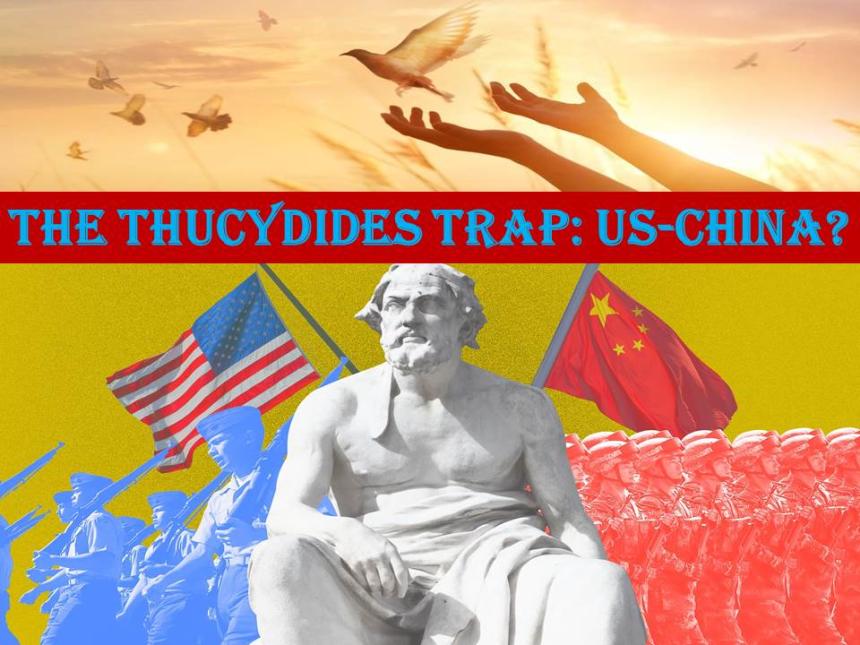

The Thucydides Trap: US-China?
The Thucydides Trap is a political theory popularized by Harvard political scientist Graham Allison. It describes the structural tension and high risk of conflict that occur when a rising power threatens to displace an established, ruling power. President Xi Jinping invoked the "Thucydides Trap" during high-level delegation talks with U.S. President Donald Trump in Beijing to warn against the dangers of great power conflict. This write up discusses the issue and proposes peace model adoption.
أَعُوذُ بِاللّٰهِ مِنَ الشَّيْطَانِ الرَّجِيمِ
بِسۡمِ ٱللهِ ٱلرَّحۡمَـٰنِ ٱلرَّحِيمِ
In the name of ALLAH, the Most Gracious, the Most Merciful
The Thucydides Trap: US-China?
The Thucydides Trap is a political theory popularized by Harvard political scientist Graham Allison. It describes the structural tension and high risk of conflict that occur when a rising power threatens to displace an established, ruling power. The term is derived from a famous observation by the ancient Greek historian Thucydides regarding the Peloponnesian War (431–404 BC); "It was the rise of Athens and the fear that this instilled in Sparta that made war inevitable."
In this scenario, war broke out not necessarily because either side actively wanted it, but because the established power (Sparta) became paralyzed by the fear of being overtaken by the rapidly growing power (Athens). This fear leads to preemptive actions, strategic miscalculations, and defensive buildups that can quickly spiral into open conflict.
Graham Allison's developed the theory after studying sixteen (16) Cases. Graham Allison applied this metaphor to modern international relations—most notably to the geopolitical rivalry between the United States and China. To test the theory, his team identified 16 instances in history where a rising power challenged a ruling power:-
War Resulted (12 cases): In cases like World War I (where a rising Germany challenged the British Empire), conflict ultimately erupted.
War Avoided (4 cases): In four instances, both sides successfully managed the power transition without going to war, such as the peaceful rise of the United States as it eclipsed the British Empire in North America at the turn of the 20th century.
President Xi Jinping invoked the "Thucydides Trap" during high-level delegation talks with U.S. President Donald Trump in Beijing to warn against the dangers of great power conflict. This, therefore, has become important to explore the political science theory popularized by Harvard professor Graham Allison in today's setting. The concept has become a central framework for understanding US-China relations. As China's economic, technological, and military capabilities have grown, the structural stress on the existing international order has increased. World leaders and diplomats—including Chinese President Xi Jinping—have invoked the concept in meetings with U.S. leaders to warn against strategic miscalculations and emphasize the importance of managing competition peacefully.
The "Trap" describes a dangerous dynamic where an established, dominant superpower (the U.S.) feels threatened by an emerging, rising power (China). The "Trap"; according to the theory, this structural stress often leads both nations into a self-fulfilling cycle of suspicion, defensive buildups, and eventually catastrophic war. Beijing views the term as a threat to be managed. Xi has long advocated for establishing a "new paradigm of major-country relations" where the U.S. and China coexist as equals rather than sliding into confrontation over issues like trade or Taiwan. President Xi used the historical reference to urge the Trump administration to avoid viewing China's growth as an inevitable threat.
The primary takeaway of the theory is not that war is inevitable, but that avoiding it requires deliberate, extraordinary statecraft, open communication, and the acceptance of new rules of engagement.
Is "The Thucydides Trap" Comparison Valid?
Let's first examine the current situation of "established power" USA and "rapidly growing power" China. The United States became a global superpower by leveraging its vast natural resources, rapid industrialization, and favorable geography during the 19th and early 20th centuries. It cemented its dominant position following World War II and the Cold War, as war-torn Europe and the collapsed Soviet Union left the U.S. with unchallenged economic and military supremacy.
In the late 19th and early 20th centuries, a booming population, abundant natural resources, and rapid technological innovation allowed the U.S. to build a massive economy, eventually surpassing the industrial output of European powers. While the First and Second World Wars devastated Europe, the U.S. mainland remained untouched. The U.S. supplied weapons and goods to the Allies, transforming its industrial sector into the "Arsenal of Democracy" and boosting its economic strength. Near the end of World War II, the U.S. established the dollar as the global reserve currency, pegged to gold, which gave the nation unparalleled financial leverage. Post-1945, the U.S. spearheaded the creation of the United Nations, the World Bank, and the International Monetary Fund, and formed defense alliances like NATO to secure its geopolitical influence. The end of the Cold War in 1991 left the United States as the world's sole superpower.
The United States also conquered the world's intelligentsia as a superpower by combining a compelling cultural narrative—the American Dream of upward mobility and freedom—with massive industrial resources, a strong free-market economy, and two oceans for geographic protection. This concept attracted global talent, capital, and innovation while establishing the U.S. as a dominant global force. Therefore, there was no compelling challenge to US's ascendency and ragefully orchestrated sheriff's role. However, as predicted by "The Rise and Fall of the Great Powers" by Paul Kennedy, who explored the politics and economics of the Great Powers from 1500 to 1980 and the reason for their decline, USA fell from the position of established power to diminishing power by engaging into war with Iran.
China’s rise to superpower status is indeed widely recognized as driven by economic statecraft, massive manufacturing capacity, and strategic investments rather than military conquest. China became a superpower because of:-
1. The 1949 revolution that ended foreign domination
2. Land reform that broke the old landlord class
3. Industrialization driven by Chinese planning, not foreign aid
4. Massive investment in education and healthcare in the 1950s-70s
5. Strategic opening on China's own terms post-1978
The US never "invested" in China to make it strong. American companies came to China to make themselves richer, not China powerful. Cheap labor. Weak environmental rules. Tax breaks. That was the deal. China took those crumbs and built its own banks, its own supply chains, its own technology. Huawei. BYD. TSMC. High-speed rail. Beidou satellites. None of that came from US charity. Meanwhile, look at countries that actually relied on US "investment" as the main strategy. The Philippines. Mexico. Egypt. Where are their superpower statuses?
The revolution created the foundation. Chinese discipline built the rest. The US was just an accidental landlord collecting rent until the tenant bought the building.
China may not have military power comparable with USA but she does have most eminent "Resource Control" which matters in next generation technology. By dominating the mining and refining of critical raw materials and rare earth minerals, China holds significant leverage over global technology and commodity markets. China launched in 2017, "The Belt and Road Initiative" (BRI); and this ambitious program involves hundreds of billions of dollars in infrastructure investments across Asia, Africa, and Europe. It translates economic capital into deep diplomatic and trade dependencies. China’s Belt and Road Initiative (BRI) has created deeply entrenched public sentiment in its favour in participating nations.
The "Thucydides Trap"—the concept that when a rising power threatens to displace an established ruling power, war becomes the most likely outcome—is a valid comparison for the United States and China since it has been uttered by the Chinese President himself. However, the economies of both superpowers are deeply intertwined via global trade and debt. War would trigger catastrophic global economic collapse, dis-incentivizing direct conflict. Chinese President Xi actually advised to avoid falling into the trap; “Can China and the United States transcend the so-called ‘Thucydides Trap’ and forge a new paradigm for major-power relations?” He said "If mishandled, the two nations could collide or even come into conflict, pushing the entire China-US relationship into a highly perilous situation,” and “Achieving the great rejuvenation of the Chinese nation and making America great again can totally go hand in hand … and advance the wellbeing of the whole world,” Xi said.
US Response to Chinese The Thucydides Trap Offer
How US will respond to Chinese President Xi's offer for avoiding The Thucydides Trap is a valid concern for the world? USA became the Super power through wars and its hard to let go old habits. Let's read a response from US General Mike Flynn @GenFlynn.
CCP President Xi’s use of the term, “Thucydides Trap” during his opening comments to @POTUS has everyone wondering …
WHAT THE …. ?
Xi’s remark on the Thucydides trap is a classic piece of Chinese diplomatic signaling; polite on the surface, however, very sharp and pointed underneath. It’s a reminder to our president (and the world) that Beijing (Xi) sees itself as the rising power in a structural rivalry with a (supposedly) established hegemon (the U.S.), and that any failure to accommodate China’s ascent risks major conflict which the United States cannot afford (and there is practically zero support from the American people currently for more war and Xi knows it).
Examining it another way, President Xi stated it intentionally to show China as Sparta (rising, dynamic, rightful heir to greater influence) and the U.S. as Athens (established but fearful and in decline). To some students of warfare, this may be an imperfect analogy, but the fact he used this phrase must be clearly and thoroughly examined.
Xi is signaling that the U.S. should step back gracefully, especially on Taiwan (and never lose site of what Xi has already said about Taiwan; One (1) China, and he’s not backing down), checking trade & tech restrictions, and increasingly regional dominance, rather than the U.S. attempting to further impede China’s “rejuvenation” efforts.
Essentially, it was a veiled warning:
Push too hard (ie., on Taiwan or decoupling), and structural tensions could lead to an extremely dangerous place.
Lastly, I believe Xi’s use of this ancient theory on warfare is explicitly tied to Taiwan tensions. At the same time, it’s cooperative language as well. Typical use of smart diplomatic double speak the Chinese are masters at.
Xi addressing a new paradigm, a brighter future for humanity because he knows the world is watching and listening and studying.
This is standard CCP diplomacy that keeps the door open for deals while putting the onus on the U.S. to avoid escalation.
Bottom line, and like it or not, he let Trump know you’re in my house now and we set the rules here.
FYI only, Thucydides wrote about the Peloponnesian War. The War (431–404 BC) was a devastating 27-year conflict between Athens and Sparta. It was driven by Sparta’s fears of growing Athenian (ie., U.S.) imperialism, the war ended with the total defeat of Athens, fundamentally altering the ancient Greek world and ending its “Golden Age.”
The Peloponnesian war lasted more than two decades. I’d say we’re somewhere in the late third quarter and time favors the watchmakers and not the watch-watchers.
We need to keep in mind that @realDonaldTrump isn’t the only one who understands nor read the art of the deal.
One may therefore deduce that the US is responding by simultaneously pursuing strategic containment and high-level dialogue, pairing diplomatic engagement with unwavering warnings on flashpoints like Taiwan. Washington views Xi’s offer not as a mutual power-sharing concession, but as a strategic challenge for China to reshape global influence on its own terms.
Concluding Remarks
This is a masterclass on why China is rising and the United States is decaying; “In America, you can change the political parties but you can’t change the policies. Billionaires in America control all policy making. China is a vibrant market economy but it is not capitalist. Billionaires in China can’t control policy and capital does not have enshrined rights. In America, capital itself has risen above the nation. In the last 66 years China is being run by one single party, yet the political changes that have taken place have been wider and broader and greater than any other country in modern history.” This is why it is far better to have one party that serves the people than two parties that both serve corporations and billionaires.
The final image of the 2026 Beijing summit isn’t a handshake; it’s a trash bin. As the U.S. delegation prepared to board Air Force One, American staff systematically collected every item handed out by Chinese officials—including credentials, pins, and burner phones—and discarded them in a bin at the bottom of the stairs. The message was unmistakable: nothing from China was allowed to cross the threshold of the President's plane.
This "digital purge" is the direct result of a total lack of trust. The U.S. delegation operated under a strict digital lockdown for the entire trip, treating every hotel Wi-Fi connection and provided device as a potential Trojan horse for CCP surveillance. By trashing the equipment before takeoff, the White House signaled that while trade deals can be signed, the security threat posed by Beijing’s cyber-espionage remains as active as ever.
In the high-stakes world of 2026 geopolitics, diplomacy and paranoia are now inseparable. The CCP wants to be treated as a global partner, but the U.S. response shows they are still viewed as a primary intelligence threat. While the cameras caught the smiles in the Great Hall, the real relationship was defined by the security teams ensuring that not a single piece of Chinese hardware made it back to Washington.
The Conclusion
USA till 28th February was the "Sole Super Power" of the world and that mode she attacked Iran along with the client state Israel. The courageous and valiant response from Iran (some say with the help of Russia and China) changed the whole paradigm. Iran responded with extensive ballistic missile and drone strikes across the Middle East, U.S. bases and Israel. Iran effectively closed the Strait of Hormuz, causing a massive global energy and supply chain shock. The conflict drew deep international concern. Russia and China's stance, largely aligned with diplomatic de-escalation and calling for an immediate cessation of hostilities, underscored the shifting multipolar dynamic.
USA lost the shine well before the President Trump official visit of China and China used the occasion to its benefit and also for the greater goods of the world. The world needs peace on durable basis and life deliverables on the basis of cooperation and mutual trust. There is a need to think beyond geo strategic jargons and develop peace overtures based on mutual self assured conditions. It's time for multipolarity essentially for economic prosperity and win win for all nations.

Call Routing Software UAE and Cloud Contact Centre UAE A Complete Gui...