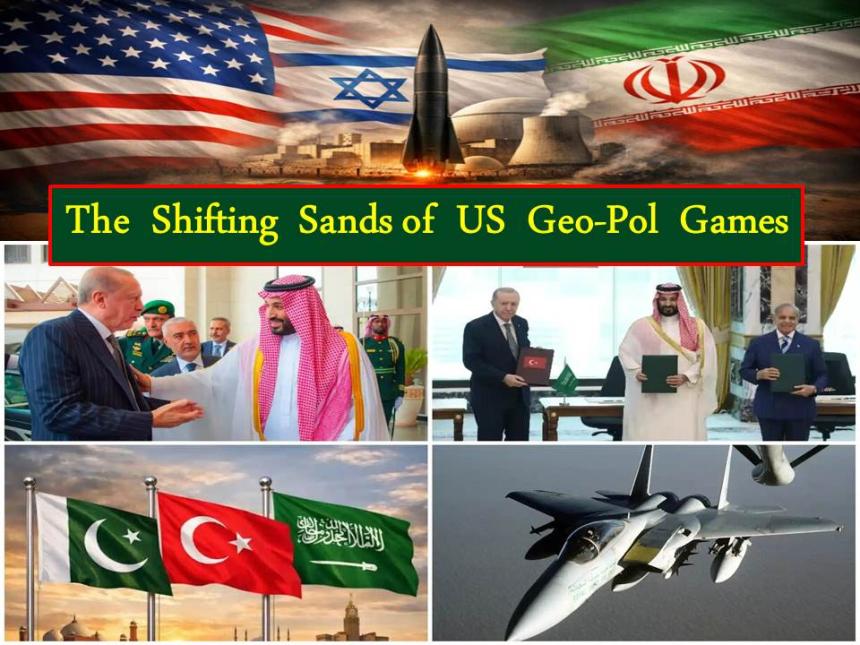

The Shifting Sands of US Geo-Pol Games
The metaphor of "losing sand through one's fingers" accurately describes the structural pressures that force the US to shift its foreign policy rationales. Historically, Gulf nations acted as passive consumers of security—buying American weapons and hosting U.S. troops. The Mecca Accord fundamentally flips this dynamic. This write up is an opinion arranged for educational purposes based upon info available freely on webnet.
أَعُوذُ بِاللّٰهِ مِنَ الشَّيْطَانِ الرَّجِيمِ
بِسۡمِ ٱللهِ ٱلرَّحۡمَـٰنِ ٱلرَّحِيمِ
In the name of ALLAH, the Most Gracious, the Most Merciful
The Shifting Sands of US Geo-Pol Games
In an opinion piece published more than two weeks earlier than the day USA and Israel combined throttled full scale war on Iran, Ms Rosemary Kelanic @RKelanic warned @POTUS Trump for provoking war with Iran. What any watcher of International Relations could see about Iran was missed by US Administration at Capital Hill? Really Strange! But Why?
Ms Rosemary Kelanic is the director of the Middle East Program at Defense Priorities (Poli Sci Ph.D)." The article titled "Provoking a war with Iran could be a deadly miscalculation for Trump" Published on February, 12, 2026. can be summarized as follows:-
"Once again, President Trump is steering the U.S. toward a perilous and unnecessary confrontation with Iran. In January, Trump threatened to topple the Iranian regime for violently crushing protests. Now, as U.S. forces amass in the Middle East, his rationale for pressuring Iran has shifted. Trump is demanding new concessions from the regime, including caps on Iran’s missile program and the total removal of enriched uranium from the country. He is also threatening consequences “far worse” than last June’s Operation Midnight Hammer. The president’s ultimate goals in the region remain unclear, as are the military measures he might adopt, which could include airstrikes, a naval blockade, or even regime change."
"A U.S. attack on Iran could yield a surprisingly protracted and dangerous conflict. Iran will fight back, hard — and its defeat is not a foregone conclusion."
"History is replete with examples of weak countries prevailing over stronger ones that believed their conventional predominance would guarantee triumph. Paraphrasing asymmetric war theorist Andrew Mack, weak states don’t need to win; they just need to not lose, to outlast their opponent until it inevitably tires of a non-essential fight where the costs dwarf the benefits."
"Iran has a good chance of pulling this off, because while the balance of power favors the U.S., the balance of resolve favors Iran. Iran cannot seriously threaten the U.S. homeland, but conflict with the U.S. threatens Iran’s very survival."
https://thehill.com/opinion/national-security/5734208-trump-iran-conflict-escalation/
Most importantly, the opinion piece didn't even mention "Hormuz"
The Strait of Hormuz has become a central point of global anxiety and geopolitical conflict because it is the world's most vital maritime oil and gas chokepoint, connecting the Persian Gulf to the open ocean, through which roughly a fifth of the global energy supply passes daily. Roughly 20 million barrels of oil—along with a major share of the world's liquefied natural gas and fertilizer components—flow through it every single day, supplying major economies across Asia, Europe, and the world.
Iran jammed the whole world's economy by using the geography as strategic leverage, and changed the paradigm of war in just few weeks with no or little maritime naval assets exerting immense financial and political pressure globally.
The U.S. administration largely miscalculated Iran’s deep institutional resilience and mistook severe economic distress for imminent regime capitulation, a blind spot frequently criticized by international relations observers who noted that external coercion historically hardens rather than collapses Tehran's security posture. But the problem of "Strategic Miscalculations" is not new with US Capitol Hill's occupants. Listen to this clip as shared on X.com from US House briefings.
US Israel Iran War NOT Ended Yet
The ongoing 2026 Iran war has fundamentally upended the assumption of American military invulnerability in the Middle East. The conflict—sparked by massive U.S.-Israeli strikes in February 2026 under "Operation Epic Fury"—has exposed structural flaws in how the United States bases its forces, transforming fixed installations from strategic assets into exposed liabilities.
In contemporary geopolitics, several Arab Gulf states maintain deep security and economic ties with Washington, relying on the U.S. military footprint to balance regional rivals like Iran. A major investigation by CNN revealed that a majority of U.S. military sites in the Middle East have sustained damage, leaving several installations virtually unusable. Iran successfully overwhelmed air defenses using sheer volume, specifically targeting high-value infrastructure. This included critical multi-million-dollar surveillance aircraft (such as the Boeing E-3 Sentry) and satellite communications "ray domes" vital for real-time tactical data transmission.
Critics from various ideological viewpoints argue that regional maneuvers—whether energy diplomacy, normalization accords, or proxy interventions—operate under the strategic constraints or "belly" of U.S. global primacy. The war has forced Gulf Arab monarchies to reassess whether hosting a heavy U.S. military footprint protects them or paints a target on their backs. Military analysts note that the era of permanent, highly visible U.S. "mega-bases" in the Persian Gulf is likely coming to an end.
Moving forward, the Pentagon is expected to abandon fixed posturing in favor of a nimble, access-driven model similar to the U.S. agreement with Oman—prioritizing temporary access to ports and airspace during crises rather than maintaining massive, exposed target profiles. The landmark Mecca Joint Defence Agreement signed on August 7, 2026 (Iran, Pakistan, Turkey) is the direct institutional byproduct of this U.S. realignment and the perceived erosion of the American security umbrella.
The Arab Imperialist Game Under the Belly of USA
The phrase "Arab imperialist game under the belly of the USA" combines historical critiques of early Arab-Islamic conquests with modern geopolitical theories regarding how Middle Eastern states and Western powers—principally the United States—interact. Rather than a unified "Arab imperialism," the dynamic usually reflects a complex web of transactional alliances, security dependencies, and regional power struggles beneath the overarching umbrella of American hegemony.
The Iran War has exposed Middle Eastern powers to an emerging reality and they have realized they could no longer outsource their existential security exclusively to Washington. Analysts from the Council on Foreign Relations explicitly note that the pact proves the era of absolute U.S.-led regional dominance is effectively over.The Mecca Accord (Mecca Joint Defence Agreement) aligns with and accelerates U.S. military realignment. Now read this opinion as shared on X.com.
Alex Krainer (@NakedHedgie) explains why Saudi Arabia, after watching the West freeze nearly $300 billion of Russian assets, is now paying a protection racket to Turkey and Pakistan. The Gulf states understand their own trillions in Western-held sovereign wealth are next. The new alliance is not about defending Israel—it is about acquiring new protectors before the imperial system loots everything. Host Zulfikar, who has direct access to the relevant deliberations, confirms the assessment as simply “protection money.”
Alex Krainer said "“Everybody saw how the Western powers didn’t hesitate a moment to freeze almost 300 billion dollars’ worth of Russian assets in the Western financial institutions. If they are brazen enough, if they are ruthless enough to do this to the number-one nuclear power in the world, then what is Saudi Arabia to them? It’s nothing. It’s a maggot they will squash whenever they choose to do so".
"Saudi Arabia not only has far more than Russia—last I looked they had something like 800 or 900 billion dollars in direct assets in the United States—but they also have these enormous sovereign wealth funds. The combined assets of the Saudi, UAE, Qatari, Bahraini and Kuwaiti sovereign wealth funds in the West are something close to five trillion dollars. One thing we can take as a near-100% certainty is that before the Western empire fails, it is going to loot all of that money and take it for its own ends."
"After Ukraine and after what they did to Russia, these rulers may be corrupt, they may be brutal, they may be ruthless and oppressive, but they are not stupid. They see the writing on the wall. They see what is coming their way."
"The way I interpret this new alliance between Pakistan, Turkey and Saudi Arabia is that Saudi Arabia is deciding to pay a protection racket to Turkey and Pakistan. Two of these three nations are major military powers; one of them is a pipsqueak. Why would Pakistan and Turkey sign an alliance with Saudi Arabia—an attack on one is an attack on all? If somebody attacks Turkey, is Saudi Arabia going to come to their aid? That’s a joke."
"I think the Saudis initiated this by saying: we are already screwed. We are going to get skinned alive. All our sovereign asset funds—we are probably never going to see them again. So what we can do is, since you are already at least on paper allied with the United States, you can become our protectors. We will pay you for it with these funds that are in the United States."
"If we say ‘send us a trillion dollars,’ Trump is going to say no—why don’t we send you a trillion dollars’ worth of Patriot missiles that we will deliver in 2046? But if Turkey or Pakistan say ‘send us a trillion dollars,’ the United States may have to send the money."
"Saudi Arabia gets new protectors, and these new protectors get some of the Saudi money.”
Host Zulfikar; "Alex, a lot of nonsense has been said about this, but you have cut to the chase. You have uttered the words that are the truest words describing what has just taken place. I say this sitting in a position where I have actually listened to the deliberations between people who put their names on the piece of paper. I am that close to the scene. Exactly what you have said is the truth. It is very simple. Saudi Arabia is buying protection. It is protection money. Easy, very simple to understand. And Saudi Arabia watched with great dismay the destruction of the United States by Iran—under 50 years of sanctions.”
The Gulf states have read the writing on the wall. Paying a protection racket to real military powers is their attempt to escape the coming looting of the imperial system.
The Conclusion
The metaphor of "losing sand through one's fingers" accurately describes the structural pressures that force the US to shift its foreign policy rationales. Historically, when initial military or political strategies begin to fail, the US pivots to new justifications to manage domestic blowback, preserve international credibility, and adapt to changing ground realities.
The shifting of official rationales—often referred to by critics as "moving the goalposts"—is a well-documented pattern in foreign policy. Historically, the US has initiated military interventions using immediate, high-stakes pretexts (such as security threats or weapons of mass destruction), only to pivot to long-term justifications like democracy-building, counter-terrorism, or regional stability when the initial pretexts proved inaccurate or unachievable.Critics view this as a strategy to maintain geopolitical influence, while proponents argue that shifting strategies reflect necessary adaptation to changing realities on the ground.
Historically, Gulf nations acted as passive consumers of security—buying American weapons and hosting U.S. troops. The Mecca Accord fundamentally flips this dynamic. By integrating Saudi financial capital, Turkish defense-industrial technology, and Pakistani military depth, the three nations are attempting to build an autonomous regional security architecture that may operate independently of Western military intervention. The accord is not an explicit anti-U.S. alliance, but rather an institutionalized "hedge". Saudi Arabia and its partners are not completely tearing up their ties with Washington; instead, they are diversifying their security portfolios. This allows Riyadh to maintain diplomatic leverage with the U.S. while ensuring it has a regional backup plan.

Best Yoga Retreat in Rishikesh: The One You Can Still Keep at Home
The best yoga retreat in Rishikesh is the one whose clock and sequence survive Monday — ad...


The Changing Digital Landscape: Technology, Innovation, and Online Exp...