The Must Have Features of A Successful Grocery Delivery Mobile App
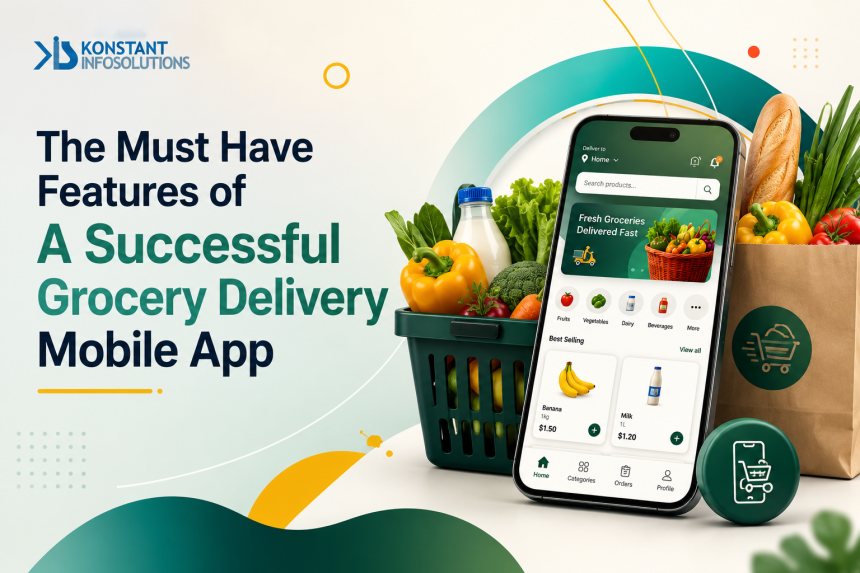
With on demand shopping and doorstep deliveries, grocery delivery applications bring convenience and efficiency into customer’s lives. Furthermore, grocery delivery app development also benefits grocery businesses by allowing them to automate operational workflows and enhance customer engagement. In the United States the demand for on-demand grocery delivery is increasing rapidly as the market is expected to reach 173.3 million users by the end of 2028.
Grocery storekeepers and owners are now shifting from brick and mortar shops to digital grocery stores. As a result, grocery delivery app development is gaining traction. Whether you want to reach more customers, manage inventory, or achieve cost efficiency, on demand grocery delivery mobile apps could be rewarding to win in today’s competitive marketplace.
What is the Grocery Delivery App?
A grocery delivery mobile app is an online platform that allows customers to browse, choose, and order groceries online from nearby grocery stores or warehouses. Instead of visiting stores physically, users can open the app, pick the product they want to purchase, add to cart, and have products delivered at their doorstep.
These apps usually include the features such as real-time order tracking, personalized recommendations, customer support, and in-app payments. Grocery delivery mobile applications not only benefit users with ease of shopping, but also support grocery businesses to go beyond geographical limitations and reach a wider audience base. Whether you are just starting your grocery delivery business or you have a well established business, do not miss out the core features as they can help you succeed in the market and launch a successful product.
How Does a Grocery Delivery App Work?
For working professionals, busy persons, or elders, grocery delivery mobile apps are a savior. These apps allow them to order groceries online and get it delivered to their preferred location at any time and from anywhere. Just with a few taps on the app, customers can search for products, add them to cart, make payments, and get them delivered within a few minutes, same day, or schedule it for later.
Here is how on demand grocery delivery mobile app works:
● Customers start searching for grocery products in the app.
● The customer chooses their preferred grocery store and then adds products to the cart for delivery.
● Customers then confirm the order either by making payment online or choosing to pay after the order is delivered.
● The customer is updated regularly about the order status.
● Once the order is successfully packed, the delivery agents are notified through the app.
● Now, the designated delivery person picks the order, and delivers it to the user's location.
Key Features of a Successful Grocery Delivery App
Before investing in grocery delivery app mobile development services, you must create a detailed list of all the features and functionalities that you must integrate in the app. This will not only ensure that your app will succeed in the market, but will also ensure you do not run out of budget while developing the app. To help you out, we have created a list of core features that you must include in the user, admin, and delivery agent panel of the app.
#For Users
The most crucial module of the grocery delivery app is the user panel. Make sure to build an interactive and intuitive user panel so users can seamlessly shop for groceries. And below are the features that you shouldn’t miss while developing the user module of the app:
Advanced Search
Within the app, users can search for preferred products and add various filters to quickly find and order groceries.
Real-Time Order Tracking
From order placement to delivery, users can see real-time status of the order directly in the app to ensure timely delivery of orders.
Push Notifications
For upcoming sales, new offers and discounts, order status updates, or other important alerts, the app sends real-time notification to users to ensure they stay engaged with the app.
User-Friendly Interface
With minimalist layout, grocery delivery mobile apps ensure users can enjoy simple and fast shopping experiences. This will enhance overall user satisfaction and engagement.
Multiple Payment Options
Within the app, users can choose from various payment options including online payments such as credit/debit cards, UPI, net banking, and offline payment methods such as pay on delivery.
Personalized Recommendations
Driven by artificial intelligence capabilities, the app customizes product suggestions and recommendations based on user preferences and shopping habits.
#For Admins
The admin module of the grocery delivery app is crucial for managing overall operations including timely deliveries, payments, inventory, and so on. To ensure admins can seamlessly monitor the operations, include these features:
Order Management Dashboard
From order placement to delivery, with a centralized order management dashboard, admins can focus on reducing delivery times for enhancing overall operational efficiency.
Customer Relationship Management
With marketing automation, the system enables admins to easily connect overall CRM tools for customer communication management and product preferences together along with strategy optimization to enhance loyalty.
Inventory Management System
A well-organized system for inventory control and the accessibility of inventory make operations simple and help avoid situations of shortages or overselling.
With a well-organized stock control and inventory, admins can simplify operations, avoid overselling as well as prevent stockouts.
Analytics and Reporting
With the emergence of AI development and integration in grocery delivery mobile apps, analytics have transformed into powerful tools. From marketing performance to sales, with advanced analytics dashboards, admins can facilitate precise decision-making and predict customer behavior.
#For Delivery Personnel
The delivery agent module of grocery delivery must be simple to use and quick. As drivers will use the app on-the-go, make sure to develop a mobile-friendly one. Below are some of the features you can integrate to ensure users can deliver orders on time.
Route Optimization
Online grocery delivery mobile apps are focused on optimizing delivery routes for drivers to make sure they can deliver orders on time while consuming less fuel.
Earnings Tracking
From the app, drivers can get detailed information and data about completed past orders, overall earnings, withdrawn amount, and commissions they have received.
Proof of Delivery
Boxes or other attributes to store photographs or signatures after and before delivery helps in avoiding order deliveries without the proper paperwork.
Steps to Develop a Successful Grocery Delivery App
Now as you have a clear idea about what features you must integrate in the grocery delivery mobile app, let's have a look at the development process. Following the below steps for grocery delivery app development, you can develop an app that will drive long-term growth and consistent profits.
Market Research
Start by doing careful market research and competitor analysis to determine major user pain points, needs and market trends. This will help you in developing an app that is unique and will succeed in the market.
Define Business Model
Pick from marketplace model, single-store or aggregator model for your grocery delivery app, integrate monetization strategies including in-app advertisement, subscriptions, or commissions. Also make sure to set clear key performance indicators (KPIs) and goals to monitor performance timely.
Plan Key Features
Carefully research top competitors of the grocery delivery industry to get a clear understanding of the features they have integrated within the app. By adding advanced features such as real-time tracking, push notification, simple browsing, secure payment gateways, user reviews, and automated order management, you can offer immersive shopping experiences to users.
Choose Technology Stack
Based on the key features of your app, make sure you pick the latest and top-notch development technologies to build the front-end as well as the back-end of your app. Moreover, choose robust third-party integrations such as secure payments gateways and in-app navigations to make your app scalable, flexible, and stable.
UI/UX Design
As you finalized the development tech stack, start building the intuitive front-end of your grocery delivery mobile app. By building clickable wireframes and mock-ups backed by core features and functionalities, you can visualize how the final app will look and perform. Make sure to leverage modern designing frameworks such as Figma or Adobe XD to integrate smooth user flows and navigations within the app.
Develop the App
Following the wireframes and mock-ups, start writing the backend code to build a solid server-side logic of the app. Moreover, with an agile development approach, you can easily break down the whole development process into small achievable milestones for faster development and quicker time-to-market.
Testing and QA
After the development phase is successfully completed, do not deploy the app directly. As the QA and testers perform rigorous automated and manual tests including usability testing, performance testing, and user acceptance testing to find and resolve all the bugs and issues that could hinder the performance.
Deploy the App
Once you have deeply tested the app and all the issues have been resolved, you can start with the deployment. Whether you are thinking about deploying the app locally in your business architecture or you want to deploy the app on a cloud server, make sure the app aligns with market standards to ensure a smooth deployment process.
Support and Maintenance
The work doesn’t end once the app is launched. Make sure you regularly monitor the app, roll out timely updates, optimize its performance, add new features, and resolve possible issues and bugs that could come-up over time. This will ensure your app stays relevant and offers smooth performance at all times.
Cost of Developing an On-Demand Grocery Delivery App
We have covered the most crucial aspect of grocery delivery app development, i.e., the features of the app. But another major question that most businesses struggle with is “how much does it cost to develop a grocery delivery app?”
Well, there is no fixed answer to this. The actual cost of developing a grocery delivery mobile app depends on several factors such as tech stack, location of mobile app development company, team size, project size and complexity, features, and more. A grocery delivery mobile includes various advanced features. Moreover, you have to build three different modules for the app including user app, store app, and driver app, with a unique feature set for each one. Also, make sure you do not forget to include third-party integrations in the app such as payments gateways or Google Maps to ensure the app offers seamless functionality.
If you don’t want to spend hundreds of dollars for developing an app that may not reach enough customers, it is recommended to do proper and in-depth market research. This will help you to gain a better understanding user’s pain points as well as functionality of top grocery delivery apps of the market.
The average cost of developing a grocery delivery app starts at $50,000 for a basic mobile app and could go up to $250,000+ for a more complex or enterprise level app. By partnering with a reliable grocery delivery app development company, you can begin with thorough market and competitor research, create a detailed documentation plan, and build a prototype of the app to get average cost as well as development timeframe estimate.
Once you have a detailed development roadmap in hand, you can start with the MVP development process. Developing an MVP for grocery delivery app could start at $10,000 and requires more than 3 months to complete. With an MVP you can quickly enter the market and start generating revenue. As the time passes, you can add new features and fine-tune the app with the support form tech team.
The Key Takeaway
The demand for on demand grocery delivery is a promising factor that will disrupt the market in coming years, and big brands such as Instacart are already ruling this industry.
By developing a grocery delivery app like Instacart with top-notch features that we discussed in this blog will definitely help you win the market with custom on demand app development services for grocery deliveries. As these apps offer a wide range of features as well as products to shop, businesses can gain a competitive edge in today’s tech market.
With continuous transformation of the grocery delivery industry, you must also focus on scaling your app features as per latest market trends and user needs. Carefully study top leaders of this industry and don’t miss the chance to add new features regularly.
How to Connect ChatGPT to Your Business Systems: A Step-by-Step Guide
Learn how to connect ChatGPT to business apps, databases, and workflows using connected ap...


Shop 10K 14K Diamond Gold Ring for Women in Texas USA–10 Karat Gold
10 Karat Gold offers a beautiful collection of stylish and elegant diamond gold rings for...

Professional Window Film Installation in Huntsville, AL: Benefits, Typ...