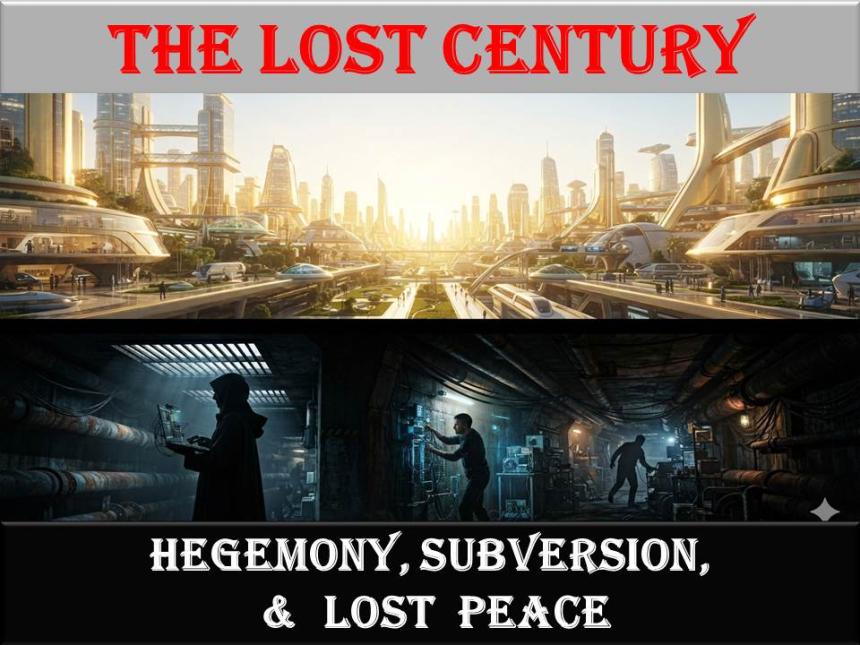

The Lost Century: Hegemony, Subversion, & Lost Peace
The last century—roughly from the WW-1 to US-Israel-Iran War into the 21st century—ultimately resulted in missed opportunities. Instead of establishing permanent global stability, it may be argued that it was a period of depleted resources, generated massive debt, and caused widespread destabilization in the Global South. This write up "lost century: Hegemony, Subversion, & Lost Peace" is about "lost peace" or the squandering of geopolitical stability by western powers lead by USA.
أَعُوذُ بِاللّٰهِ مِنَ الشَّيْطَانِ الرَّجِيمِ
بِسۡمِ ٱللهِ ٱلرَّحۡمَـٰنِ ٱلرَّحِيمِ
In the name of ALLAH, the Most Gracious, the Most Merciful
The Lost Century: Hegemony, Subversion, and the Cost of Pax Americana
The twentieth and early twenty-first centuries will be remembered as the era of Pax Americana—a global order marketed as a triumph of liberal democracy, free-market capitalism, and international stability. Yet, beneath the polished rhetoric of global governance lies a starkly different reality for the global majority. While its predecessor, Pax Britannica, relied on state-backed corporate monopolies like the East India Company to anchor its empire through overt territorial extraction, the American imperium engineered a far more insidious, corrosive, and defective methodology. By weaponizing financial systems, conducting covert intelligence subversions, institutionalizing military dictatorships, and funding perpetual regional conflicts, Pax Americana did not deliver global peace. Instead, it hijacked the modern era, turning it into a "lost century" for humanity—a period where the wealth and ingenuity of the world were squandered on enforcing unipolar hegemony at the direct expense of the common citizen.
From Renaissance Light to Caged Humanity: The Betrayal of the Universal Ideal
To truly understand the tragedy of this lost century, one must trace the long, agonizing arc of human expectation. When Western civilization emerged from the stagnation of the Dark Ages—a period marked by fragmented feudalism, systemic fear, and a halt in cultural and scientific advancement—it did so through the luminous awakening of the Renaissance. The Renaissance revived a profound belief in human potential, igniting an unprecedented expansion in philosophy, science, and literature.
As this intellectual awakening matured, it gave birth to the foundational spirit of Romanticism. Across literature and philosophy, a common message resonated: a yearning for the collective good, the breaking of artificial chains, and the realization of a borderless empathy shared by all humans. It was an age when humanity confidently expected to rise collectively, using its evolving brilliance to benefit mankind as a whole.
Then came Industrialization—the great material pivot of history. For the first time, humanity unlocked the ease of mass production, generating the mechanical capability to eliminate scarcity, build universal networks, and foster a world where the mixing of human races, cultures, and ideas could flow freely across the globe.
However, this universal goodness was progressively hijacked. Under Pax Britannica, the awe-inspiring marvels of the Industrial Revolution were swiftly redirected away from the global collective good and toward the localized glory of the British Crown. To be sure, this imperial framework provided certain functional utilities to its colonies; it constructed better modes of transportation, established sprawling railway networks, and brought a mechanical ease of life to far-flung ports—yet these infrastructures were fundamentally designed to streamline extraction and assert naval superiority.
The deeper fracture of humanity occurred as the world order formalized around rigid borders and nation-states. Rather than facilitating a borderless, beautifully integrated global family where humans could move and mix freely, the international system systematically caged humanity behind militarized lines and bureaucratic walls. When the baton of global management was passed from London to Washington, the world did not see a return to the universal ideals of the Romantic era. Instead, Pax Americana arrived—not with the transparent violence of old-world empires, but with a deceitful, hyper-financialized, and deeply corrosive methodology that turned the dream of global human prosperity into a fragmented landscape of control.
The Cataclysms of Mid-Century and the Fractured Promise of the UN
The structural cages of the nation-state ultimately collapsed under their own weight during the catastrophic intervals of World War I and World War II. These total wars bore witness to a colossal, unprecedented loss of human life and a perversion of human ingenuity. The very factory floors designed during the Industrial Revolution to bring ease of production to mankind were instead re-engineered into assembly lines of mechanized slaughter.
Out of the ash and rubble of 1945, a traumatized global consciousness sought to salvage the universal ideals of the Renaissance through the concept of multinationalism. The creation of the United Nations was heralded as humanity’s institutional shield against future slaughter. It promised a platform where sovereign states could resolve conflicts collectively, prioritizing the global good over tribal conquest.
However, this global promise was fundamentally fractured at birth. To ensure the participation of the major victorious powers, a profound structural flaw was baked directly into the UN Charter: the Security Council Veto Power granted to the Permanent Five (P5) nations. This structural compromise instantly transformed the UN Security Council from an engine of collective security into a deadlocked colosseum for imperial rivalry.
Rather than fostering global integration, the veto power calcified the international system into the paralyzing grip of the Cold War. For nearly five decades, the United States and the Soviet Union utilized their respective vetoes to shield their regional client states, block humanitarian interventions, and paralyze collective global action. The Global South was transformed into a collection of proxy battlefields, completely tearing apart the fragile multinational framework before it could ever take root.
When the Soviet Union finally collapsed, the world entered what historians termed the Unipolar Moment—a brief, absolute decade of American hegemony. Unchecked by any global counterweight, Washington did not use this window of total dominance to undo the cages of borders or invest in universal human flourishing. Instead, it basked in neoliberal arrogance, enforcing its economic will through global financial institutions while expanding its military footprint.
This unipolar overreach culminated in the paradigm-shifting events of September 11, 2001. In the wake of 9/11, all hell broke loose. Rather than responding with institutional restraint, Pax Americana suffered a devastating, auto-immune reaction to terrorism. Washington launched global, unilateral military campaigns, fundamentally corroding its own professed democratic norms from within through emergency surveillance statecraft, indefinite detentions, and extrajudicial renditions. The unipolar decade was violently squandered, dragging humanity into an era of perpetual, multi-trillion-dollar "forever wars" that left a trail of fractured states, regional chaos, and institutional distrust across the globe.
The Destruction of Human Capital in East Asia
Nowhere is the corrosive nature of Pax Americana more evident than in its systematic distortions of East and Southeast Asia. The region is often heralded as a triumph of capitalist modernization, but a closer examination reveals how Washington altered, instrumentalized, and degraded Asian human capital to serve its Cold War and post-Cold War chessboards.
1. Indonesia: The Eradication of the Intellectual Left — Pax Americana’s intervention was cataclysmic. In 1965, the CIA actively supported the rise of General Suharto, providing death lists to the military junta during an anti-communist purge that slaughtered between 500,000 and one million teachers, artists, unionists, and intellectuals. By physically liquidating the nation's organic left-wing and progressives, Washington fundamentally lobotomized Indonesia’s human capital. Under Suharto’s subsequent decades-long dictatorship, the education system was hollowed out to produce a compliant workforce for American extractive industries, starving Indonesia of the independent intellectual architecture required to chart a sovereign economic future.
2. The Philippines: The Feudal Client State — The United States spent decades propping up the kleptocratic dictatorship of Ferdinand Marcos Sr. to secure vital strategic military assets like Clark Air Base and Subic Bay. To keep the country firmly within the American orbit, Washington supported an archaic, feudal land-tenure system that suppressed domestic industrialization and agrarian reform. The long-term toll on human capital has been devastating: the Philippines was engineered to become a permanent exporter of low-wage domestic and service labor. Generation after generation of top-tier Filipino doctors, nurses, and engineers are forced to seek survival abroad, generating a state-sanctioned brain drain that systematically strips the nation of its best minds to subsidize Western health and corporate sectors.
3. South Korea: The Hyper-Stress Colony — Pax Americana first locked the nation under a succession of brutal, U.S.-backed military dictators (from Syngman Rhee to Park Chung-hee and Chun Doo-hwan), violently crushing democratic uprisings like the 1980 Gwangju Massacre. When democracy finally broke through, it was immediately subjected to the harsh discipline of the 1997 IMF restructuring package. Today, the Korean populace is trapped in a hyper-financialized system designed to export tech at all costs. The result is a society optimized for corporate productivity but hostile to human life: a brutal education and labor landscape that has fueled epidemic levels of isolation, a staggering suicide rate, and the lowest fertility rate on earth. By prioritizing its status as an unsleeping frontline outpost for the U.S. military, South Korea's human capital is literally failing to reproduce itself.
4. Japan: The Eviscerated Sovereign — Following WWII, Washington rewrote Japan’s constitution, creating a permanent security dependency. When Japan’s economic brilliance threatened American industrial hegemony in the 1980s, Washington systematically crushed its economic autonomy through the 1985 Plaza Accord, forcing an artificial currency appreciation that triggered Japan’s "Lost Decades" of stagnation. Furthermore, to anchor its geopolitical containment of China and Russia, Pax Americana turned Okinawa and mainland Japan into a perpetual, un-sovereign aircraft carrier. Decades of subservience have eviscerated the creative risk-taking of Japan's once-pioneering industrial class, locking a shrinking, aging demographic into a rigid corporate bureaucracy optimized exclusively to maintain Washington's regional defense architecture.
The Vassalization of Europe: The 51st State
The structural decay of Pax Americana is acutely visible in its treatment of its closest partners. Rather than cultivating a coalition of independent, sovereign allies, Washington meticulously engineered a captive continent. As critics and insiders like former Chief of Staff Colonel Lawrence Wilkerson have noted, the U.S. apparatus systematically penetrated Europe's foundational pillars—buying the compliance of newspaper editors, labor union leaders, parliamentarians, and key defense officials, including successive NATO Secretaries-General like Jens Stoltenberg and Mark Rutte.
Through the weaponization of soft-power entities like USAID, the United States hollowed out European political autonomy, replacing genuine statecraft with Washington-aligned technocracy. By conditioning European leadership to prioritize American geopolitical objectives over their own domestic economic security, Pax Americana effectively reduced Europe to the status of a 51st State. Today, as the United States hits a severe fiscal wall—where its national debt servicing now surpasses its entire defense budget—it forces these dependency-plagued nations to shoulder the financial tab of an empire it can no longer afford, creating a self-reinforcing engine of Western decline.
The Global South: A Chessboard of Broken Sovereignty
If Europe was reduced to a compliant satellite, the Global South was treated as a disposable chessboard. Across the Middle East and Asia, Pax Americana consistently dismantled organic democratic movements, institutionalized authoritarianism, and stoked extremism to safeguard its resource monopolies and client states.
1. The Derailment of Persian Democracy — The modern tragedy of Iran stands as the genesis of modern U.S. democratic subversion. In 1953, via Operation Ajax, the CIA and MI6 orchestrated the overthrow of Iran's democratically elected Prime Minister, Mohammad Mossadegh, simply because he chose to nationalize Iranian oil for the benefit of his people. By replacing democracy with the brutal, absolute autocracy of the Shah, the West systematically crushed the secular and liberal center of Iranian politics. This catastrophic intervention ensured that when the inevitable 1979 revolution occurred, it was deeply radicalized and led by the clergy. Decades of subsequent economic sanctions, political isolation, and regional proxy wars have permanently scarred the nation, demonstrating how a singular act of mid-century imperial hubris can derail an entire civilization for generations.
2. The Chaining of Pakistan's Institutions — In Pakistan, Pax Americana achieved its objectives by actively shackling the democratic process. Throughout the Cold War, the Soviet-Afghan War, and the post-9/11 "War on Terror," Washington repeatedly bypassed civilian institutions to cut transactional deals directly with military juntas. By funneling billions of dollars in military aid to dictators like Ayub Khan, Zia-ul-Haq, and Pervez Musharraf, the American security apparatus artificially inflated the power of the military elite over the constitutional state. The legacy of this policy is a permanently fractured democracy, where the authentic political will of the common citizen remains chained by a domestic security architecture that was funded, legitimized, and sustained by the global hegemon.
3. The Containment of China and the Rise of Extremism in India: The Megalothymia Curse — In South Asia, the contemporary obsession with containing the rise of China has forced Pax Americana to execute its most philosophically damaging intervention yet. To weaponize India as a vital regional counterweight to Beijing, Washington did not merely seek a standard military alliance. Instead, it actively exploited and cultivated Megalothymia—the classic, obsessive desire to be recognized as superior to others, a psychological force that serves as the ultimate curse of modern populists. By feeding this psychological condition within the political apparatus of Prime Minister Narendra Modi, the Western imperial architecture validated an aggressive, exclusionary vision of superiority. To maintain a front against China, Washington chose to look away while a historic cradle of profound human philosophy, secularism, and pluralistic values was systematically transformed. Under this transactional arrangement, the world's most populous democracy has been increasingly steered toward a rigid, hyper-nationalistic extremist landscape. By providing international legitimacy, economic concessions, and high-tech defense partnerships to an administration driven by majoritarian dominance, Pax Americana did not protect liberty. Instead, it financed the erosion of India's foundational secular fabric. For the sake of a short-term geopolitical buffer, the global hegemon subverted the long-term stability of the subcontinent, proving once again that it will gladly sacrifice the social cohesion of an entire civilization to anchor its own fraying supremacy.
The Garrison Mindset and Physical Fatigue
To protect its interests and shield its core Middle Eastern proxy, Israel, the United States transformed the Muslim world into a dense network of military bases. This aggressive hyper-militarization disenfranchised the local populations, bred deep regional resentment, and ultimately overextended the American war machine itself.
The physical limitations of this empire were starkly illustrated during the grueling deployment of the nuclear-powered supercarrier USS Abraham Lincoln (CVN-72). Pushed to its absolute operational limits in the Middle East under Operation Epic Fury, the massive warship spent a historic 286 consecutive days at sea without a single port visit. When the visibly battered, rust-laden carrier finally transited past Singapore to return home, it served as a powerful visual metaphor for Pax Americana: an exhausted, structurally fatigued machine running on empty, unable to maintain its global logistics lines without extreme strain.
The Fatal Denouement: The Fall of the Unipolar Fortress
The structural fatigue of the American war machine is no longer merely logistical—it has become existential. The trajectory of global geopolitics is no longer defined by a gentle, managed U.S. "retreat" or the calculated hemispheric consolidation of a "Byzantium Strategy." Instead, the world is witnessing a chaotic, self-inflicted collapse. Donald Trump, whose escalation of hostilities and aggressive policies toward Iran stand as one of the greatest strategic blunders in United States history, is not responsible for triggering the foundational decline of the American empire—but he is directly responsible for its fatal, unravelling denouement.
This is the end. In the oil-rich Persian Gulf, the vulnerability of American power has been laid bare; heavily targeted U.S. military bases have been severely damaged or destroyed, and the geometric realities of modern warfare ensure they likely will not be rebuilt. Traditional allies, recognizing the erratic volatility of Washington’s leadership, are abandoning the empire—even within the corridors of Europe.
The decadence and immorality of modern American society, mirrored in the vulgarity and cruelty of its political theater, have become the defining features of its twilight era. The Global South, horrified at the empire’s flagrant disregard for international humanitarian law—most visible in its direct enabling of the ongoing catastrophe and genocide in Gaza—now sees the United States explicitly as the enemy.
The structural horrors of Abu Ghraib Prison may have receded from domestic Western consciousness, but for the rest of the world, those images of U.S. soldiers and contractors sadistically humiliating and torturing imprisoned Iraqis permanently replaced the idealized, "Disneyfied" version of America once exported across the globe. By locking the world into a conflict over the Persian Gulf that continually disrupts the global oil supply, Pax Americana is rapidly pushing the global economy over a cliff.
Conclusion: The Realization of Bin Laden’s Dream
The true tragedy of the "lost century" is the profound opportunity cost inflicted upon mankind. The last hundred years yielded unparalleled technological breakthroughs, massive accumulations of wealth, and unprecedented human connectivity. Yet, rather than utilizing these advancements to fulfill the Romantic dream of a borderless world working toward the collective good, Pax Americana diverted the world's collective wealth into weapons manufacturing, covert operations, and the maintenance of a decaying global fortress.
This reality underpins the profound observations of senior statesmen like George Yeo, former Foreign Minister of Singapore, who notes that current global geopolitics is fundamentally driven by a forced U.S. "retreat" and "decline," dictated by the math of an empire that can no longer fund itself. As Washington pressures its allies to carry their own weight, it triggers a self-reinforcing downward spiral where outsourced security inevitably translates into a loss of strategic obedience.
We are going down. And the sheer weight of this collapsing monolith will inevitably bring many down with it. Osama Bin Laden may rest in a watery grave in the North Arabian Sea, and Al-Qaeda may be reduced to a shadow of its former self, but Bin Laden’s most fervent strategic dreams have been fully realized over the last twenty-five years. Through the gross miscalculations of the empire—its squandering of trillions of dollars on endless military debacles and the ascendancy of its own version of a grotesque, unhinged leadership—the unipolar world order successfully engineered its own destruction. For the common man on the streets of the Global South, the era of American hegemony draws to a close not as a triumph of liberty, but as a cautionary tale of imperial hubris, leaving behind a fragmented, deeply scarred world.
Customized Festival Tour Packages: Create a Memorable Travel Experienc...