
TDD vs BDD: Understanding the Key Differences, Benefits, and When to Use Each
Compare TDD vs BDD in software development. Learn key differences, benefits, use cases, and how both approaches improve code quality, collaboration, and testing efficiency.
Modern software development is no longer just about writing code—it’s about building reliable, maintainable, and high-quality systems. This is where development methodologies like Test-Driven Development (TDD) and Behavior-Driven Development (BDD) come into play.
If you’ve ever been confused about tdd vs bdd, you’re not alone. Both approaches aim to improve software quality, but they differ significantly in philosophy, implementation, and collaboration style. This guide breaks it all down in a clear, practical way.
Test-Driven Development (TDD) is a development approach where tests are written before the actual code.
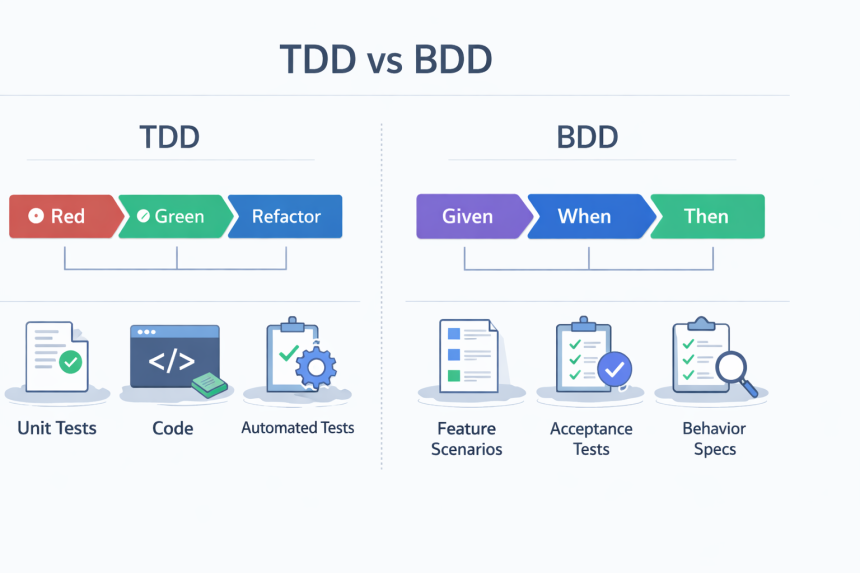
It follows a simple and iterative cycle often called Red → Green → Refactor:
- Red: Write a failing test
- Green: Write just enough code to pass the test
- Refactor: Improve the code without breaking the test
- Focuses on unit testing
- Written primarily by developers
- Ensures code correctness at a granular level
- Encourages simple and modular design
Before writing a function to add two numbers, you first write a test:
Then you implement the add function to pass the test.
Behavior-Driven Development (BDD) extends TDD by focusing on application behavior from the user’s perspective.
Instead of writing technical test cases, BDD uses natural language that both developers and non-technical stakeholders can understand.
BDD scenarios are typically written in the Given–When–Then format:
- Given: Initial context
- When: Action performed
- Then: Expected outcome
- Focuses on user behavior and business requirements
- Encourages collaboration between developers, testers, and business teams
- Uses tools like Cucumber or SpecFlow
- Improves communication and shared understanding
Understanding tdd vs bdd becomes easier when you compare them side by side:
AspectTDDBDDFocusCode correctnessUser behaviorLanguageTechnical (code-level)Natural languageAudienceDevelopersDevelopers, testers, stakeholdersTest LevelUnit testsFunctional/acceptance testsGoalBuild robust codeEnsure correct behaviorCollaborationLimitedHighWhen to Use TDD
TDD is ideal when:
- You are working on complex logic or algorithms
- You want high test coverage at the unit level
- Code quality and maintainability are top priorities
- You’re building components or libraries
- Early bug detection
- Cleaner and modular code
- Faster debugging
- Strong regression safety
BDD works best when:
- You need clear alignment with business requirements
- Multiple stakeholders are involved
- You want to define acceptance criteria upfront
- The system has significant user interaction
- Better communication across teams
- Reduced misunderstandings
- Documentation through test scenarios
- Focus on real user outcomes
Yes - and in fact, they often should.
Think of TDD and BDD as complementary rather than competing approaches:
- BDD defines what the system should do (behavior)
- TDD ensures how the system works internally (implementation)
- Write BDD scenarios to define expected behavior
- Break scenarios into smaller units
- Use TDD to implement each unit
This combination ensures both correct functionality and correct behavior.
Not true. BDD builds on top of TDD—it doesn’t replace it.
2. “TDD is only for testing”TDD is actually a design approach, not just a testing strategy.
3. “BDD is only for non-technical users”While BDD is readable by non-technical stakeholders, it still requires strong technical implementation.
While both approaches are powerful, they come with challenges:
- Initial learning curve
- Writing tests first can feel unnatural
- Requires discipline
- Overly verbose scenarios
- Maintenance of feature files
- Risk of unclear or poorly written scenarios
The key is to use each approach where it adds the most value.
- Start small—don’t try to implement everything at once
- Use TDD for backend logic and APIs
- Use BDD for user flows and business-critical features
- Keep tests readable and maintainable
- Avoid over-testing trivial code
Modern tools and platforms can further streamline this process. For example, solutions like Keploy help developers capture real API interactions and convert them into meaningful test cases, making it easier to align testing with real-world usage patterns.
The discussion around tdd vs bdd isn’t about choosing one over the other—it’s about understanding their strengths and applying them wisely.
- TDD helps you build the system right
- BDD helps you build the right system
When used together, they create a powerful development workflow that improves code quality, enhances collaboration, and ensures your software delivers real value to users.
If your goal is to ship reliable, user-focused software, mastering both TDD and BDD is essential.

Event Transportation Solutions in 2026: How AI-Powered Scheduling Is R...

Understanding the New Era of Digital Innovation and Online Experiences
Understanding the New Era of Digital Innovation and Online Experiences


FIFA World Cup Tickets: Spain Brilliant Victory Sends Them into the FI...



The Pure Adrenaline of Match Day and Live Sporting Events
The Pure Adrenaline of Match Day and Live Sporting Events
