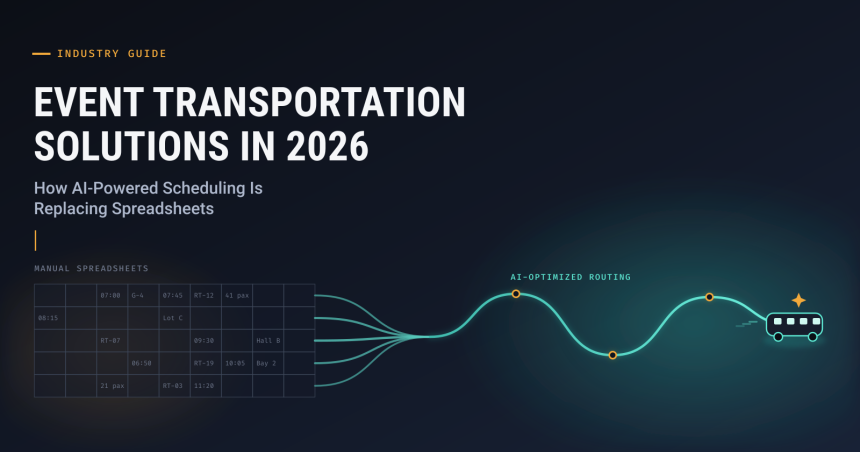

Event Transportation Solutions in 2026: How AI-Powered Scheduling Is Replacing Spreadsheets
Discover how modern event transportation solutions use AI-driven scheduling to replace spreadsheets, cut delays, and simplify logistics for every event type in 2026.
For years, transportation for a wedding, a conference, or a sports event has been planned the same way. A spreadsheet is shared, a dozen calls are made, and a group chat is refreshed by the planner just to figure out where a shuttle actually is. This method was tolerated when events were small and predictable. It is broken quickly, however, the moment multiple venues are involved, hundreds of guests are added, or a schedule is moved by an hour right before doors open. This exact gap is being closed by modern event transportation solutions, and in 2026, a clear move is being seen across event logistics: manual coordination is being replaced by AI-powered scheduling.
The urgency behind this move is reflected in how fast the event industry itself is growing. According to a2026 events industry market report, global events spending is projected to cross well over a trillion dollars in 2026, and corporate events already account for the largest share of that global market. As budgets and guest volumes are increased, the transportation layer, often treated as an afterthought, is turned into one of the biggest points of failure for the entire event.
A spreadsheet is a static document. An event is not. The moment a flight is delayed, a venue's load-in time is changed, or a different pickup window is needed by fifty VIP guests, a spreadsheet cannot react on its own. The change has to be noticed by someone, every row has to be manually updated, and every affected driver and coordinator has to be called, texted, or emailed. That lag is where most transportation failures actually happen. The plan is rarely wrong; it simply cannot be updated in real time.
This exact problem is solved by dedicated event transport solutions. Instead of a document that must be manually maintained, transportation is treated as a live system by a connected platform: guest lists, driver assignments, routes, and timing are all updated together, automatically, the moment something changes. For planners managing weddings, festivals, corporate gatherings, or multi-venue conferences, this difference determines whether a schedule slip is handled as a minor adjustment or allowed to become a full-blown crisis.
At their core, three things that spreadsheets were never designed to handle are combined by today's event transportation solutions: automation, real-time visibility, and predictive intelligence.
- Automated Scheduling and Dispatch
Rather than drivers being manually matched to pickup slots by a coordinator, routes and vehicles are assigned automatically by transportation scheduling software, based on guest counts, venue distance, and vehicle capacity, and reassignments are made instantly whenever plans are changed.
- Real-Time Tracking for Guests and Organizers
Live ETAs are given to guests instead of a shuttle's arrival being guessed at, and a single dashboard showing every vehicle's location is provided to organizers instead of a dozen separate phone calls having to be made.
- Dynamic Re-Routing
When a pickup window is threatened by traffic, weather, or a last-minute schedule change, the route is recalculated by the system rather than the problem being caught by a human. This is backed up by industry data: on-time performance in the 95 to 99 percent range is consistently achieved by AI-routed fleets, compared to just 70 to 80 percent for manually planned routes.
- VIP and Priority Handling
Separate, tightly timed transport is often required by executives, speakers, or wedding parties. This is managed alongside general guest shuttles by a good platform, without two disconnected systems being created.
- Multi-Venue Coordination
Conferences and festivals are rarely held in one location. Shuttles between a hotel block, a main venue, and an after-party are coordinated as exactly the kind of multi-point logistics problem that event transportation systems were built to manage, something that simply cannot be visualized in real time by a spreadsheet.
A different kind of pressure is carried bycorporate event transportation than by a wedding or a festival. A late shuttle at a wedding is felt as an awkward moment. When a client, a keynote speaker, or a delegation is carried to a conference session, direct business consequences are created by a late shuttle: meetings are missed, agendas are disrupted, and a poor first impression is left on guests who are evaluating the company as closely as the event itself.
This is why automated scheduling tools are being adopted fastest by corporate planners. One of the largest and most consistently growing segments of the events industry is represented by corporate and trade events, and vendors are increasingly being evaluated by buyers in this segment on their technology stack, not just their fleet size, as these gatherings evolve into data-rich environments built around measurable outcomes. For a multi-day conference where attendees are arriving from different flights, staying at different hotels, and needing to reach different sessions on time, manually coordinated transportation cannot realistically be used at scale.
The move toward automated logistics is not confined to the event industry. It mirrors what has already happened across broader transportation and delivery operations, where the case is made clearly by the numbers. Transportation cost reductions in the range of 15 to 25 percent are reported by companies that have adopted AI-based routing, along with a return on investment typically seen within three to six months. A handful of variables (traffic, timing, capacity) can reasonably be accounted for at once by a human dispatcher, while dozens of these factors are processed simultaneously by AI-driven transportation scheduling software, with continuous adjustments made as conditions change.
This same trend is being watched by event organizers within their own industry. The inability to access clean, real-time operational data is named by a large share of teams as the biggest obstacle to proving event ROI, and transportation is one of the places where this data gap is seen most visibly, since post-event ROI data is named by over half of event leaders as their biggest frustration. Part of that gap is closed by a connected transportation platform, since arrival times, utilization rates, and delay patterns are generated as usable data automatically, instead of being left buried in a spreadsheet that is never reviewed once the event has ended.
The same configuration is not needed by every event, which is where many teams get stuck: event transportation systems are evaluated in the abstract instead of against an actual use case.
- Weddings typically require tight, small-scale coordination: guest shuttles are needed between a hotel and a venue, along with precise timing for the wedding party.
- Corporate events and conferences require multi-day scheduling, VIP handling, and integration with registration or agenda data, so that transport updates are triggered automatically as sessions change.
- Festivals and sports events require large, fluctuating crowd volumes to be handled, along with parking coordination and dynamic dispatch as attendance is spiked at specific times.
- Multi-venue conferences require continuous shuttle loops to be run between locations, with live visibility maintained so that no venue is left waiting on transport that is stuck elsewhere.
These scenarios should be flexed across by the right platform, rather than every event type being forced into the same rigid workflow. This is where purpose-built event transportation solutions, built specifically for the event industry rather than adapted from a genericfleet management software system, tend to outperform general-purpose tools.
If spreadsheets and group texts are still being relied on by your team, a few questions are worth asking before vendors are evaluated:
- Are guest, driver, and admin views supported separately by the platform, or is the same crowded interface used by everyone?
- Can automatic re-routing be performed, or does every schedule change still have to be manually caught and fixed?
- Is integration offered with existing event management or registration tools, or will two separate systems have to be maintained by your team?
- Can scaling be done from a single-venue wedding to a multi-day, multi-venue conference without an entire platform switch?
- What kind of reporting is generated after the event, and can that data actually be used to inform the next one?
When these questions are answered honestly, it is usually found by teams that the cost of switching to dedicated transportation scheduling software is smaller than the cost of the delays, miscommunications, and manual rework that is quietly absorbed by their current process every event cycle.
The choice between competing event transport solutions is rarely decided by which platform has the flashiest dashboard. A narrower set of practical questions is usually weighed by the teams responsible for approving these purchases. Will this be integrated cleanly with the tools already in use? Can scaling be done without a full re-implementation being required next year? Does it hold up on data security and uptime when VIPs, executives, or thousands of paying attendees are being carried?
Integration tends to be weighed most heavily in practice. A second data silo is created the moment a transportation platform cannot be connected to existing registration, CRM, or event management systems, which is exactly the problem automation is meant to solve. Scalability is weighed almost as heavily: a system built for a 200-guest wedding should not have to be replaced the moment a 5,000-attendee conference is taken on by an organization. Both ends of that range are handled by the strongest event transport solutions on the market, without a platform switch being forced in between.
Security and reliability round out the list, particularly where transport is being coordinated for public figures, executives, or large public gatherings. Live location data, guest information, and driver details all need to be handled with the same rigor that is applied to any other operational system. It should not be treated as an afterthought simply because it is "just transportation."
The direction is clear. The same path that has already been taken by ticketing, registration, and event marketing is now being followed by transportation logistics: manual, spreadsheet-driven processes are being left behind in favor of connected, automated platforms. As AI-driven planning tools are adopted more broadly across the events industry, transportation remains one of the last major pieces still being caught up on by many organizations. Organizations that modernize this piece first are the ones seen showing up on time, avoiding last-minute chaos, and freeing their event teams to focus on the experience rather than the logistics behind it.
What are event transportation solutions?
Software platforms used to automate scheduling, dispatch, routing, and tracking for guest and staff transport at events are called event transportation solutions. A connected, real-time system replaces manual spreadsheets and phone-based coordination.
How is transportation scheduling software different from a regular fleet management tool?
Ongoing commercial delivery or ride operations are what general fleet software is built for. The unique demands of one-off or recurring events, guest lists, VIP handling, multi-venue routing, and time-boxed schedules tied to an agenda, are what event-specific transportation scheduling software is designed around.
Are event transport solutions only useful for large events?
No. While complexity is what scales with, even smaller events like weddings benefit from automated scheduling and live tracking, since the manual coordination burden is removed from the planner on the day of the event.
Why is corporate event transportation treated differently from other event types?
Tighter timing tied to business agendas, VIP guests, and multiple simultaneous pickup points is usually involved in corporate event transportation, which is why automation and real-time visibility are treated as more critical than in more flexible, social event settings.
Can event transportation systems handle last-minute schedule changes?
Yes. This is considered one of their core advantages over spreadsheets. Vehicles can be automatically re-routed and ETAs updated by modern systems the moment a change occurs, rather than the issue being left for a coordinator to catch and manually fix.
Do these platforms work across multiple venues at once?
Yes. Shuttle loops between a hotel, a main venue, and additional locations, known as multi-venue coordination, are treated as one of the primary use cases for dedicated event transportation solutions, particularly for conferences and festivals.
What kind of ROI can event teams expect from switching to automated scheduling?
While results are varied by event size and complexity, fewer delays, reduced manual coordination time, and better post-event reporting are typically seen by organizations that automate scheduling and routing, following the same pattern already seen in broader transportation and logistics automation.
What Are the Benefits of Using an At Home Hyperbaric Chamber?



Lucky88 Casino Truc Tuyen Ca Cuoc The Thao Va Game Slot lucky88
Lucky88 Casino Truc Tuyen Ca Cuoc The Thao Va Game Slot lucky88