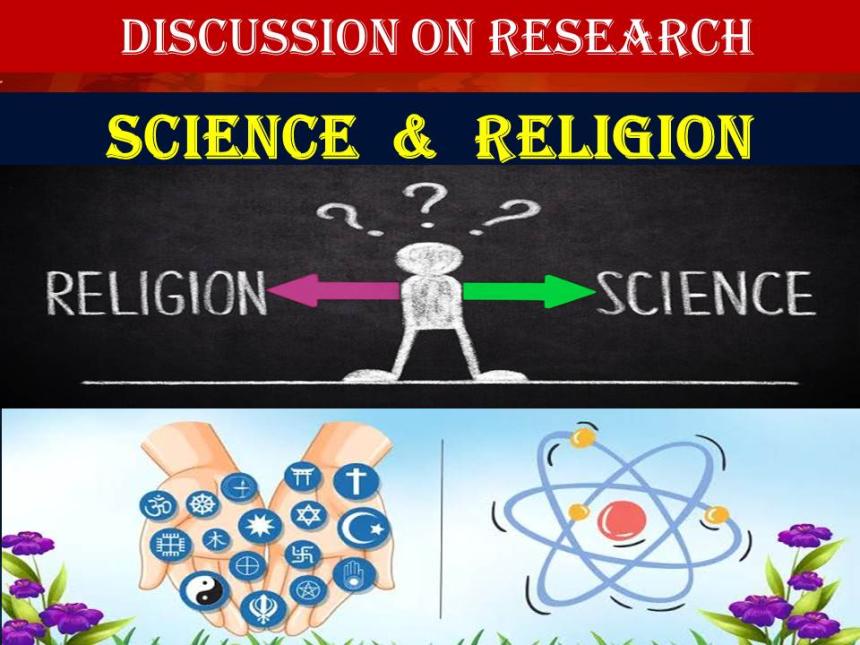

Science & Religion
The modern debate about science and religion "conflict thesis"—the idea that science and religion are in perpetual and inherent opposition—was largely popularized in the late 19th century by secular thinkers, academics, and scientists rather than religious authorities. This writ up is acommentry of the debate on the basis of a recent opinion offered in an interview from Harvard University Scientist, Dr. Willie Wei-Hock Soon.
أَعُوذُ بِاللّٰهِ مِنَ الشَّيْطَانِ الرَّجِيمِ
بِسۡمِ ٱللهِ ٱلرَّحۡمَـٰنِ ٱلرَّحِيمِ
In the name of ALLAH, the Most Gracious, the Most Merciful
Science & Religion
The formal debate between science and religion as distinct, competing worldviews largely dates back to the late 19th century, catalyzed by key milestones like Charles Darwin’s theory of evolution (1859) and the publication of adversarial books such as John William Draper’s "History of the Conflict Between Science and Religion" (1874). Earlier historic flashpoints—such as the Galileo affair in the 17th century—provided isolated precedents, but a generalized public debate crystallized primarily during the Victorian era.
Philosophy and theology heavily overlapped; natural philosophy was often viewed as a tool to understand divine creation rather than oppose it. During the seventeenth century, when the tussle between church and scientist rose in Europe; an early high-profile clash took place regarding heliocentrism and scriptural authority, though primarily political and theological at the time. During "the Enlightenment (18th Century) era "Rationalism" grew, but mainstream thinkers still generally sought harmony between natural laws and a creator. However, during the last century authors like John William Draper and Andrew Dickson White explicitly framed science and religion as locked in a historical "warfare".
Today by early twenty first century, "Science and religion" are considered as two distinct ways humans understand the world, focusing respectively on empirical evidence and spiritual meaning. Science focuses on the physical world using tests, experiments, and measurements to answer how things work; whereas Religion focuses on the spiritual world using faith, sacred texts, and traditions to answer why we exist and how to act. While some view them as conflicting, many see them as complementary.
There is a view that science and religion fight over the same facts, making them complete opposites; and there are people who take the idea that they both cover separate areas of life and do not interfere with each other. But as we travel across the globe an "Integrated" approach "belief" is also heard that science and faith can work together to offer a complete picture of reality.
The view tossed in late nineteenth century that science and religion as locked in a historical "warfare" has changed dramatically among professional historians and scholars, though the conflict narrative still remains popular in public media.Modern academic consensus has completely rejected the 19th-century "Conflict Thesis" in favor of more nuanced frameworks.
Historians of science, pioneered by scholars like John Hedley Brooke, now widely accept the "Complexity Thesis". This view demonstrates that the historical relationship between science and religion was rarely a battlefield. Instead, it was deeply intertwined. Historically, religious beliefs frequently served as the primary motivation and justification for scientific inquiry. Early modern giants like Isaac Newton and Johannes Kepler viewed studying the natural world as a religious duty to understand the mind of God.
Modern research has proven that famous "warfare" stories were highly exaggerated or fabricated by Victorian writers to push political agendas. For instance, Galileo’s trial was primarily a complex political and theological dispute over scriptural interpretation authority, rather than a flat rejection of science itself. These days, News outlets and entertainment media find conflict narratives far more engaging and profitable to broadcast than stories of quiet, historical cooperation. However, the work of science is not affected by conflicts as it requires solid arguments and empirical evidences.
The Science and Religion Debate in Today's World
A Harvard University Scientist, Dr. Willie Wei-Hock Soon (30 September 1965) is a Malaysian-born American astrophysicist and geoscientist known for his controversial research on solar variation and climate change. He was long affiliated with the Harvard-Smithsonian Center for Astrophysics and the Mount Wilson Observatory. Dr. Willie Soon claims that the Mathematical Precision Related to Antimatter proves that the Universe was Designed and was not an accident.
In an interview on the Tucker Carlson Network, astrophysicist Dr. Willie Soon argued that the mathematical precision of the universe specifically regarding the discovery and behavior of antimatter—provides evidence of a intentional, supreme designer. Dr. Willie Soon highlights Paul Dirac’s 1928 mathematical equation.
Paul Dirac presented a mathematical formula known as "Dirac Equation" in 1928. It is a relativistic wave equation that successfully unifies quantum mechanics with Albert Einstein's theory of special relativity to describe the behavior of subatomic particles like electrons. The Dirac equation is most frequently written in natural units (\(\hbar = c = 1\)) using Feynman slash notation as:
\((i\gamma ^{\mu }\partial _{\mu }-m)\psi =0\)
The equation naturally produced both positive and negative energy solutions. Instead of discarding the negative energy states as mathematical anomalies, Dirac eventually realized they predicted a completely new particle: the positron (the electron's antimatter twin), which was physically discovered four years later in 1932.
Prior to 1928, physicists knew electrons had an intrinsic angular momentum called "spin," but they had to manually force it into their equations. Spin emerged automatically from the Dirac equation as a required mathematical consequence of merging relativity with quantum mechanics. The formula purely predicted the existence of antimatter (positrons) years before experimental physicists observed them in cosmic rays. Dr Willie Soon argues that this level of flawless mathematical predictability implies a pre-existing blueprint.
Paul Dirac's 1928 antimatter equation and physical constants points to an intentional, intelligent creation. This viewpoint relies on the fine-tuning argument, though mainstream science treats design claims as philosophical interpretations rather than testable empirical proof. What he actually said is that the mathematical precision and fine-tuning of the universe—specifically referencing the behavior and balance of matter and antimatter—POINT TO intentional design rather than random chance.
Dr. Willie Soon highlights this predictive power as evidence of a deeply ordered, mathematical reality. Following the Big Bang, matter and antimatter should have completely destroyed each other. A razor-thin surplus of regular matter survived, allowing stars, planets, and life to form, which proponents view as too precise to be accidental. Universal constants like gravity and electromagnetism are calibrated so precisely that tiny changes would make life impossible, leading Soon and other thinkers to infer a designer.
Supporters of fine tuning argue that the deep mathematical beauty and order of the universe find a more natural explanation in a rational creator than in random chance. Most scientists view mathematics as a descriptive language used to model physical behavior rather than a direct theological validation. Whether these constants imply a creator remains a matter of personal belief and philosophical debate rather than scientific consensus.
The connection between elegant mathematics and a higher power is not unique to Dr Willie Soon. In 1963, Paul Dirac himself famously wrote that "God is a mathematician of a very high order" when marveling at how physical laws align with beautiful mathematical theory.
However, the broader scientific community treats the matter-antimatter asymmetry (known as baryon asymmetry) as a profound physics mystery rather than definitive proof of a creator. Mainstream physicists are actively searching for natural mechanisms—such as CP-violation in particle physics—to explain why matter dominated antimatter after the Big Bang, rather than attributing the phenomenon to supernatural design. The science gurus are still reluctant to accept the valid arguments in search of empirical evidences; which Dr. Willie Soon has forwarded.
Dr. Willie Soon provided No "Solid Empirical Proof" But Certainly Prudent Logical Argument
Science does not prove the non-existence of God. Instead, science studies the natural and physical world, while God is typically defined as a supernatural or immaterial being that exists outside of nature. Because science relies on testing and measuring things we can observe, it cannot test or measure something that is outside the physical universe. While science explains the mechanics of the universe, it does not answer why the universe is here or what started it, leaving those questions to philosophy, personal belief, and faith.
However, Harvard University Scientist, Dr. Willie Soon claims that the Mathematical Precision Related to Antimatter PROVES that the Universe was "Designed" and the only claimant for such a design from all Abrahamic Religions is God / ALLAH.
Good to know that a real scientist finally admits when countless non-scientists have known for millennia. I've tried explaining this very thing using the following short video. Fathers once taught children about right, wrong, and the sacred. Today, brilliant scientists marvel at the universe, but leave no room for its Creator. What if every discovery quietly points back to the One who set the stars in place — and waits with open arms? #FaithAndScience
The Conclusion
The debate of science and religion was not initiated by religious domain. The modern "conflict thesis"—the idea that science and religion are in perpetual and inherent opposition—was largely popularized in the late 19th century by secular thinkers, academics, and scientists rather than religious authorities. Historians note that the modern narrative of warfare was a later ideological construct, not an accurate reflection of historical interactions where religious institutions often funded and housed early scientific pursuits.
The debate between science and religion became a tool to secularize politics; when political secularization arose from statecraft needs, religious wars, and Enlightenment philosophy, while the science-religion dialogue emerged later as a cultural and intellectual shift. The religion is not based on empirical evidence but the "Unseen God" is believed to have existed as "Omnipotent", "All Knowing & Watching" and "Power of Day of Judgement (Malik-e-Yum Deen)". The Religion doesn't require Science to offer proof of God, but the Science will require complete philosophical guidance in its pursuit for "Whole Truth".
Affordable Delhi to Mussoorie Taxi for a Comfortable Journey
Book an affordable Delhi to Mussoorie cab with Mr. Cabby at fares starting from ₹12/km. En...

Expert Flower Delivery in Delhi NCR | Fresh Luxury Bouquets
Discover expert flower delivery in Delhi NCR by Sai Flower. Hand-crafted European spiral b...

Uterine Fibroids and Pregnancy: What Women Should Know
Uterine Fibroids and Pregnancy: What Women Should Know Uterine fibroids are non-cancero...

Umrah Packages from New York for a Peaceful and Memorable Spiritual Jo...
Book Umrah Packages from New York with complete travel services including flights, hotels,...