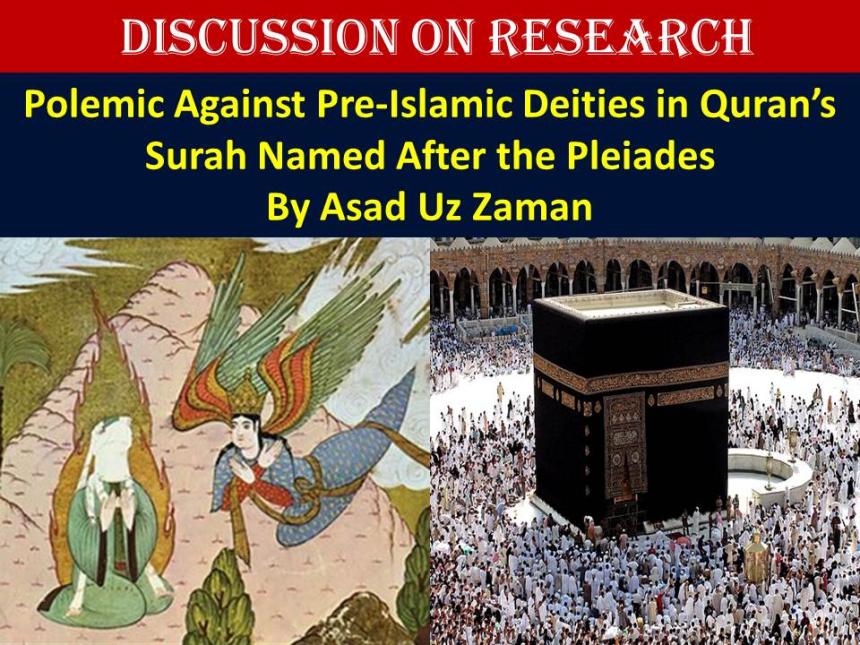

"Polemic Against Pre-Islamic Deities in Quran’s Surah Named After the Pleiades By Asad Uz Zaman"
Al-Quran is the final Holy scripture revealed upon last of Prophets Muhammad (PBUH) and scholars have also invested in researching on various topics. Asad Uz Zaman has carried out a master thesis at University of Maryland USA, that examines Surah An-Najm through the lens of ancient astral mythology and pre-Islamic Arabian religion. This write up "Polemic Against Pre-Islamic Deities in Quran’s Surah Named After the Pleiades; By Asad Uz Zaman" is about the discussion and findings made in the thesis.
أَعُوذُ بِاللّٰهِ مِنَ الشَّيْطَانِ الرَّجِيمِ
بِسۡمِ ٱللهِ ٱلرَّحۡمَـٰنِ ٱلرَّحِيمِ
اللہ کے نام سے شروع جو بڑا مہربان نہایت رحم کرنے والا ہے
In the name of ALLAH, the Most Gracious, the Most Merciful
Polemic Against Pre-Islamic Deities in the Surah Named After the Pleiades By Asad Uz Zaman
In his 2020 thesis, historian Asad Uz Zaman analyzes Sūrat al-Najm as a celestial polemic that dismantled the divine authority of pre-Islamic Arabian goddesses Allāt, al-ʿUzzā, and Manāt. He argues that the sūrah strategically subverts astral religion and the cosmic imagery of Venus to redirect devotion from the stars toward the Creator. The master's thesis titled "Polemic Against Pre-Islamic Deities in the Sūrah Named After the Pleiades," written by Asad Uz Zaman in 2020, is a historical and theological analysis.
The Abstract of the thesis says that " it explores the idea of whether Allāt, al-‘Uzzā, and Manāt were worshipped as manifestations of Venus by Muhammad’s (PBUH) pagan opponents known as the mushrikūn; an idea inspired through engagement with Gerald Hawting’s book "The Idea of Idolatry and the Emergence of Islam". By reading Q53 Sūrat al-Najm within a broader context of ancient Near Eastern astral religion / mythology, I develop an “astral” interpretation of Muhammad’s angelic vision of the Archangel Gabriel, highlighting how the description of Gabriel at the beginning of the sūrah parallels the movements of Venus as the morning star in some salient features. Based on this finding I argue that the Venusian description of Gabriel serves as a polemic posing him in comparison to the goddesses mentioned later in the sūrah at Q53:19-20. These developments prompt me to examine their implications for the Satanic verses story and propose a date for Q53’s revelation".
The core arguments, methodology, and focus of the thesis academic work may be described as follows:-
The thesis centers on Sūrat al-Najm (Qur'an Chapter 53), which translates directly to "The Star" or historically references "The Pleiades" (al-najm) in pre-Islamic Arabian astrology. It investigates the status and worship of the three primary pre-Islamic goddess entities mentioned in the sūrah: Allāt, al-ʿUzzā, and Manāt. It explores whether these goddesses were actively worshipped as manifestations of the planet Venus by Muhammad’s (PBUH) polytheistic opponents, the mushrikūn.
The author's thesis framework was directly inspired by scholar Gerald Hawting's influential book, "The Idea of Idolatry and the Emergence of Islam". By placing Sūrat al-Najm within the broader context of ancient Near Eastern astral religions and mythologies, the paper shifts the understanding of pre-Islamic practice from primitive stone idol-worship to a complex celestial belief system.
The Key Analytical Findings of the Thesis
The Astral Interpretation of Gabriel: The thesis develops a novel interpretation of the Prophet Muhammad's (PBUH) angelic vision of the Archangel Gabriel at the beginning of the sūrah. It argues that the description of Gabriel’s descent parallels the planetary movements of Venus acting as the morning star.
The Nature of the Polemic: Based on this celestial parallel, the author argues that the Venusian description of Gabriel serves as a direct literary and theological counter-argument (polemic). By absorbing the stellar imagery associated with Venus into a subservient angelic entity (Gabriel), the text methodically dismantles the divine authority of the pagan goddesses who were viewed as cosmic or astral powers.
The Discussion made in Thesis
In pre-Islamic Arabia (the period often termed Jahiliyyah), the religious landscape was a rich polytheistic system where tribes maintained local pantheons, celestial cults, and sacred spaces. At the absolute zenith of this system stood three prominent female deities: Allāt, al-ʿUzzā, and Manāt. In the late antique Hijaz region, these three were collectively venerated as the "Daughters of Allāh" (Banāt Allāh), acting as high-ranking cosmic intercessors between humans and a distant, supreme creator deity. They were deeply woven into the geopolitical, economic, and spiritual identity of the Arabian Peninsula.
1. Allāt: The Matron of Abundance and War
The Name: Derived from al-Ilāhah, meaning "The Goddess". She represents one of the oldest recorded deities in the region, with early mentions tracing back to the 5th century BCE by the Greek historian Herodotus.
Attributes: She was worshipped as a mother goddess of fertility, agriculture, earth, and prosperity, but under regional Greco-Roman influence, she also absorbed the martial qualities of Athena and Minerva.
Cult Center: Her primary sanctuary was in the city of Ta'if, located southeast of Mecca. She was represented there by a massive, sacred white stone cube fiercely protected by the Banu Thaqif tribe.
Regional Reach: Beyond the Hijaz, her worship extended across the Near East. Safaitic nomad graffiti frequently invoked her, and she was a major patron deity in the caravan cities of Palmyra, Hatra, and the Nabataean Kingdom.
2. Al-ʿUzzā: The Supreme Power and Celestial Star
The Name: A feminine Arabic epithet meaning "The Most Mighty" or "The Powerful One".
Attributes: Al-ʿUzzā was the goddess of cosmic power, military victory, and protection. Crucially, she was heavily linked to astral worship, specifically identified with the planet Venus as the Morning and Evening Star.
Cult Center: Her principal shrine was located in the valley of Nakhla, a critical trade route intersection near Mecca. She was venerated there through a sacred stone structure flanked by three holy acacia trees.
Tribal Importance: She was the chief patron goddess of the powerful Quraysh tribe of Mecca. During the Battle of Uhud (624 CE) against early Muslims, the Quraysh standard-bearers actively carried her name into battle, shouting, "O people of ʿUzzā, people of Hubal!".
3. Manāt: The Ancient Arbiter of Destiny
The Name: Derived from the Arabic root for linguistic concepts like "portion," "allotment," or "fate".
Attributes: She was the goddess of fate, time, fortune, and death. Manāt was believed to weave the inescapable thread of a human's lifespan (ajal) and was deeply feared and respected as the arbiter of human mortality. She also functioned as a protector of graves and final resting places.
Cult Center: Manāt is historically considered the oldest of the three deities. Her principal idol—a dark rock—was erected on the Red Sea coast at Qudayd (between Mecca and Medina).
Tribal Importance: She was the supreme patron deity of the Aws and Khazraj, the two dominant Arab tribes of Medina (Yathrib). Their yearly seasonal pilgrimages to Mecca were legally and spiritually incomplete until they marched to the coast, sacrificed before Manāt, and shaved their heads at her shrine.
The Economic and Ritualistic System
The "Daughters of Allāh" were not just theological concepts; they were the pillars of the pre-Islamic pilgrimage economy (Hajj).
The Ka'bah's Pantheon: While each goddess had her own geographic fortress city, they were all heavily honored within the central multi-tribal sanctuary of the Ka'bah in Mecca.
Ritual Chants: Pilgrims from competing desert tribes would engage in Tawaf (circumambulation) around the Ka'bah while chanting specific rhythmic talbiyah praises celebrating the three goddesses as "the high-flying cranes" (al-gharānīq al-ʿulā) whose cosmic intercession was intensely desired.
The Islamic Transition
The arrival of Islamic monotheism directly targeted this entrenched regional trinity. Sūrat al-Najm (53:19-23) systematically names Allāt, al-ʿUzzā, and Manāt, dismissing them as mere "empty names" invented by ancestral tradition rather than true cosmic authorities. Following the conquest of Mecca in 630 CE, the physical shrines and sacred stones of all three goddesses were methodically dismantled and destroyed by Muslims, effectively concluding the visible era of open polytheistic goddess worship in the region.
The chapter 3 of Asad Uz Zaman's thesis examines the specialized astral vocabulary in the opening verses of Q53, demonstrating how its imagery parallels the movements of Venus. This Venusian framing of the Angel of Revelation functions as a theological polemic that demotes pagan astral divinities and provides a unified compositional timeline for the sūrah. The thesis examines how specific terminology shifts from classical Arabic literature into a Qur'anic vocabulary optimized for monotheistic polemics. By analyzing the utility of these literary Arabic words, the text demonstrates a deliberate re-framing of pre-Islamic astral and pagan notions to serve subordinate monotheistic agent descriptions. This type of discussion is also available in various Arabic and even Urdu language religious academic work.
From thesis one interesting para reads as "it becomes clearer how the ascent and descent of the heavenly being that is traditionally identified as the angel Gabriel in these verses closely parallels the movements of Venus in its apparitions as the morning star. Recall from the previous chapter (Fig. 2-6 pp. 51-52) that the planet rises earlier and earlier each night and therefore reaches a higher and higher position in the sky at the time of sunrise, until such time as it levels off reaching a peak altitude above the horizon. The fact that Venus may reach a peak altitude of 48 degrees corresponds well with the qur’anic description of the angel as being “in the highest part of the horizon,” as much higher angular altitudes above the horizon would require the observer to crane their neck to observe a celestial body directly up above their head. And finally, we know that after Venus has reached a peak altitude by leveling off from its previous ascent, that it rises later and later each night, appearing lower and lower in the sky close to the time of sunrise and consequently looking as if it is slowly descending in the morning sky".
The thesis continues to describe about ArchAngel as "Gabriel’s appearance to Muhammad upon the eastern horizon in his true form are better contextualized when understood according to our hypothesis that the movements of the angel evoke the celestial imagery of the planetary movements of Venus. If the movements of the angel are described in Venusian terms, then the various decontextualized reports that al-Ṭabarī records of Gabriel appearing to Muhammad on the eastern horizon are highly suggestive that the angel is being analogized to the movements of Venus in its apparition as a morning star. After Venus passes between the Earth and the Sun it appears as a morning star for close to nine months out of the year along the eastern horizon, rising higher in the sky around the time of sunrise each day until it levels off/reaches a peak altitude and then its elevation at sunrise decreases each day making it appear as if it is slowly descending towards the horizon".
"This has important implications for people who interpret the language of the descent of the angel in Q53:5-9 to be metaphorically or literally related to some kind of astral phenomenon just as Dost, Adams, and Hussain do. If we take the exegetical reports of Q53:7 and Q81:23 of Gabriel appearing on the eastern horizon seriously, one would presume that his subsequent descent as described in Q53:8-9 would be towards the eastern horizon as well. If we interpret Gabriel’s movements in this passage as being representative of or concurrent with the movement of some celestial body, then that celestial body could only be one of the inferior planets i.e. Mercury or Venus. It cannot be one of the fixed stars, or an asterism comprised of the fixed stars because the fixed stars never set on the eastern horizon".
In his thesis, Asad Uz Zaman interprets the angelic vision of Gabriel in Sūrat al-Najm as a celestial cosmic figure framed by late antique astronomy and parallel to the morning star Venus. By absorbing stellar splendor while remaining a servant to God, this portrayal serves as a theological polemic designed to dismantle the authority of pre-Islamic pagan goddesses.
The Conclusion
Asad Uz Zaman’s thesis concludes that Sūrat al-Najm operates as a unified polemic that subverts pre-Islamic astral polytheism by repurposing celestial imagery to affirm monotheism. Furthermore, the text demonstrates internal linguistic cohesion and situates early Islam within the intellectual framework of the Late Antique religious landscape.
NOTE: The research paper may be reached at the link below:-
https://api.drum.lib.umd.edu/server/api/core/bitstreams/eb554e0d-9c79-4a4d-9e88-ed04a8add630/content
Vigortrix Review: Is It Worth Trying? Results, Pricing & Where to Buy
What Is Vigortrix? Vigortrix is a men's vitality dietary supplement designed to support e...



The Connection Between Employee Development and Organizational Perform...
Golden Touch Fusion CBD – Premium Quality and Natural Wellness Support
What Are Golden Touch Fusion CBD? Golden Touch Fusion are a cannabidiol (CBD) supplement...