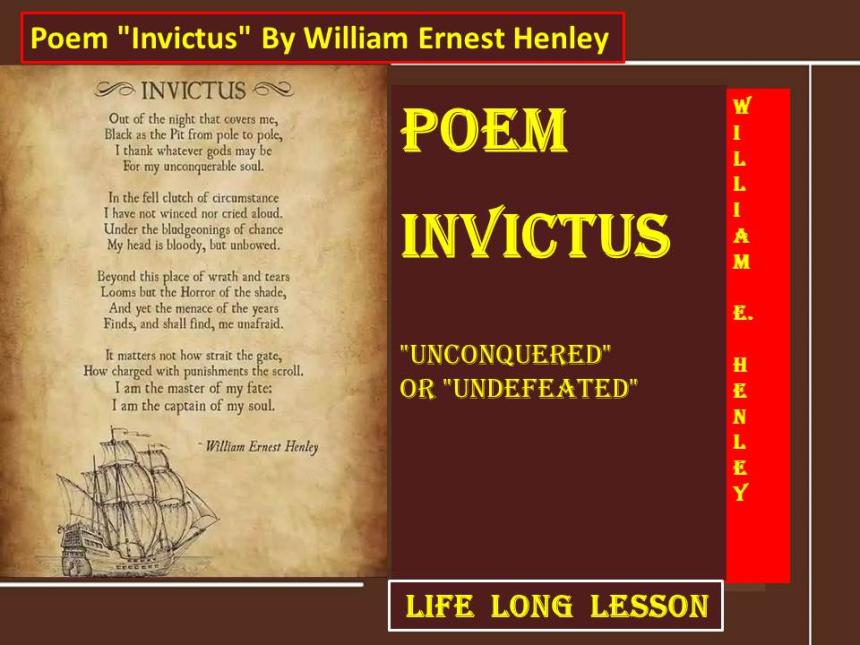

Poem "Invictus" By William Ernest Henley
William Ernest Henley, (1849 - 1903) was an English poet, writer, critic, and editor. Though he wrote several books of poetry, Henley is remembered most for his 1875 poem "Invictus". William Ernest Henley's work has inspired world leaders, royalty and even a Hollywood movie. The poem "Invictus" By William Ernest Henley is most known for its themes of willpower and strength in the face of adversity. This write up about poem "Invictus" has been arranged for educational purposes.
أَعُوذُ بِاللّٰهِ مِنَ الشَّيْطَانِ الرَّجِيمِ
بِسۡمِ ٱللهِ ٱلرَّحۡمَـٰنِ ٱلرَّحِيمِ
In the name of ALLAH, the Most Gracious, the Most Merciful
Poem "Invictus" By William Ernest Henley
William Ernest Henley, (August 23, 1849, Gloucester, United Kingdom - July 11, 1903, Woking, United Kingdom) was an English poet, writer, critic, and editor. Though he wrote several books of poetry, Henley is remembered most often for his 1875 poem "Invictus". William Ernest Henley's work has inspired world leaders, royalty and even a Hollywood movie. Best known for writing the poem Invictus, Henley is also believed to have been the inspiration for the character Long John Silver, in Robert Louis Stevenson's "Treasure Island".
Poem 'Invictus' By William Ernest Henley is a powerful and inspiring poem written by William Ernest Henley. It serves as a testament to the indomitable human spirit and resilience in the face of adversity and continues to inspire individuals to overcome challenges and embrace a sense of inner strength (e.g. Nelson Mandela, who used it as a rallying cry during his time in prison).
The poem is most known for its themes of willpower and strength in the face of adversity, much of which is drawn from the horrible fate assigned to many amputees of the day—gangrene and death. Ironically, the poem "Invictus" was written by William Ernest Henley, while he underwent medical treatment for tuberculosis of the bone. The poem is drawn from Henley's experience recovering from the amputation of his left leg in an Edinburgh hospital at a time when hospitalization often meant death.
Originally the fourth part of a longer sequence published in Henley's collection "In Hospital", this 16-line section has taken on a life of its own. The unwavering resilience it summons in the face of adversity has led to its enduring popularity and use in a variety of contexts. The poem's uncertain relationship with religion and its insistence on individual strength also ties it to issues facing England in the late 19th century.
The central idea of "Invictus" by William Ernest Henley is the unconquerable resilience of the human spirit in the face of severe adversity. It emphasizes courage, self-mastery, and the defiant refusal to let pain or difficult circumstances break one's inner resolve or dictate one's destiny. The main idea of "Invictus" is the theme of triumph over adversity. The poem encourages to remain hopeful despite the experiences of pain and suffering.
The overall tone of Poem “Invictus” by William Ernest Henley is determined and defiant. One may sense this tone already in the title, which is Latin for “unconquerable.” The concept of unconquerability powerfully announces the poem's central theme, which concerns the indomitable nature of the human spirit. Henley uses symbolism to express his courage against difficulties and to clarify the feelings and images mentioned in his poem.
Summary of Poem "Invictus" By William Ernest Henley
William Ernest Henley’s "Invictus" is a powerful 16-line Victorian poem about unwavering resilience and the elasticity of the human spirit. The poem was written while Henley was recovering from a grueling, life-threatening leg amputation; therefore, the poet through this poem asserts that no matter how harsh life gets, individuals possess the ultimate control over their own destinies. In William Ernest Henley's poem "Invictus", the use of strong and descriptive language and extravagant metaphors help clearly convey the theme of the poem which is to never lose hope no matter the circumstance, and how you control your fate and decide your future.
Poem "Invictus" By William Ernest Henley
Out of the night that covers me,
Black as the Pit from pole to pole,
I thank whatever gods may be
For my unconquerable soul.
In the fell clutch of circumstance
I have not winced nor cried aloud.
Under the bludgeonings of chance
My head is bloody, but unbowed.
Beyond this place of wrath and tears
Looms but the Horror of the shade,
And yet the menace of the years
Finds, and shall find, me unafraid.
It matters not how strait the gate,
How charged with punishments the scroll,
I am the master of my fate:
I am the captain of my soul.
The Explanation of Poem "Invictus" By William Ernest Henley
The poem has a repetitive structure that emphasizes the recurring nature of adversity and the constancy of inner strength. Note how each stanza opens with a description of adversity and ends with an affirmation of emotional fortitude.
The speaker begins by emerging from a metaphorical night that lies on top of the speaker like a physical thing. This night, which seems to fill the whole world, is as dark as Hell. Despite this darkness, the speaker feels gratitude towards any god or gods that may exist for granting unshakeable resilience.
Looking back on life's past challenges, which constrained the speaker like a giant fist, the speaker remembers never showing discomfort or complaining. Going even further, the speaker compares life's unexpected mishaps to being beaten with a heavy implement. The speaker was damaged by this beating, yet that fact did not decrease the speaker's pride or resolve.
Now the speaker looks beyond the present of anger and sadness to the future. Unfortunately, the future's only certainty is death, which hangs over the present like a terrifying shadow. However, the speaker once again affirms that the threat of inevitable suffering does not, and never will, frighten the speaker.
The speaker doesn't care how challenging life becomes, alluding to a biblical passage in which a narrow gate represents extreme difficulty. Nor does the speaker care how many horrible events lie in the book of fate. The speaker controls the course of their own inner life. Like a ship's captain, the speaker remains in charge of their inner life's unconquerable element: the soul.
Stanza 1: The speaker opens by describing a dark, overwhelming "night that covers" him. Despite being trapped in deep, inescapable suffering, he expresses deep gratitude that his soul remains "unconquerable".
Stanza 2: Facing harsh circumstances and the "bludgeonings of chance," the speaker endures severe pain without wincing or crying out. Even though he is bloody, he holds his head high, remaining unbowed.
Stanza 3: Confronted by the horrors, shadows, and darkness of the afterlife/death, the speaker notes that it does not terrify him. He is ready to face whatever the coming years bring completely unafraid.
Stanza 4: The speaker rejects the idea of being a victim of circumstance or higher powers, choosing instead to be the architect of his own life. The poem concludes with its most famous lines:
"I am the master of my fate:
I am the captain of my soul."
The speaker concludes that despite the strict limitations or punishments life imposes, he alone steers the course of his existence.
The Conclusion "I am the master of my fate, I am the captain of my soul".
There is another poem "Don't Quit" by Edgar Albert Guest which advocates for persistence, resilience, and optimism in the face of adversity. The poem emphasizes that success is often just around the corner, even when things seem at their worst. The poem "Invictus,” by William Ernest Henley, is above all a poem about resilience in the face of suffering. This resilience comes from the courage to embrace life and refuse despair.
"Don't Quit" acknowledges life’s inevitable twists, turns, and uphill struggles. Similarly, "Invictus" speaks of the "night," "wrath and tears," and "bludgeonings of chance". Both agree that hardships happen, but enduring them builds character. Together, these poems provide a comprehensive blueprint for endurance and cultivate a defiant, unbowed spirit (Henley), but keep pressing forward, resting when needed, because victory might be just around the corner (Guest).
One poem "Don't Quit" by Edgar Albert Guest advocates "perseverance and hope"; and advises to keep trying because success is often just a breadth away from reach. The other poem "Invictus,” by William Ernest Henley, advocates "defiance and self-mastery"; and advises to show resilience of the soul against a harsh universe.
Henley’s speaker acknowledges the brutal reality of "wrath and tears" and asserts control over his internal state despite uncontrollable external circumstances. Guest’s speaker acknowledges realistic, daily struggles (e.g., debts, uphill roads) and reassures the reader that these hurdles can be overcome if they simply don't give up. These iconic poems weave a complementary philosophy for overcoming adversity.
In the first line of first stanza of poem "Invictus,” by William Ernest Henley “Out of the night that covers me" uses night as a symbol; and represents the hardships, sufferings and the pain of worldly existence that may fell upon due to any reason. The concluding lines—"I am the master of my fate: / I am the captain of my soul"—summarize the core message. The message is that no matter what life throws at us, we must maintain complete control over our own choices and our inner identity.
William Ernest Henley’s "Invictus" and Edgar Guest’s "Don’t Quit" share a powerful, combined lesson on resilience and self perseverance. Together, they teach that while suffering and setbacks are inevitable, ultimate triumph belongs to those who refuse to surrender their inner spirit and keep fighting when the odds are stacked against them.
Hospital Curtain Track Suppliers in India & Operation Theatre Technici...

Golden Touch Fusion CBD: How They Work, Expected Results, and Where to...
Introduction Golden Touch Fusion CBD Gummies are marketed as a cannabidiol (CBD) suppleme...
Oil and Grease Paper Price Trend Q2 2026 | Price Trends, Forecast, Cha...

Cotton Yarn Price Trend Q2 2026 | Price Trends, Forecast, Chart, Price...