
Revolutionize Growth with Dynamics 365 Finance & Operations
Transform your business with Dynamics 365 Finance & Operations. Automate finance, optimize supply chains, improve productivity, and drive smarter decisions.
Introduction
Businesses today face constant pressure to improve operational efficiency, maintain financial accuracy, and adapt quickly to changing market demands. As organizations expand, managing multiple departments through disconnected software often creates challenges such as delayed reporting, duplicate data, manual workflows, and limited visibility into business performance. These issues not only slow productivity but also make strategic decision-making more difficult.
An intelligent Enterprise Resource Planning (ERP) platform provides the foundation for overcoming these challenges. By connecting finance, procurement, manufacturing, inventory, and supply chain operations into a single cloud-based environment, organizations can simplify complex processes while gaining real-time business insights. A modern ERP system enables companies to automate routine tasks, reduce operational costs, and improve collaboration across every department.
Whether your business operates in manufacturing, retail, distribution, wholesale, or professional services, adopting an integrated ERP solution is an important step toward achieving sustainable growth and digital transformation.
The Importance of Digital Finance and Operations
Modern enterprises generate vast amounts of financial and operational data every day. When this information is spread across multiple systems, businesses often struggle with inconsistent reporting, communication gaps, and inefficient workflows.
A unified ERP platform brings together accounting, procurement, inventory, manufacturing, sales, and reporting into one centralized system. This integration eliminates data silos while ensuring every department works with accurate and up-to-date information.
As a result, organizations can respond faster to customer demands, improve financial planning, and strengthen operational performance.
Business Challenges That Limit Growth
Growing businesses often experience operational obstacles that impact efficiency and profitability.
Financial Complexity
Managing multiple legal entities, currencies, tax regulations, and financial reports manually can increase administrative workload and reduce reporting accuracy.
Inventory Inefficiencies
Poor inventory visibility often leads to stock shortages, excess inventory, delayed customer deliveries, and higher storage costs.
Disconnected Business Processes
When procurement, finance, production, and warehouse management operate independently, communication delays and duplicated work become common.
Limited Decision-Making Capability
Without real-time analytics, executives rely on outdated reports, making it difficult to identify opportunities or respond to changing market conditions quickly. These challenges highlight the need for an integrated business management platform.
How Dynamics 365 Finance & Operations Creates Business Value
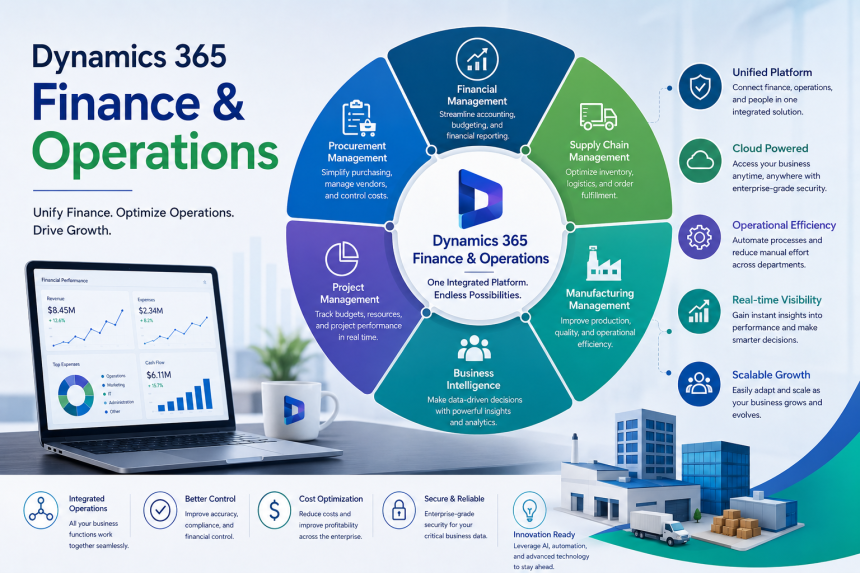
Businesses seeking operational excellence increasingly rely on Dynamics 365 Finance & Operations to manage complex enterprise processes from a single cloud-based platform. The solution combines financial management, manufacturing, supply chain optimization, procurement, project accounting, and business intelligence into one integrated system.
With centralized data and intelligent automation, organizations gain better control over daily operations while improving collaboration between departments. The platform also integrates with Microsoft 365, Power BI, Azure, and other Microsoft business applications, allowing businesses to create a connected digital ecosystem that supports innovation and growth.
By eliminating manual processes and providing real-time insights, organizations can make faster decisions while improving overall productivity.
Core Features That Strengthen Business Operations
Financial Management
Automate budgeting, accounting, cash flow management, accounts payable, accounts receivable, tax compliance, financial reporting, and fixed asset management through one centralized platform.
Supply Chain Management
Monitor procurement, warehouse operations, transportation, inventory, vendor relationships, and order fulfillment with greater accuracy and efficiency.
Manufacturing Management
Improve production planning, shop floor control, quality assurance, resource scheduling, and production monitoring to maximize manufacturing performance.
Project Operations
Track project budgets, allocate resources effectively, monitor expenses, and analyze project profitability throughout every stage.
Business Intelligence
Interactive dashboards and advanced analytics provide executives with real-time insights that support informed business decisions.
Major Benefits for Modern Enterprises
Improved Productivity
Automation reduces repetitive administrative work, allowing employees to focus on strategic business initiatives.
Greater Financial Visibility
Finance teams gain instant access to accurate reports, improving budgeting, forecasting, and financial planning.
Enhanced Operational Efficiency
Integrated workflows eliminate duplicate data entry while improving collaboration between finance, operations, procurement, and warehouse teams.
Lower Operational Costs
Optimized inventory management, procurement automation, and process improvements help reduce unnecessary expenses.
Scalable Growth
Cloud-based architecture allows businesses to expand operations without investing in expensive infrastructure upgrades.
Industries That Benefit Most
Manufacturing
Improve production efficiency, quality control, procurement, and inventory management through connected business processes.
Retail
Manage inventory across multiple locations, improve purchasing decisions, and deliver better customer experiences.
Distribution
Optimize warehouse operations, transportation planning, supplier collaboration, and order fulfillment.
Wholesale
Simplify inventory tracking, financial reporting, procurement, and customer order management.
Professional Services
Improve resource allocation, project budgeting, billing automation, and profitability analysis.
Why Cloud ERP Is the Future
Cloud technology has transformed enterprise software by providing businesses with flexibility, security, and continuous innovation.
Organizations benefit from:
- Automatic system updates
- Enterprise-grade cybersecurity
- Secure remote access
- Reduced IT maintenance
- High system availability
- Business continuity support
- Flexible scalability
These advantages allow organizations to focus on business growth instead of managing complex infrastructure.
Best Practices for Successful ERP Implementation
A successful ERP implementation requires careful planning and continuous improvement.
Businesses should:
- Define measurable business objectives.
- Analyze existing workflows before implementation.
- Clean and validate business data.
- Train employees across departments.
- Configure the platform based on operational requirements.
- Continuously evaluate system performance after deployment.
Working with experienced implementation specialists helps ensure smoother adoption while maximizing return on investment.
Preparing Your Business for Long-Term Success
Technology continues to reshape enterprise management through artificial intelligence, predictive analytics, automation, and cloud computing. Organizations that embrace intelligent ERP solutions gain the flexibility needed to respond quickly to changing customer expectations and evolving market conditions.
A connected business platform enables companies to improve operational resilience, accelerate innovation, and create sustainable competitive advantages. By investing in digital transformation today, businesses build a stronger foundation for future growth while improving operational excellence across every department.
Conclusion
Managing finance and operations through separate systems can create unnecessary complexity, reduce efficiency, and slow business growth. Organizations need an intelligent ERP platform that connects financial management, procurement, inventory, manufacturing, supply chain, and business analytics into one integrated solution.
Dynamics 365 Finance & Operations provides the tools businesses need to automate critical processes, improve financial accuracy, optimize operational performance, and gain real-time visibility across the organization. With its cloud-based architecture, intelligent automation, and advanced reporting capabilities, the platform empowers organizations to reduce costs, increase productivity, strengthen compliance, and confidently achieve long-term business success in an increasingly digital world.


Effective Cleaning Bins Solutions: Improve Hygiene with Expert Waste B...





What Is Cenforce? A Complete UK Patient Guide
Learn what Blue Zopiclone is, how it works, recommended UK dosage, safety advice, possible...