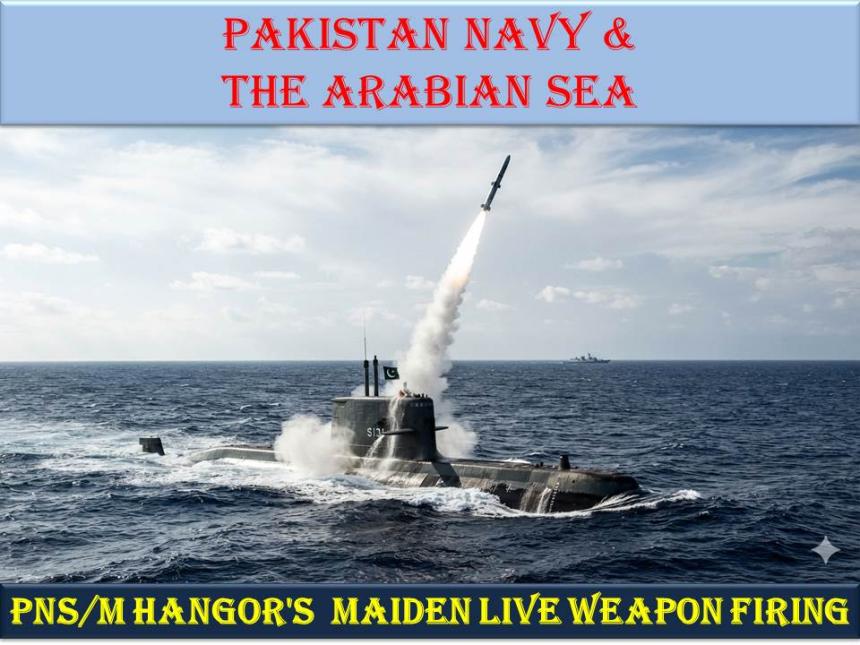

Pakistan Navy & The Arabian Sea
Pakistan Navy has transformed itself from a modest coastal defense force into a highly networked, technology-driven maritime power capable of enforcing a credible sea denial strategy. The geopolitical landscape of the Indian Ocean Region (IOR) is undergoing a profound transformation, driven by rapid military modernization and shifting maritime balances. This write up "Pakistan Navy & The Arabian Sea" is about the latest maiden weapon live firing from PNS/M Hangor which has also been inducted in Pakistan Fleet earlier during last year.
أَعُوذُ بِاللّٰهِ مِنَ الشَّيْطَانِ الرَّجِيمِ
بِسۡمِ ٱللهِ ٱلرَّحۡمَـٰنِ ٱلرَّحِيمِ
In the name of ALLAH, the Most Gracious, the Most Merciful
Pakistan Navy & The Arabian Sea
(Strategic Asymmetry, Multi-Domain Integration, and the Hangor-Class Submarine)
Abstract
This paper analyzes the strategic operationalization of the Pakistan Navy's newly inducted Hangor-class submarine, PNS/M HANGOR, following its successful maiden Live Weapon Firing in the North Arabian Sea. It evaluates the vessel's technological advancements—most notably Air-Independent Propulsion (AIP) and long-range anti-ship cruise missile integration—within the broader context of Pakistan's evolving maritime doctrine over the past two decades. The study examines how the Pakistan Navy counters regional conventional asymmetries through a cost-effective strategy of asymmetric sea denial, supported by a sophisticated multi-domain operations web. Finally, it highlights the structural transition toward self-reliance enabled by the indigenous defense manufacturing matrix of KS&EW, NESCOM, and internal naval development structures.
Executive Summary
- Strategic Milestone: The successful maiden live firing of an extended-range anti-ship cruise missile by PNS/M HANGOR marks a qualitative shift in Pakistan’s subsurface combat readiness, validating its weapon integration and underwater stealth capabilities.
- Asymmetric Advantage via AIP: The induction of eight Hangor-class submarines (equipped with AIP technology) expands submerged endurance to three weeks. This capability shifts the regional tactical balance by creating a highly potent, invisible Anti-Access/Area Denial (A2/AD) bubble across the North Arabian Sea and beyond.
- Network-Centric Lethality: The platform operates as an integrated node within a multi-domain operations web, linking subsurface assets with land, air, and unmanned surveillance networks. This allows for automated target acquisition and kill-chain execution without compromising submarine stealth.
- Divergent Military Philosophies: Unlike resource-heavy and fragmented procurement models optimized for global power projection, Pakistan’s defense architecture is tightly streamlined for data-driven, asymmetric efficiency—rendering its naval posture significantly more effective than the sum of its individual parts.
- Institutional Self-Reliance: The program establishes a sustainable framework for engineering sovereignty. Through targeted technology transfers, a robust trilateral partnership between KS&EW, NESCOM, and the Pakistan Navy’s internal development structures ensures the domestic production and long-term evolution of strategic maritime assets.
Introduction
The geopolitical landscape of the Indian Ocean Region (IOR) is undergoing a profound transformation, driven by rapid military modernization and shifting maritime balances. A pivotal milestone in this arena occurred with the Pakistan Navy’s successful maiden Live Weapon Firing (LWF) from its newly inducted submarine, PNS/M HANGOR, in the North Arabian Sea. By launching an anti-ship cruise missile and destroying a designated target at an extended range with pinpoint precision, the Pakistan Navy has not only validated the combat readiness of its newest asset but has also signaled a major qualitative shift in its underwater warfare capabilities.
Over the last two decades, the Pakistan Navy has transformed itself from a modest coastal defense force into a highly networked, technology-driven maritime power capable of enforcing a credible sea denial strategy. This evolution has been shaped by profound operational challenges. Chief among them are a stark conventional force asymmetry with a numerically superior rival, severe domestic budgetary constraints, and a historical vulnerability to broad 'sea blindness' within national policy frameworks. Furthermore, the operationalization of the Gwadar Port and the China-Pakistan Economic Corridor (CPEC) exponentially expanded the Navy's area of responsibility, demanding a permanent presence to secure critical Sea Lines of Communication (SLOCs) from hybrid, conventional, and non-conventional maritime threats.
Despite these hurdles, the last 20 years have seen an aggressive reinforcement of Pakistan’s maritime strength. Moving away from a purely defensive posture, the Navy has prioritized high-yield, networked capabilities over raw platform counts. Key surface inductions have included four advanced Tughril-class (Type 054A/P) multi-mission frigates from China, modern Babur-class (MILGEM) corvettes developed in partnership with Türkiye, and the highly versatile Yarmook-class corvettes (built by Dutch shipbuilder Damen). Together, these modern platforms bring formidable anti-air, anti-surface, and anti-submarine capabilities to the fleet.
Concurrently, the establishment of the international AMAN exercise series since 2007 has elevated Pakistan’s maritime diplomacy into a powerful global platform. Drawing over 50 nations into a unified counter-piracy and counter-terrorism framework, these biennial drills are anchored in a profound message: promoting peace for all in the Indian Ocean. Operating under the official slogan "Together for Peace," the AMAN exercises highlight the Pakistan Navy’s role as a collaborative regional stabilizer. These two decades of modernization and strategic outreach have culminated in a potent blend of foreign technology transfer and deep integration, laying the structural groundwork for the Hangor-class to thrive.
Technical Prowess and Combat Capabilities
The PNS/M HANGOR is the vanguard of an ambitious eight-vessel procurement program, representing a massive technological leap forward for Pakistan’s submarine fleet. At the core of its strategic value is the integration of Air-Independent Propulsion (AIP) systems. Traditional diesel-electric submarines must surface or snorkel frequently to recharge their batteries, leaving them highly vulnerable to modern anti-submarine warfare (ASW) surveillance. AIP technology shatters this limitation, allowing the Hangor-class to remain submerged for weeks at a time. This extreme endurance, combined with advanced acoustic silencing, grants the vessel unparalleled stealth in the challenging littoral waters of the Arabian Sea.
The success of the live weapon firing confirms that this stealthy platform is backed by lethal teeth. The seamless integration of extended-range anti-ship cruise missiles allows the submarine to engage surface threats well beyond the horizon. Furthermore, the platform's architectural capacity to deploy dual-use precision systems—including the potential for nuclear-capable regional deterrence weapons like the Babur-3—solidifies its role as a survival-driven asset capable of maintaining a robust second-strike capability.
The Economics of Sea Denial and Multi-Domain Integration
The deployment and successful weapon testing of PNS/M HANGOR carries immense strategic weight, primarily serving as a highly efficient maritime deterrent. In the matrix of South Asian security, asymmetric naval balances have long pressured Pakistan to seek innovative, cost-effective, and highly lethal defensive measures. The Hangor-class addresses this imbalance by exponentially increasing the operational and financial cost of sea denial for adversarial surface fleets.
A submarine, however, is only as lethal as its targeting data. Rather than operating in isolation, the Hangor-class is seamlessly woven into a sophisticated multi-domain operations web. By feeding off an integrated data network that connects subsurface assets with land-based radar, maritime patrol aircraft, and unmanned aerial vehicles (UAVs), these submarines can complete complex kill chains without exposing themselves through active sensors.
With an extended submerged endurance of three weeks, a cluster of advanced AIP submarines can remain continuously deployed and undetectable. This prolonged operational window completely alters the tactical calculus in the region; it forces an adversary to expand its ASW resources thin across the entirety of its maritime periphery—stretching from the Arabian Sea all the way to deep-water ports in the Bay of Bengal—keeping hostile forces permanently guessing.
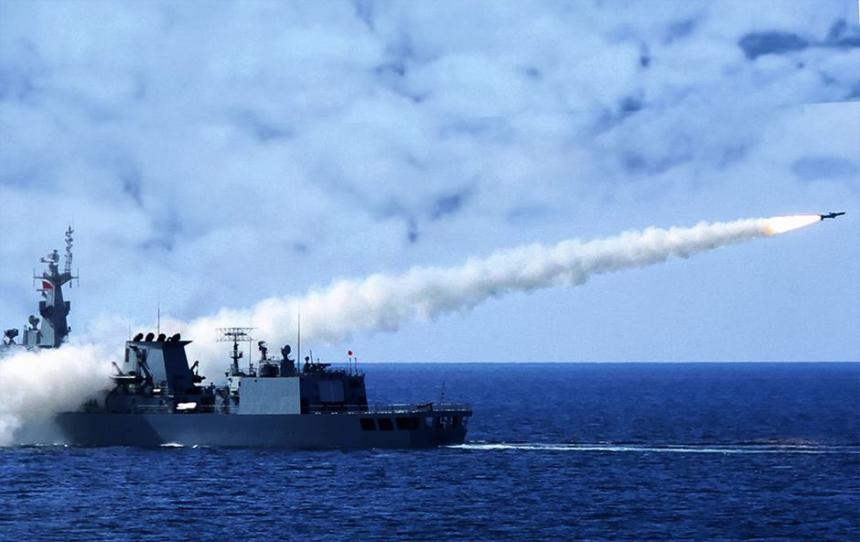
Divergent Procurement Philosophies and Strategic Efficacy
The structural contrast between the regional defense establishments reflects fundamentally different strategic constraints and procurement philosophies. While larger regional defense budgets are frequently strained by complex, fragmented, and bureaucratic global power projection goals—such as the simultaneous pursuit of aircraft carriers and indigenous destroyers—Pakistan’s procurement is tightly optimized for asymmetric efficiency.
By focusing heavily on unified networks, standardized platforms, and targeted technology transfers, Pakistan ensures its systems are data-driven and fully integrated. The overarching Hangor agreement structures this procurement into two deliberate phases:
- Phase One: The construction of the first four hulls in China, ensuring rapid technology transfer and timely fleet reinforcement.
- Phase Two: The transfer of technical expertise to the Karachi Shipyard & Engineering Works (KS&EW), where the final four submarines are being built domestically.
This streamlined synergy ensures that Pakistan's naval defense architecture functions as significantly more than the sum of its individual parts.
The Conclusion
Crucial to the sustainability of this modernization is Pakistan’s aggressive transition toward self-reliance, achieved through robust indigenous capability. This is driven by the structural synergy between the Karachi Shipyard & Engineering Works (KS&EW), national research bodies like NESCOM, and the Pakistan Navy's own internal infrastructure. KS&EW's proven capacity to build complex surface vessels and advanced AIP submarines domestically ensures localized engineering sovereignty. Concurrently, NESCOM provides critical development for indigenous missile tech and electronic systems, while the Navy's own technical commands optimize software and sensor integration. This trilateral indigenous matrix ensures that Pakistan’s strategic assets are not merely purchased, but organically sustained, secured, and evolved from within.
The maiden live weapon firing of PNS/M HANGOR is far more than a routine military exercise; it is the opening chapter of a rejuvenated maritime strategy in the Arabian Sea. In a strategic environment where full-spectrum deterrence is paramount, assets like the Hangor-class act as a vital insurance policy. By successfully pairing deep-submergence stealth with an integrated multi-domain operations web, the Pakistan Navy has demonstrably enhanced its defensive posture—ensuring that it retains the capability to exact an unacceptably high operational cost from any hostile force and preserving equilibrium across the vital waters of the Indian Ocean.



Explore Creative Kitchen Cabinets Design Ideas for Your Home
A well-planned kitchen cabinets design can transform the appearance and functionality of y...
