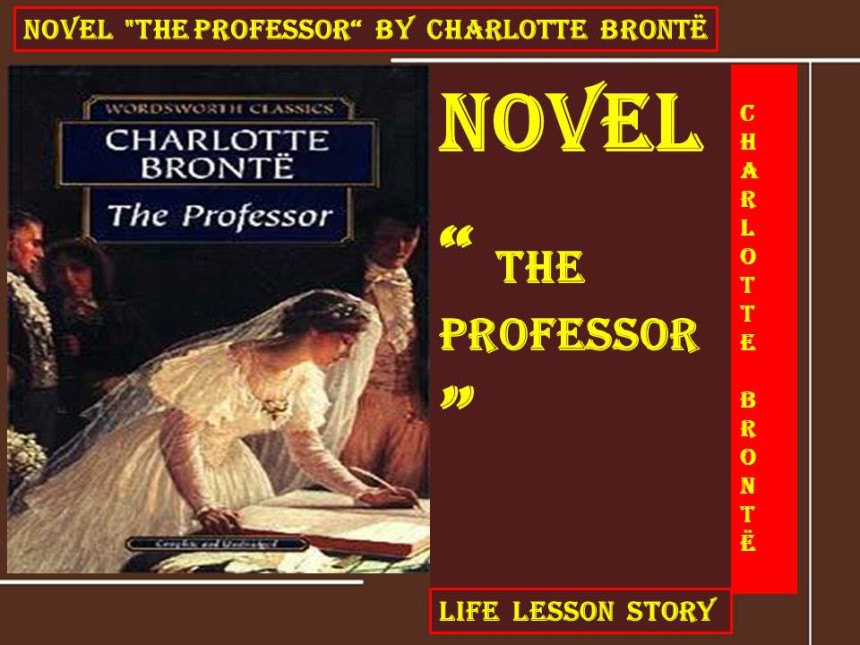

Novel "The Professor" By Charlotte Brontë
Charlotte Nicholls, maiden name Charlotte Brontë (April 21, 1816 - March 31, 1855) was an English novelist and poet. The Novel "The Professor" By Charlotte Brontë is believed to have been written in 1846 and centers on themes of independence, ambition, identity, and building a purposeful life. This write up has been arranged for educational purposes.
بِسۡمِ ٱللهِ ٱلرَّحۡمَـٰنِ ٱلرَّحِيمِ
In the name of ALLAH, the Most Gracious, the Most Merciful
Novel "The Professor" By Charlotte Brontë
The Professor, A Tale; was the first novel written by English author Charlotte Brontë. Charlotte Nicholls, commonly known by her maiden name Charlotte Brontë (April 21, 1816, Thornton, United Kingdom - March 31, 1855, Haworth, United Kingdom) was an English novelist and poet, and was the elder sister of Emily, Anne and Branwell Brontë. She is best known for her novel Jane Eyre, which was first published under the pseudonym Currer Bell. Her work is described to have been Influenced by William Shakespeare, Lord Byron and Walter Scott etc.
Charlotte Brontë wrote the novel "The Professor" in 1846 before Jane Eyre, but was rejected by many publishing houses. "The Professor" Charlotte Brontë's first novel, follows the life of William Crimsworth, an orphan who confronts the challenges of family dynamics, employment, and love. The Professor was based on Brontë's experiences in Brussels as a pupil and teacher at Constantin Héger's school for girls. In the novel William Crimsworth, an Englishman, becomes a teacher in Brussels and falls in love with a fellow teacher. Crimsworth is based on Héger, to whom Brontë was devoted.
The most important themes of The Professor are touched upon, Religion, Patriotism, Social identity and Gender Issues. Charlotte Bronte explored the theme of religion as an optimistic aspects as well as the oppressive side of the church and its incapability.
Hunsden Yorke Hunsden, a flippant, cynical mill owner who befriends William Crimsworth. He encourages William abroad, buys for him his mother's portrait when Edward Crimsworth's belongings are auctioned off, and later becomes William's adviser on investments.
Charlotte Brontë's The Professor centers on themes of independence, ambition, identity, and building a purposeful life, following protagonist William Crimsworth's journey from struggling Englishman to respected teacher in Belgium, highlighting self-reliance, moral integrity, authentic love, and the value of character over superficiality, contrasting with her more passionate works through quiet realism.
Charlotte Brontë's The Professor; William Crimsworth seeks dignity and purpose by rejecting family wealth for honest work in Belgium, exploring true connection through shared struggle and mutual respect, contrasting materialism with inner worth, and highlighting education's transformative power against societal limitations, especially for women.
The Summary of "The Professor" by Charlotte Brontë
In The Professor, Charlotte Brontë follows the life of William Crimsworth. Along the way, the author reflects on the hardships of life, the perseverance needed to face and overcome those hardships, the necessity and value of education, and the variety of relationships possible between people. These are all still relevant to modern readers, who may face different challenges than the novel’s characters but must still cope with the same underlying struggles. Through Crimsworth’s eyes, Brontë offers advice, inspiration, and plenty of food for thought.
A Rough Start
William Crimsworth, orphaned and raised by cold, aristocratic uncles, is offered a comfortable living in the Church and a marriage to a cousin. Disgusted by their condescension and determined to earn his own way, William refuses both, choosing instead to follow in his late father's footsteps as a tradesman. This decision sets him on a path of hardship, as he seeks to define himself through honest labor rather than inherited privilege, and foreshadows the struggles and self-determination that will shape his life.
The novel opens with a letter from William Crimsworth to a school friend from Eton. Crimsworth describes how his aristocratic uncles offer him a position in the Church and marriage to a cousin after he leaves school. Crimsworth turns them down on both counts. Instead, he decides to follow the path of his father. “I will be a tradesman,” he informs his disgusted uncles.
Crimsworth reconnects with his older brother, Edward, a mill owner. It is clear from the beginning that Edward hates Crimsworth even though he gives him a position as a clerk in his counting house. “I served Edward as his second clerk faithfully, punctually, diligently,” Crimsworth explains. Yet his brother treats him with continual contempt. Instead of finding familial support, William encounters coldness, rivalry, and even cruelty. Edward, threatened by William's intelligence and independence, treats him as a subordinate, not a sibling. The toxic environment at Crimsworth Hall and the mill, compounded by Edward's proud and jealous nature, forces William to confront the reality that blood ties offer him no refuge, and that he must rely on his own resilience.
William's life as a clerk in his brother's mill is marked by relentless toil, humiliation, and emotional isolation. Edward's tyranny is absolute, and William's efforts to maintain dignity are met with suspicion and sabotage. The only warmth he finds is in the memory of his mother and fleeting glimpses of beauty in the harsh industrial landscape. The mill becomes a symbol of the soul-crushing effects of unchecked power and class division, pushing William toward a breaking point.
At a dance at Edward’s home, Crimsworth meets Yorke Hunsden, another mill owner. Hunsden is sarcastic, abrupt, and unconventional, but he takes an interest in Crimsworth to the point that he publicly criticizes Edward’s harsh treatment of his brother. Crimsworth is thereby fired from his position, and Hunsden gives him a letter of recommendation and suggests he go to Belgium. Crimsworth is relieved by the turn of events, knowing that he did nothing to cause it. “I had not forced circumstances; circumstances had freed me,” he remarks.
A New but Imperfect Life
After a final confrontation with Edward, William resigns, severing his last familial tie. With little money and no prospects, he follows the advice of the eccentric but insightful Hunsden and travels to Belgium. There, he hopes to find honest work and a new beginning, free from the oppressive class structures and personal animosities of England. The journey is both literal and symbolic—a crossing from darkness into the possibility of self-made light.
William Crimsworth arrives in Brussels, Belgium, determined to make a new life for himself, at least partially on his terms. He meets with Mr. Brown, Hunsden’s associate, and on Brown’s recommendation, takes a position as an English and Latin “professor” at Monsieur Pelet’s school for boys. Crimsworth quickly establishes his authority over the boys, who grudgingly give him their respect, and the professor’s life settles into a routine of classes. Though the work is demanding and the pay modest, William finds satisfaction in honest labor and the respect it brings. He is introduced to the complexities of Belgian society, the challenges of cross-cultural communication, and the subtle power dynamics of the classroom. Teaching becomes both his livelihood and a means of self-discovery.
Next door to Pelet’s establishment is a girls’ school run by Mademoiselle Zoraide Reuter. Crimsworth soon takes a position teaching English to the young ladies. Mademoiselle Reuter often engages Crimsworth in conversation, and her manner and attention draw him in. He discovers, too, that teaching girls is quite different from teaching boys. He quickly adapts his method, surprised by the girls’ “conceited coquetry,” yet “the mutiny was quelled” by his determination.
Crimsworth soon realizes that Mademoiselle Reuter is a “crafty little politician” with ulterior motives toward him. He enjoys sparring with her but is still somewhat attracted by her charms. One night, he overhears an exchange between Pelet and Mademoiselle Reuter in the garden. The two are involved in an intimate relationship and are merely manipulating Crimsworth. William, wary but intrigued, navigates her advances and the social labyrinth of the pensionnat, where appearances often mask ambition and self-interest.
Crimsworth does not allow himself to fall into depression. “Reason was my physician,” he says. He works through the situation logically and adopts a new manner toward Mademoiselle Reuter and Pelet. He also continues in his positions, teaching as he always has. The chapter explores the dangers of misplaced trust and the complexities of female agency.
Soon, Crimsworth gets a new pupil, Frances Evans Henri, the sewing teacher at Mademoiselle Reuter’s school. Frances wants to improve her English, and Crimsworth is drawn to the young woman’s serious manner and underlying talents. He begins to give her special attention, which makes Mademoiselle Reuter jealous.
As Crimsworth gets to know Frances, he appreciates her quiet persistence and learns about her background. Frances is the orphan of a Swiss father and an English mother, and she dreams of visiting England. She is poor with few resources or hopes of improving her life, but she holds onto her dreams and works hard to improve her mind, using her small income to pay for lessons in many subjects. Through shared lessons, they discover a meeting of minds and hearts, each finding in the other a kindred spirit. Their love grows quietly, rooted in mutual admiration and the shared experience of hardship. The school, with its rigid hierarchies and petty intrigues, becomes a backdrop for their private world of learning, hope, and emotional awakening.
Crimsworth’s admiration for Frances grows, but so does Mademoiselle Reuter’s jealousy. Mademoiselle Reuter dismisses Frances from her position. Frances’ absence shows Crimsworth how much he has come to love the young woman, and he greatly resents Mademoiselle Reuter’s manipulation and deception. He quits his position at her school. When Pelet and Mademoiselle Reuter announce their engagement, Crimsworth decides he can no longer remain at Pelet’s establishment. He decides to leave, yet this sets him back into a position without income. Further, he cannot find Frances, and Mademoiselle Reuter claims not to know her address, although he knows she is lying.
Happiness for Always
Crimsworth sets out on his own, but he has the support of one of his pupil’s fathers, Mr. Vandenhuten, whose son he saved from drowning. This man uses his influence to obtain Crimsworth a position teaching English at a college. Crimsworth meets Frances again in a cemetery where she is mourning her aunt. The two reestablish their connection, and Crimsworth finally understands how much he loves her. Their reunion is marked by honesty, vulnerability, and a renewed commitment to face life's challenges together. The graveyard setting underscores the themes of mortality, resilience, and the redemptive power of love.
Frances also gets a new teaching position, and Crimsworth proposes marriage. Hunsden visits and he and Frances develop a habit of debating that they both enjoy. Crimsworth and Frances marry and set up housekeeping, both teaching successfully. They have a son named Victor, and Frances, with Crimsworth’s full approval and support, starts her own school.
With modest means and mutual support, William and Frances marry and establish a small but thriving school. Their partnership is one of equals, each contributing to their shared success through hard work, respect, and affection. The school becomes a symbol of their triumph over adversity and their ability to create meaning and happiness through perseverance and cooperation.
The Crimsworths' school flourishes, attracting students from diverse backgrounds and earning a reputation for excellence. Frances, once a marginalized lace-mender, becomes a respected educator and role model. Their work is not only a means of survival but a mission to empower others through knowledge and self-discipline. The school stands as a testament to the transformative power of education and the dignity of honest labor.
A Home of Their Own : Peace, partnership, and the promise of the future
Through years of diligence and sacrifice, the Crimsworths achieve financial independence and social respectability. Their success is not marked by wealth or status, but by the satisfaction of a life built on integrity, love, and self-reliance. The narrative reflects on the meaning of happiness, the value of work, and the quiet heroism of ordinary lives.
Ten years later, Crimsworth says, “we have realized an independency.” Their hard work and discipline have paid off, and “To England we now resolved to take wing...Frances realized the dream of her lifetime.” After traveling for a while, they settle down in a home near Hunsden, which spices up life significantly. Crimsworth enjoys the domestic environment with his wife and son and is happy and content.
The story closes with William and Frances enjoying the fruits of their labor in a modest but happy home. Their son, Victor, embodies the hope and potential of the next generation. The couple's journey—from orphaned ambition and grinding poverty to love, partnership, and self-made security—serves as a quiet affirmation of the values of perseverance, honesty, and mutual respect.
Conclusion
Brontë's stated aim was to depict a hero who earns his way through life, without sudden windfalls or improbable rescues. The plot is grounded in the realities of work, poverty, and social constraint, with no miraculous reversals or idealized love interests. This realism is both a narrative device and a thematic statement, challenging the conventions of Victorian fiction and emphasizing the dignity of ordinary lives.
Work—whether in the mill, the classroom, or the home—is both a source of suffering and a means of self-realization. Education, for both William and Frances, is depicted as a tool of empowerment, a way to transcend social barriers and claim agency. The school they build together becomes a symbol of hope, progress, and the possibility of a better future.
The Professor is Charlotte Brontë's meditation on the value of self-reliance, the dignity of honest labor, and the redemptive power of love grounded in mutual respect. Brontë offers a narrative of struggle, perseverance, and quiet triumph, in which happiness is not bestowed by fate but earned through effort and integrity.
At its heart, The Professor is a story of two outsiders—William and Frances—who, through resilience and partnership, carve out a space of freedom and fulfillment in a world that offers them little.
Charlotte Brontë's The Professor centers on finding fulfillment through integrity, perseverance, and genuine connection amidst societal constraints, highlighting themes of self-reliance, love, and challenging class/gender norms as protagonist William Crimsworth achieves modest success and an equal partnership with Frances Henri, showing that true wealth lies in mutual respect and honest labor, not just ambition or status.
Its lessons are as relevant today as in Brontë's time: that true contentment is found not in wealth or status, but in honest work, self-knowledge, and the courage to love and be loved as equals.






How to Sell Post Office Building Assets: A Guide for USPS Property Own...
Looking to sell post office building assets? This practical guide covers valuation, qualif...