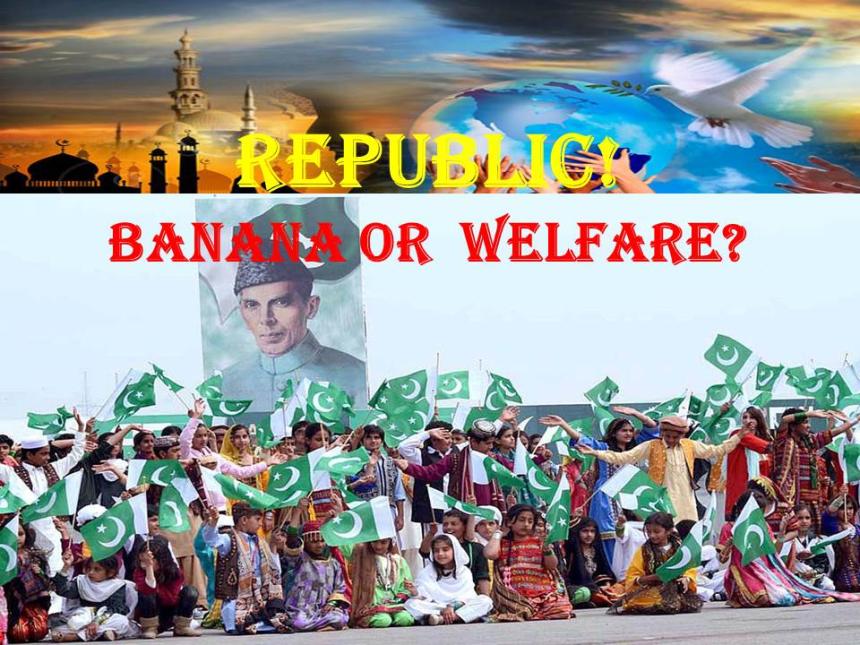

Republic! Banana or Welfare?
Republic was defined as living a just & moral life is inherently better, more fulfilling, and ultimately happier than living an unjust life, regardless of external rewards or consequences; hence a "Republic" must be a welfare state and an "Islamic State" can't be anything but God Fearing welfare state. This write up is an opinion on the current status of Pakistan based on an article published in "The Friday Times".
أَعُوذُ بِاللّٰهِ مِنَ الشَّيْطَانِ الرَّجِيمِ
بِسۡمِ ٱللهِ ٱلرَّحۡمَـٰنِ ٱلرَّحِيمِ
اللہ کے نام سے شروع جو بڑا مہربان نہایت رحم کرنے والا ہے
In the name of ALLAH, the Most Gracious, the Most Merciful
Republic! Banana or Welfare?
"The Republic" is a famous Socratic dialogue authored by Plato around 375 BC (some 2400 years ago) and much talked about in the world since the age of awakening after "Magna Carta". The main point of Plato's Republic is to define justice and prove that living a just, moral life is inherently better, more fulfilling, and ultimately happier than living an unjust life, regardless of external rewards or consequences.
The profound impact of The Republic—and classical Greek philosophy in general—saw a massive resurgence during the Renaissance and the Age of Enlightenment. As European thinkers moved past the Middle Ages, texts like The Republic helped shape modern conversations about law, individual liberties, and human society.
In this digital age, the world has moved far away from discussions on the topic "Republic" because it's no more a concept but has taken solid shape. Now the world knows that "A republic is a form of government where ultimate power resides with the citizens. In this system, citizens elect representatives to make laws and govern on their behalf. Crucially, a republic has no monarch, and the head of state—such as a president—is chosen through elections rather than inheritance".
Western civilization shifted to the nation-state model by combining sovereignty with the republican ideal. This transition provided a profound structural benefit: shifting ultimate political power from hereditary monarchs to "the people," which enabled widespread civic participation, built institutional accountability, and fostered unified national identities.
The Western Nations were the colonial masters of global south and it provided "freedom or independence" to their colonies; albeit the rights enshrined in "Republic"; which it chose for itself. Pakistan also came into being on 14th August 1947 after separation from British India; a country under colonial rule since 1857. The country came into being after a division of India on the basis of "Two Nation Theory"; to become an Islamic State; a Republic; to adopt a model in sync with Rashidun Caliphate. However; the 79 years since independence may reflect only one image for this country- a "Laboratory" for experimenting dictatorial models. Hence, the debate about the form, type and kind of government is continuing in abundance.
In the following, let's read an article published in local daily "The Friday Times" on July 13, 2026 and written by Saad Hafiz.
The Republic! Pakistan Has Yet to Build?
Successful states create unity not by eliminating diversity, but by ensuring that different communities feel represented and invested in a shared future.
Pakistan’s greatest challenge today is not defending the idea of the state, but completing the work of building one. Every country carries a story about why it was created. Pakistan’s story began with a powerful idea: that Muslims of British India constituted a distinct political community whose cultural, religious, and political interests required protection through a separate homeland.
That idea shaped the creation of Pakistan and remains central to how many Pakistanis understand their national identity. But nearly eight decades later, the question facing the country is no longer only why Pakistan was created. The more difficult question is what kind of state it wants to become.
Pakistan’s challenge is not choosing between its history and modernity. It is finding a way to preserve a sense of national identity while building a state based on equal citizenship, constitutional government, tolerance, and institutional strength. Many countries struggle with this balance, but Pakistan’s experience has been particularly complex because questions of identity, security, democracy, and economic development have always been deeply connected.
From its earliest years, Pakistan has wrestled with the challenge of managing diversity. It is a country of different languages, cultures, ethnicities, and regional identities. A strong national identity cannot be built by ignoring these differences or demanding conformity. Successful states create unity not by eliminating diversity, but by ensuring that different communities feel represented and invested in a shared future.
This is why federalism is more than a constitutional arrangement; it is a foundation of national cohesion. Pakistan’s provinces have different histories, resources, and political aspirations. A healthy federation does not view these differences as threats. Instead, it creates institutions that allow diversity to coexist with a common national purpose.
When citizens believe their voices matter and their regions are respected, diversity becomes a source of strength. When communities feel excluded or unheard, differences can become sources of political tension and instability. The challenge is not creating uniformity, but creating belonging. Pakistan’s security concerns are also real. Its geography, regional rivalries, terrorism challenges, and difficult neighborhood have ensured that national defense remains a major priority. The Pakistan Army has played a central role in protecting the country’s territorial integrity, and many citizens continue to view it as an important national institution.
The challenge, however, is not whether Pakistan needs a capable security institution. It does. The challenge is ensuring that all national institutions operate within a constitutional framework that strengthens, rather than weakens, the state. History shows that security alone cannot create a successful nation. Military capability can protect borders, but only strong civilian institutions, accountable governance, rule of law, and economic opportunity can build lasting national confidence. The strongest states are those where institutions complement each other and where legitimacy comes from both security and public trust.
Pakistan’s economic journey reflects a similar challenge. For decades, the country has moved through repeated cycles of external assistance, debt management, and short-term stabilization. These measures may provide temporary relief, but they cannot replace the deeper reforms needed to create a productive and self-reliant economy.
National power in the 21st century is built not only through military strength, but through human development, technological capability, exports, education, and innovation. Countries that succeed economically are those that create conditions where businesses can grow, talent can flourish, and citizens can participate in a productive economy. Pakistan must move beyond a cycle of crisis management toward long-term economic transformation. Social protection remains essential, but redistribution cannot permanently substitute for wealth creation. A country must first expand its economic capacity before it can sustainably provide opportunities and security for its people.
This also requires rethinking the relationship between the state and society. Citizens do not judge a state only by its ability to defend territory; they judge it by whether it provides justice, opportunity, dignity, and a sense of ownership. National strength comes when people believe institutions work for them rather than above them. Ultimately, Pakistan’s unfinished task is not simply political—it is institutional. The country must answer difficult questions about the relationship between the state and citizens, the center and provinces, security and liberty, identity and pluralism.
The Pakistan of the future will not be built only through stronger defenses or louder political battles. It will be built through trust: trust that institutions serve citizens, that diversity is respected, that rights are protected, and that national progress belongs to everyone. The true measure of Pakistan’s success will not only be whether it survives challenges. It will be whether it builds a republic where its people believe they have a meaningful place within it.
NOTE: The above is taken from the LINK as follows:-
https://www.thefridaytimes.com/13-Jul-2026/republic-pakistan-yet-build
Can a Republic be a Problem?
A "Republic" may be problematic primarily because its representative and majoritarian frameworks can lead to the "tyranny of the majority," systemic gridlock, and the marginalization of minority groups. Additionally, some argue that republics concentrate excessive “executive power” and are vulnerable to plutocracy, where “wealthy elites” hold disproportionate political influence.
Ruling elites, nobility, and those loyal to a "king" (any form of dictator) strongly opposed the establishment of a republic. They favor absolute monarchy (democratically elected king like Bhutto of Pakistan), oligarchy (Waderas, Rich Businessmen) or aristocratic systems (Hum Hukamran Khandan; Larkana or Gwalmandi).
The country called Pakistan came into being to be an "Islamic Republic"; but there remained till today many vested interest groups (even as organs and institutions of state) which never wanted to be answerable or accountable for their actions and unrestricted greed for accumulation of wealth and power. Those groups strengthened control over state resources with every passing day and by Machiavellian constitutional amendments have gained unrestricted power over the lives of the people-the state themselves and owner of the resources of the land (definitely in republic).
Hence the query like "why Pakistan was created and what kind of state it should become?" is still debated. Pakistan was created to provide a separate homeland where Muslims of the Indian subcontinent could practice their religion, preserve their culture, and secure their political and economic rights. Quaid-e-Azam Muhammad Ali Jinnah and Allama Iqbal, the country was designed to be a modern, democratic Islamic state. (A Republic on the model of Riyasat-e-Medina).
Is diversity a problem? Pakistan came into being in two wings; two distinctly diverse geographical regions with diverse local language and traditions; and the only common factors between the two were the religion-Islam and common challenges of nation building for removal of poverty, economic devastation and security from Hindu India. The ruling elite could not manage the diversity and opted for separation although through violent means. East Pakistan became Bangladesh on 16 December 1971.
However, the "Ruling Janta" of the country after the "Fall of Dhaka" has successfully cultivated diversity (division) in "West Pakistan" and has event fully created a monster of it as well. The divide and rule mantra may have provided votes in the ballot but has also fueled hate & anger; and rage for biting the bullet has been engrossing.
The agony is that measures were enshrined in constitution for maintaining poverty and status in the name of “quota” and protection of certain section of population. The past five decades have only proved that quota system was actually a measure for creating division. Then poverty was protected n the name of support; e.g. Benazir Income Support Programme.
No country may survive a foreign threat with a credible deterrent and thus Armed Forces are a necessity and not luxury. However, National power in the 21st century is built not only through military strength, but through human development (education and skills), enhancing technological capability and exports and innovative creation of indigenous resources.
The Conclusion
A state functions through essential foundational organizations or institutions. At its core, a sovereign state relies on a permanent population, a defined territory, sovereignty (supreme authority over its affairs), and an organized government. The essential organizations of a republic state are defined by the constitutional separation of powers, primarily consisting of the Legislature (which makes laws), the Executive (which enforces laws), and the Judiciary (which interprets laws). These bodies operate under popular sovereignty, meaning political authority derives from the citizens.
Pakistan will be “Republic” only, when the people of the country, will gather power, to enforce its will on the affairs of the state. This principle was manifested through “French Revolution” and is also enshrined in the “Objectives Resolution”. It establishes that the authority of the state is a sacred trust exercised by the people through chosen representatives for establishment ALLAH’s commandments in true spirit.
The people will foster influence on affairs of state only when they ooze sovereignty in their own being and that is only possible when they perceive honour, dignity and respect as their birth right with free will to have opinion and express it too and freedom to live and let live others.
Republic was defined as living a just & moral life is inherently better, more fulfilling, and ultimately happier than living an unjust life, regardless of external rewards or consequences; hence a "Republic" must be a welfare state and an "Islamic State" can't be anything but God Fearing welfare state.

Urgent Care Near Me Open Now: Fast Medical Help Anytime | ER of Forthw...

Social Science Assignment Help in UAE: Strengthening Research, Critica...
Academic success is built through steady improvement rather than perfection. Each assignme...

Assignment Help for Canadian Students: A Complete Guide to Academic Su...
Pursuing higher education in Canada is an exciting journey, but it also comes with demandi...