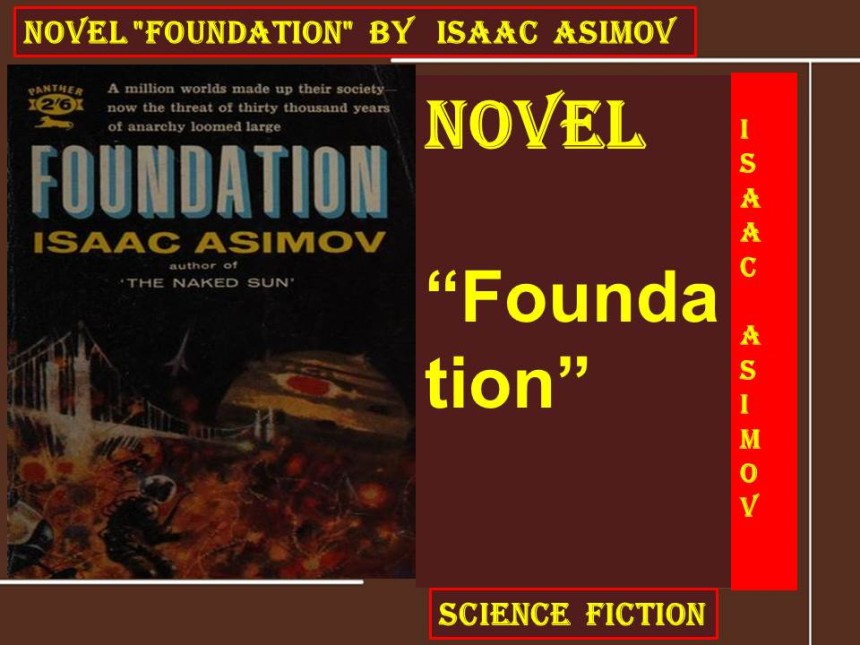

Novel "Foundation" By Isaac Asimov
Isaac Asimov (January 2, 1920 - April 6, 1992) was a Russian born, American writer and professor of biochemistry at Boston University. "Foundation" is a science fiction novel by American writer Isaac Asimov. The main theme of Isaac Asimov’s Foundation is the inevitability of the fall of large, corrupt empires and the use of science—specifically psychohistory—to manage the transition, shorten the ensuing dark age, and steer the course of history. This write up has been arranged for educational purposes.
بِسۡمِ ٱللهِ ٱلرَّحۡمَـٰنِ ٱلرَّحِيمِ
In the name of ALLAH, the Most Gracious, the Most Merciful
Novel "Foundation" By Isaac Asimov
Elon Musk, a businessman and entrepreneur known for his leadership of Tesla, SpaceX, Twitter, and xAI; ha recently said that the "Foundation Series" inspired him to start SpaceX. I respect science fiction writers because they create scenarios of what they think the future will be like. Foundation is a science fiction novel by American writer Isaac Asimov.
Isaac Asimov (January 2, 1920, Petrovichi, Russia - April 6, 1992 New York, United States) was a Russian born, American writer and professor of biochemistry at Boston University. During his lifetime, Asimov was considered one of the "Big Three" science fiction writers. It is the first book in the Foundation Trilogy. Foundation is a cycle of five interrelated short stories, first published as a single book by Gnome Press in 1951. The Complete Isaac Asimov's Foundation Series Books 1-7 (Foundation, Foundation and Empire, Second Foundation, Foundation's Edge, Foundation and Earth, Prelude to Foundation, Forward the Foundation).
The main theme of Isaac Asimov’s Foundation is the inevitability of the fall of large, corrupt empires and the use of science—specifically psychohistory—to manage the transition, shorten the ensuing dark age, and steer the course of history. It explores the interplay between large-scale historical forces and individual actions, prioritizing intellectual, strategic, and technological power over raw force. The core conflict is not just between good and evil, but between stagnation and progress, managed through calculated, long-term planning.
The Key Themes and Analysis can be narrated as follows:-
Psychohistory and Determinism: The story centers on Hari Seldon’s mathematical science that predicts the future behavior of massive populations, suggesting that historical trends are predictable and inevitable, even if individual actions are not.
The Rise and Fall of Civilizations: The narrative mirrors the decline of the Roman Empire, analyzing the cyclical nature of history and the inevitable decay of massive, stagnant political structures.
Knowledge and Technology as Power: The Foundation preserves knowledge and uses technological superiority (religion / science) to influence, control, and eventually dominate more powerful, but technologically stagnant, neighboring kingdoms.
Strategic Leadership (Seldon Crisis): The novel highlights that effective leadership requires foresight, diplomacy, and intellect, rather than mere violence, to survive inevitable crises.
Optimism and Legacy: Despite the bleak premise of galactic collapse, the book is fundamentally optimistic, highlighting humanity's ability to shape its future, preserve knowledge, and rebuild.
The central idea of Foundation by Isaac Asimov is that the inevitable fall of a civilization can be mitigated and the subsequent dark age significantly shortened through the application of psychohistory—a blend of history, sociology, and mathematics—which allows for the prediction and management of future societal trends. The novel emphasizes that while the fall of an empire is inevitable, proactive planning and the preservation of scientific thought can ensure the swift resurrection of civilization. The core theme is that "violence is the last refuge of the incompetent," focusing on how knowledge, technology, and foresight can guide civilization through collapse.
The Key Aspects of the Central Idea is as follows:-
Mathematician Hari Seldon calculates that the Galactic Empire will collapse, plunging the galaxy into 30,000 years of barbarism. He creates two "Foundations" at opposite ends of the galaxy to preserve knowledge and technology, aiming to reduce this chaos to only 1,000 years. The story explores whether the future is set by large-scale, impersonal forces or if individual actions can steer history. Seldon's plan relies on mathematical probabilities (the "Seldon Crisis") rather than specific individuals, though "clever" leaders like Salvor Hardin are required to navigate these crises. The Foundation is not just a repository of books; it is an active center for science and technology (especially nuclear energy) that uses knowledge as a tool to gain political influence over surrounding, less-advanced kingdoms. Inspired by Edward Gibbon’s The History of the Decline and Fall of the Roman Empire, the novel focuses on how empires rise, decay, and fall, and how a new civilization can be built from the ashes of the old.
Summary of Novel "Foundation" By Isaac Asimov
The novel "Foundation" tells a story of "our future" as believed by the writer Isaac Asimov. For twelve thousand years the Galactic Empire has ruled supreme. Now it is dying. Only Hari Seldon (main character and hero), creator of the revolutionary science of psychohistory, can see into the future—a dark age of ignorance, barbarism, and warfare that will last thirty thousand years. The series chronicles Empire's subsequent conflicts with the flowering Foundation and its allies over the course of the passing centuries, the characters and stories that bridge the divide between them, and how the galaxy's future is imperiled by the one event Seldon's psychohistory fails to predict.
Darren MacDonald gives review about "Foundation Trilogy" in Great Reads as “A sweeping fiction epic about the fall of the Galactic Empire spanning 25 million worlds. The Foundation, inclined towards individual action and liberty, is a colony dedicated to science and creating a new empire. The Second Foundation, unknown to the first, works to guide the future leaving them the masters of the universe. The trilogy is about ideas in action, particularly trade-offs between individual liberty and central planning, fate and free will. It’s also an entertaining space opera.”
Foundation by Isaac Asimov is a foundational science fiction novel detailing the collapse of a 12,000-year-old Galactic Empire and the efforts of psychohistorian Hari Seldon to minimize the ensuing Dark Age from 30,000 years to just one millennium. Seldon establishes a "Foundation" of scientists on the remote planet Terminus, designed to preserve human knowledge and technology through a series of inevitable, predicted crises.
The Key details may be summarized as follows:-:
Psychohistory: Seldon uses this mathematical science to predict that the Empire will fall and a 30,000-year barbarism will follow.
The Foundation: Set on Terminus, this group is forced to navigate, over decades, major political and social crises ("Seldon Crises") by relying on ingenuity rather than brute strength.
Some main characters in the novel "Foundation" by Isaac Asimov are:
Salvor Hardin: The first Mayor of Terminus, who uses political maneuvering and religion to overcome external threats from neighboring warlords.
Hober Mallow: A trader who shifts the Foundation's power from religious influence to economic, trade-based control.
The Mule is a fictional character in the Foundation series by Isaac Asimov. First appearing in the 1945 novella "The Mule", he is a mutant and telepath who seizes control of the galaxy as a dictator after the fall of the Galactic Empire.
There is one Sleeper also. We don't know much more than the hints of religious doctrine that the Sleeper is the deity of Gaal's home world that will awaken and save those who it can recognise among its chosen believers (those marked with the prayer stones).
Central to this story is Hari Seldon, a pioneering psychohistorian who foresees the Empire's fall and establishes the First and Second Foundations as critical components of his Seldon Plan. Following Seldon's death, his recorded teachings guide future generations in navigating political and societal challenges. Seldon is a psychologist and is mathematically brilliant. He established and legitimized the field of “psychohistory” which is the study of humanity. And he calculated the historical predictions of the future and outlined them in what was later known as The Seldon Plan. He predicted the mass action of human groups, the eventual demise of the Galactic Empire and the rebirth of a new Galactic Empire.
The Foundation Trilogy is brilliant because it demonstrates strategy in action. It highlights the dangers of not thinking for you, accepting the status quo, and not having a Plan B. You see the normalcy bias unfold, where people underestimate the possibility, severity and impact of an impending disaster so they fail to adequately prepare. When Seldon did the calculations for his historical predictions, he assumed that humanity would remain the same. The Foundation was defeated during one crisis because Seldon did not allow for anomalies like the “Mule” a mutant who could control people’s emotion and have them do his bidding.
Best Quotes from "Foundation" by Isaac Asimov
"Never let your sense of morals prevents you from doing what is right. Violence is the last refuge of the incompetent. To succeed, planning alone is insufficient." "The saddest aspect of life right now is that science gathers knowledge faster than society gathers wisdom. Never let your sense of morals prevent you from doing what is right. In life, unlike chess, the game continues after checkmate."
Key Lessons from Foundation Trilogy by Isaac Asimov
Think for yourself, or others will do it for you.
Things are seldom what they seem so dig beneath the surface.
Don’t accept the way things are simply because it’s the status quo.
What are your assumptions based on? Test them!
Nothing remains the same.
When creating scenarios in decision-making, have you taken into account the normalcy bias?
Conclusion
The core moral lesson of Isaac Asimov’s Foundation is that while individuals cannot stop the inevitable, slow decay of large, inflexible institutions (like empires), collective knowledge, foresight, and adaptability can shape a better future, limiting the duration of chaos. The series emphasizes that "violence is the last refuge of the incompetent" and that long-term planning, science, and cooperation are more effective than brute force.
Institutions that cannot change will eventually fall; survival requires flexibility. Preserving and advancing science is the key to rebuilding civilization after a collapse. True, long-term impact comes from collective effort and planning, not just individual, heroic action. Nothing is permanent; the rise and fall of civilizations is a natural, cyclical process. The value of anticipating problems (via "psychohistory") is to mitigate, rather than prevent, crises.
NOTE: The above has been arranged with the help of material available freely on Social Media Sites.
The Modular Business: Building a Company by Combining Virtual Offices,...

Best cancer care treatment Hospitals India
Best cancer care treatment Hospitals India