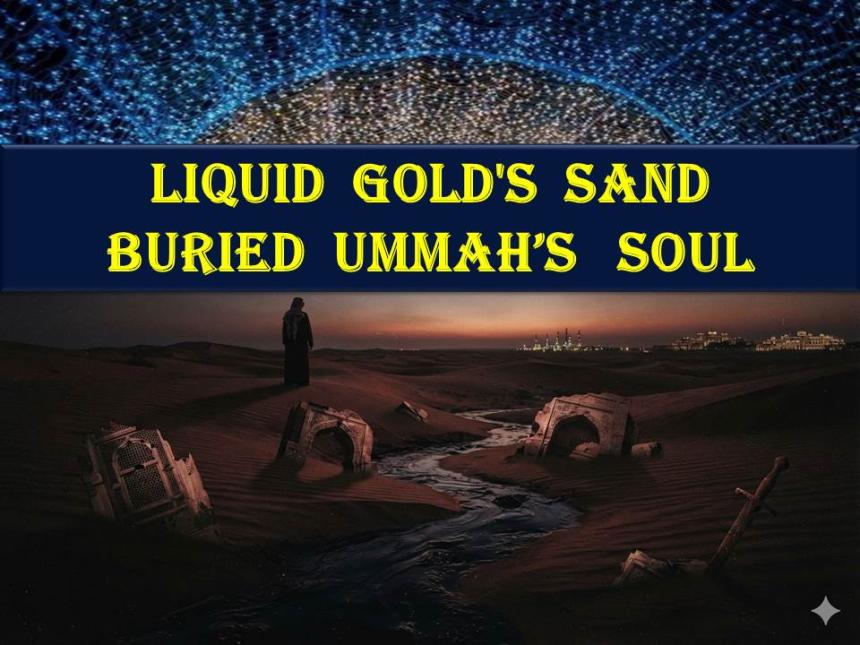

Liquid Gold's Sand Buried Ummah’s Soul
The title of this fictional story "Liquid Gold's Sand Buried Ummah’s Soul" is a symbolic piece of poetic imagery that refers to the discovery of oil (liquid gold) in the Middle East and its profound, sometimes corrupting, impact on the Islamic world (the Ummah). This story suggests that the sudden influx of extreme wealth may have "buried" or suffocated the spiritual, moral, and cultural values of the collective Muslim community (the Ummah).
أَعُوذُ بِاللّٰهِ مِنَ الشَّيْطَانِ الرَّجِيمِ
بِسۡمِ ٱللهِ ٱلرَّحۡمَـٰنِ ٱلرَّحِيمِ
In the name of ALLAH, the Most Gracious, the Most Merciful
Liquid Gold's Sand Buried Ummah’s Soul
The phrase "Liquid Gold's Sand Buried Ummah’s Soul" is a fictional story generated with AI to fuel poetic imagination that refers to the discovery of oil (liquid gold) in the Middle East and its profound, sometimes corrupting, impact on the Islamic world (the Ummah). Instead of uniting the Ummah, oil wealth often exacerbated divisions, fueled proxy wars, and led to alliances with foreign powers that critics argue compromised the independence and ethical standing of regional leadership. Here is a breakdown of the core themes behind this concept:-
The "Liquid Gold" (Oil Wealth)The Blessing: The discovery of massive petroleum reserves beneath the desert sands completely transformed the region, bringing unprecedented wealth, modernization, and global geopolitical influence to previously impoverished nations.
The Curse: Economists and historians often refer to the "resource curse" or "paradox of plenty," where an abundance of a single valuable resource can lead to economic stagnation in other sectors, political corruption, and social inequality.
Crimson Sands and Broken Alliances (1915)
A copper-hued shadow of twilight stretched across the endless expanse of sand south of Riyadh. The dry desert winds whipped against the tent flaps, creating a low, mournful wail. Captain William Shakespear adjusted the lens of his heavy camera, closing his left eye to focus. Sitting before him on a rustic wooden chair was Abdulaziz bin Saud—his face hardened by the unforgiving desert sun, his eyes harboring a deep dream of ruling Nejd, and his hand resting firmly on the hilt of an ancestral sword.
The Captain clicked the shutter. A flash lit up the dusk, and the image of this unsung tribal chieftain was forever etched into the pages of history.
"William," Ibn Saud said, rising from his chair and straightening his towering frame. "Your magic box can capture my reflection, but it cannot show the volcanic lava simmering in my heart against the Ottomans."
Shakespear smiled, removed his military cap, and stood beside Ibn Saud. Two men from entirely different worlds, bound together not by blood, but by the profound solitude of the desert. "Amir! London does not need your picture; it needs your resolve. And I have already told my superiors who the true master of the Arabian Peninsula is."
The morning of January 24, 1915, was bitterly cold. At the Battle of Jarrab, the camel cavalry of Al Rashid—loyal to the Ottoman Empire—advanced through the darkness. Dressed in his British military uniform, Captain Shakespear stood shoulder-to-shoulder with Ibn Saud’s men, directing the artillery.
"William! Fall back!" Ibn Saud bellowed, gripping the reins of his horse.
But the British Captain’s veins pulsed with the unyielding pride of the Empire. A split second later, a bullet tore through the sandstorm and pierced Shakespear’s chest. As he collapsed onto the dunes, his final gaze fell upon Ibn Saud. The founder of the kingdom was weeping, while the architect of its alliance was bleeding out into the crimson sands of Nejd. He was only thirty-six years old.
The Ledger of Darin
Shakespear was gone, but London’s strategic necessity remained alive. The world was consumed by the fires of the Great War, and breaking the Ottoman Empire from within was the British Crown's highest priority.
On the chilly night of December 26, 1915, a table was set on the shores of the Persian Gulf for the Treaty of Darin. A British political officer slid a long parchment toward Ibn Saud.
"Amir Abdulaziz, sign this. With this stroke of the pen, Nejd, Al-Ahsa, Qatif, and Jubail belong to you. In return, London guarantees a monthly stipend of five thousand pounds, modern rifles, and the protection of the Crown."
Ibn Saud held the pen, the image of Shakespear's smiling face flashing through his mind. For a brief moment, he pondered: Is the price of power the blood of a friend and a foreign payroll?
Yet, history is written by cold necessity, not by emotion. The pen moved, the ink dried, and the House of Saud emerged onto the global map. British gold and British guns had become Ibn Saud’s destiny.
The Advent of Jack, Hidden Treasures, and the Fitnah of Wealth (1930)
Years passed. The desert was no longer silent; it smelled of gunpowder and conquest. Ibn Saud was expanding his dominion far beyond Nejd, but the British stipend was beginning to feel like a noose around his neck.
Then, in 1917, another Englishman entered the royal court: Harry St. John Philby, known simply as "Jack." Unlike Shakespear, he was no romantic adventurer; he was as cold as ice and as cunning as a fox.
Deceiving a people by donning the garb of Islam was an old, well-tested formula in history. It had been weaponized time and again, and the tragedy of the Islamic world is that it succeeded every single time. How easily the lust for wealth and the dream of luxury blind a man is a spectacle repeated constantly in history. The Holy Prophet Muhammad ﷺ prophesied fourteen centuries ago: "Verily, for every Ummah there is a fitnah (trial), and the fitnah of my Ummah is wealth." But rulers intoxicated by worldly pleasures and power rarely heed prophetic warnings.
On an evening in 1930, Philby bowed his head with calculated hypocrisy in the courtyard of the royal mosque, recited the Shahada, and transformed into "Sheikh Abdullah." The simple desert Bedouins and the materialist courtiers readily accepted his disguise, elevating him to a position of immense trust. He became so close to the King that the most critical decisions of the state were whispered into existence through him.
On a scorching afternoon, a heavy 1930s American automobile crawled up the steep, winding mountain roads of Taif. Inside the car, an eerie, silent tension filled the air. King Abdul Aziz sat in the backseat, the heavy burden of the state etched into his brow. Right beside him sat Philby, draped in traditional Arab robes, adjusting his spectacles.
Ibn Saud: (Heaving a deep, exhausted sigh) "Abdullah... the sands of Nejd are demanding sacrifices we cannot afford. We need gold to keep the tribes quiet, and the British are sitting on their bags of pounds like coiled serpents. The Treaty of Darin feels like a prison now."
Philby: (Leaning in closely) "Your Majesty... London is no longer the empire it was in Shakespear’s days. It is growing old and frail. They will only give you enough of a stipend to keep you dependent. They want Nejd to remain a hungry, thirsty desert forever."
Ibn Saud: (Fixing his sharp, hawkish eyes on Philby) "You, an Englishman, speak against your own Crown? Shakespear gave his life for me, and you seek to turn me against my benefactors?"
Philby: (A mysterious, deceptive smile spreading across his face) "I am no longer William Shakespear, Your Majesty. I have eaten the salt of this desert; I am Sheikh Abdullah. Shakespear was a soldier who spoke the language of emotion. I am a statesman, and I speak the language of the earth... and this earth is speaking to you."
Philby: (Pointing out the window toward the barren, dusty landscape where the ultimate trial lay buried) "You are sleeping right on top of a treasure that can buy entire empires, Your Majesty. Beneath this sand lies an ocean of petroleum so vast that its heat can melt the palaces of London. Oil. Liquid Gold."
Ibn Saud: (Laughing with a mixture of disbelief and growing avarice) "Water? We cannot even find drinking water here, Abdullah. British experts have sifted through these sands and declared there is nothing here but date palms and Bedouins."
Philby: (Dropping his voice to a whisper, letting the temptation sink deep into the King's heart) "The British lie! They know that if you extract this oil, the House of Saud will break free from their control. They want to keep you a beggar. But across the ocean, a new master is awakening... the Americans. Their companies possess the technology to tear open the chest of this desert and pull out the black gold."
Ibn Saud: (Anxiously) "If I invite the Americans, London will view it as treason."
Philby: (Decisively) "Treason? When American dollars begin to flow through this desert, the British pound will be worth less than scrap paper. Your Majesty, change the bargain. Hand the old British ambassadors back their ledgers and open your gates to Washington. History favors those who know exactly when to change their masters."
Pax Americana and the Rothschilds' Gambit
Philby stabbed his own homeland in the back, but he completely won the confidence of a King blinded by the trial of wealth.
In 1933, when the Standard Oil Company of California (which later became Aramco) secured the oil concession, the chapter of the British pound was firmly closed. The sound echoing through the royal palaces was no longer the clinking of British coins, but the rustle of the American dollar, bought at the cost of the Ummah's sovereignty.
This was not merely a commercial contract; it marked the dawn of a new global order. The world was transitioning from Pax Britannica to Pax Americana. The unseen, immensely powerful puppet masters of global banking—the Rothschilds—were changing their game. Their centuries-old calculations revealed that the war-torn British Isles were no longer a secure vault for their usurious capital. To rule the world, the United States was a far better, more fortified stronghold.
For the US dollar to become the ultimate global currency, it required an immortal pillar of support. Ibn Saud's signature fulfilled the Rothschilds' grand design. Oil was no longer just a fuel extracted from the earth; it became the financial bedrock that anchored Pax Americana, tying the destiny of the Muslim world to the vaults of New York and London, whose strings were pulled directly by these global financiers.
The Fall of Hejaz and the Debt of History
Since the dawn of Islam, the holy land of Hejaz had been revered and sacred to all Muslims. For thirteen hundred years, the sanctuary that held the hearts of the global Ummah—the cities overseen by the Ottomans and the Sharif of Mecca—was now targeted by Nejdi warriors advancing on the strength of British gold and weaponry.
In the courtyard of the mud palace in Riyadh, crates of British rifles stood open. The Nejdi warriors, their faces hardened by the desert and eyes burning with zeal, looked at the gleaming weapons with awe. They believed this weaponry was granted to them by divine decree to purge Hejaz of "innovations."
Ibn Saud picked up a rifle, chambered a round, and looked toward the horizon where the borders of Hejaz began—Mecca, Medina, Taif.
"Amir!" an old Bedouin scholar from Nejd, his beard dyed red with henna, whispered as he approached Ibn Saud. "We are marching upon Hejaz, but remember... that is the city of the Prophet ﷺ. We are entering it with guns bought with the gold of foreigners. Is this truly aligned with the Divine Law?"
Ibn Saud lowered the rifle, a cold smile appearing on his face. "Sheikh! History remembers conquests, not intentions. If we do not take Hejaz today, the Sharif of Mecca will ally with the British and bury us in the wells of Nejd forever."
The old scholar sighed deeply. "God does not change His law, Amir! If today we spill the blood of our own people in alliance with foreigners, this game will show its true colors a hundred years from now. This is a lesson of history that no king wishes to learn."
But Ibn Saud did not know this—or perhaps, blinded by power, he refused to see it. The warriors, claiming to be the true purifiers of the faith, forgot that a kingdom built upon foreign stipends and the blessings of non-Muslim powers can never remain truly sovereign.
The world then witnessed the forces of Nejd descend upon the sanctity of Hejaz. Blood flowed in Taif. Historical sites, centuries-old tombs, and sacred remnants of the Prophet's companions were erased in a wave of zealotry labeled as the "establishment of monotheism," while the British handlers watched from the shadows, celebrating a massive strategic triumph.
When Ibn Saud crowned himself King in the court of Mecca, Philby stood in a corner of the hall, smiling. He whispered to an American representative standing beside him: "Look at them. They think they won this war for their God. They have no idea whose pocket holds the ledger that leased this entire land to them."
The Trap of the Petrodollar
By 1955, King Abdul Aziz had passed away. The royal palaces were now filled with absolute luxury and the hum of American air conditioners. Black gold was gushing from the sand, but its price was dictated entirely by Washington.
Through the Aramco agreements, Philby had successfully tethered the price of oil exclusively to the US dollar, birth to the Petrodollar. This immense wealth was now flowing directly back into Wall Street, inflating the financial empires that would ultimately fund the weaponry used against their own brethren in Palestine. God had pulled a treasure from beneath the holy sands to empower the Ummah, but its rulers had bartered that independence away to secure their own thrones, binding their destiny to global lenders.
An old Englishman with a long white beard stood outside the palace gates. It was Philby. The servants of the new King had thrown his luggage out into the dust.
"We no longer have any need for you, Sheikh Abdullah. Go to Beirut, go to London, go wherever you wish," a young prince said coldly.
Philby attempted to laugh, but his eyes were completely hollow. He had steered this entire empire from London to Washington, and today he was being discarded like broken furniture. Walking down the palace steps, he turned back one last time and muttered under his breath:
"O Kings! You may cast me out, but the handcuffs of the dollar I have locked around your future generations are chains you will never be able to break until the end of time." He wandered off to Beirut, where he died an anonymous death in 1960.
The Collapse of the Ledger and a Hungry World (The End)
A century later, the grand chessboard completely inverted.
The strategic crisis in the Middle East became the catalyst for the most catastrophic global food and economic collapse in human history. The entire coastline of Yemen—Mocha, Dhubab, and Hisn Murad—along with the surrounding strategic islands fell under the absolute control of the Houthis, choking off the Red Sea. The final blow came from drone strikes that completely severed Saudi Arabia's lifeline: the East-West Pipeline.
The kingdom stood on the precipice of total ruin, completely unable to export 90% of its crude oil. But the true catastrophe lay elsewhere.
They could no longer export phosphate or urea. Ammonia, sulfur, methanol, and petrochemicals—the export of every vital agricultural chemical ground to an absolute halt. Without these crucial fertilizers reaching the farmlands of the world, crops withered, and global food production plummeted by 50%.
Inside a sealed room in Riyadh, a representative of an American banking consortium spoke frantically over a satellite phone to the Saudi Minister of Finance:
"Your Majesty! The commodity exchanges in New York and Chicago have completely crashed. This is no longer just about oil. From Asia to Africa, the lack of fertilizer has pushed the entire planet into a famine the likes of which has not been seen in centuries."
The Saudi minister replied in a trembling voice, "But we gave Washington trillions of petrodollars for our defense! Where are our missile batteries? Where are our allies?"
A cold, ruthless laugh echoed from the other end of the line: "Dollars? Your Majesty, when the world has no grain, no one is going to trade their last loaf of bread for your paper dollar. Your petrodollar ledgers are nothing but scrap paper now. Should Washington save itself, or your desert?"
The line went dead.
The minister turned to look out the high palace window. Out on the horizon, the dust of Nejd was blowing—the very sand beneath which Captain Shakespear lay buried, and upon which Philby had stood when he pointed out the hidden treasures.
The entire world was starving, and the kingdom that once claimed to feed the global economy was now trapped inside the cage of its own desert, where neither British gold nor American guns were of any use. The soul of the Ummah was buried in the sand of liquid gold, and the scales of history stood perfectly balanced.
The Divine Law and the Ultimate Justice
The divine law (Sunnatullah) is absolute, and it makes no distinction between a nominal believer or a non-believer, for He is not merely the Lord of a single tribe, but Rabb-ul-Aalamin—the Lord of all the Worlds. His grace, His mercy, and His blessings are not the inherited property of any specific lineage, family, or crown. Its rightful inheritors are only those who show true gratitude for His blessings and utilize them to bring ease and justice to His creation.
When this divine treasure extracted from the sand was met with arrogance, extravagance, and weaponized to subjugate the Ummah rather than uplift it, the Ultimate Judge of the universe simply changed the ledger. Now, nothing remained but desolation over the burning desert sands, and the wind whispered the eternal truth: Crowns change, and the ledgers of earthly masters expire, but the law of the Lord of the Worlds never changes.
Dish Network Installers Near Me: Professional Satellite Dish Installat...