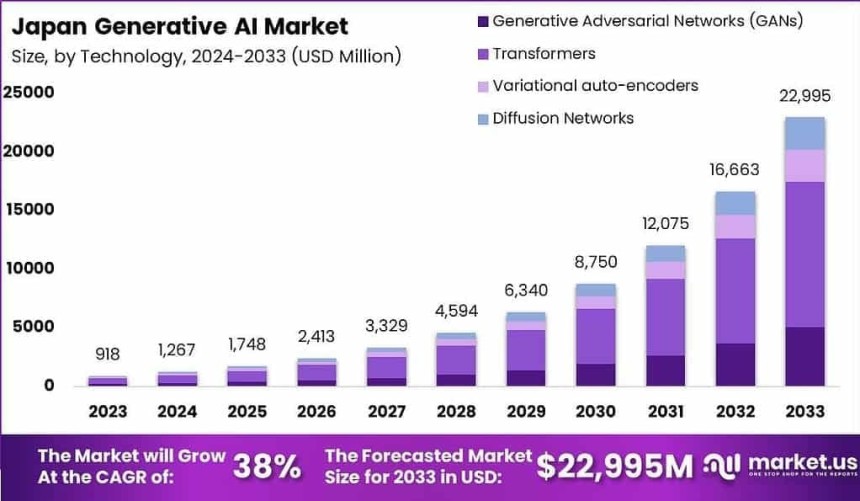

Japan Generative AI Market Vanguard: 2024-2033
Introduction The Japan Generative AI Market, valued at USD 918 million in 2023, is projected to reach USD 22,995 million by 2033, growing at a CAGR of 38%, driven by technological innovation and government initiatives like Society 5.0. Japan’s robust AI ecosystem fuels adoption across industries. Generative AI transforms healthcare, media, and finance through advanced content creation and automation, addressing labor shortages and an aging population. This market’s growth highlights its critical role in delivering efficient, creative solutions, positioning Japan as a leader in the global AI landscape with cutting-edge technological infrastructure. Key Takeaways Market growth from USD 918 million (2023) to USD 22,995 million (2033), CAGR 38%. Software dominates components with 64.5% share in 2023. Transformers lead technology with a significant share. Media & Entertainment holds a dominant end-use share. NLP dominates applications; LLMs lead model outlook. Data privacy and high costs are key restraints. Component Analysis In 2023, software held a 64.5% share, driven by demand for AI platforms enabling content generation. Services grow rapidly, supporting implementation and customization. Hardware, particularly GPUs, expands to meet computational demands, with companies like NVIDIA providing essential infrastructure for generative AI applications in Japan. Technology Analysis Transformers dominated in 2023, excelling in NLP and content generation due to their scalability. Generative Adversarial Networks (GANs) grow steadily, enabling realistic data synthesis. Diffusion networks and variational autoencoders gain traction, supporting creative content and simulations in media, healthcare, and other sectors. End-Use Analysis Media & Entertainment led in 2023, leveraging AI for content creation and animation. Healthcare grows rapidly, using AI for drug discovery and diagnostics. Finance and automotive sectors expand, adopting generative AI for fraud detection and supply chain optimization, driven by Japan’s innovation-driven economy. Application Analysis Natural Language Processing (NLP) led in 2023, powering chatbots and content automation. Computer vision grows fastest, supporting visual content generation. Other applications, such as code generation and simulations, expand, driven by demand for personalized, efficient solutions in media, retail, and healthcare sectors. Model Outlook Analysis Large Language Models (LLMs) dominated in 2023, excelling in NLP tasks like text generation. Image generation models grow steadily, supporting media and design. Multimodal models gain traction, combining text and visuals for enhanced applications in advertising, entertainment, and customer engagement. Market Segmentation By Component: Software (64.5% share), Services, Hardware. By Technology: Transformers (dominant), GANs, Diffusion Networks, Variational Autoencoders. By End-Use: Media & Entertainment (dominant), Healthcare, Finance, Automotive. By Application: NLP (dominant), Computer Vision, Code Generation, Simulations. By Model: LLMs (dominant), Image Generation, Multimodal. By Region: Japan (5.7% of global market in 2024). Restraint High development costs (USD 100,000–1 million per system) and integration complexities hinder growth. Data privacy concerns, driven by strict regulations, and a shortage of skilled AI professionals pose challenges. Perceived irrelevance (68% of non-users) and usability issues further limit adoption in Japan. SWOT Analysis Strengths: Government support, advanced infrastructure, Society 5.0 initiatives. Weaknesses: High costs, skill shortages, privacy concerns. Opportunities: Healthcare innovation, Asia-Pacific growth, AI-driven automation. Threats: Regulatory complexities, cybersecurity risks, global competition. Growth relies on addressing skills gaps and privacy concerns. Trends and Developments In 2023, 65% of enterprises adopted generative AI, driven by AI and IoT integration. NLP grew 30%, enhancing customer service. Partnerships, like Sony’s 2024 collaboration with RIKEN, boost innovation. Asia-Pacific’s 38.8% CAGR reflects demand. Mobile AI and 3D visualization advance usability in Japan. Key Player Analysis Key players include OpenAI, NVIDIA, Google, Sony, and Fujitsu. OpenAI and Google lead in NLP platforms, NVIDIA in hardware, and Sony and Fujitsu in tailored solutions. Strategic partnerships, like NEC’s 2025 collaboration with Toyota, drive innovation for Japan-specific AI needs. Conclusion The Japan Generative AI Market is set for robust growth, driven by innovation and government support. Despite cost and privacy challenges, opportunities in healthcare and media ensure progress. Key players’ advancements will redefine Japan’s AI landscape by 2033.
Best Age Calculator Calculate Exact Age Online Without Manual Math
Best Age Calculator Calculate Exact Age Online Without Manual Math


Why FC27 Midfield Roles Matter in the U4gm 4-1-4-1
The best meta 4-1-4-1 custom tactics in FC27 should give your striker support without leav...
Symptoms of Pregnancy After Embryo Transfer in IVF
Symptoms of Pregnancy After Embryo Transfer in IVF The IVF journey can bring many emoti...
