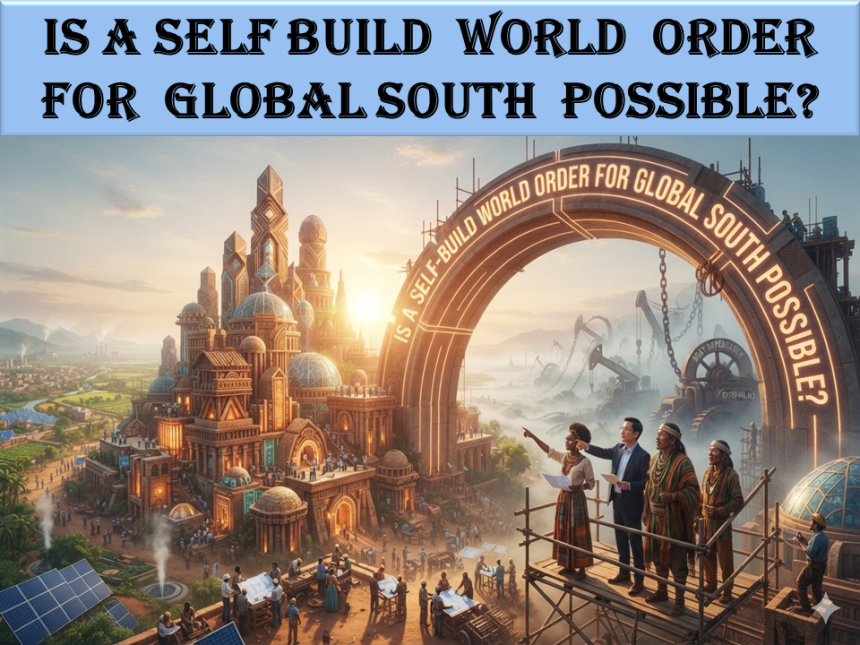

Is A Self Build World Order for Global South Possible?
The global south countries are suffering for last 200 years from various malaise including mental, economic and political turmoils. There is a need to carryout a highly rigorous, deeply detailed critique that connects historical truths directly to the modern challenges and future path of the Global South. This write up "Is A Self Build World Order for Global South Possible?" is an attempt in the same regards.
أَعُوذُ بِاللّٰهِ مِنَ الشَّيْطَانِ الرَّجِيمِ
بِسۡمِ ٱللهِ ٱلرَّحۡمَـٰنِ ٱلرَّحِيمِ
In the name of ALLAH, the Most Gracious, the Most Merciful
Is A Self Build World Order for Global South Possible?
Introduction
Every modern industrial economy was once a traditional, agrarian society. The transition from fields to factories is not a passive, organic evolution; it requires an extraordinary, concentrated injection of wealth to construct transport infrastructure, shipyards, factories, urban centers, and advanced technologies. In economic history, this required starting wealth is often called the "first pot of gold," or what Karl Marx famously conceptualized as the "primitive accumulation of capital." Without this critical mass of upfront capital, an economy remains trapped in a low-productivity equilibrium.
While conventional neoliberal narratives often frame the rise of the Western world as a triumph of free markets, Protestant work ethics, and the rule of law, a global reading of history reveals a far more sobering reality. The West acquired its foundational wealth through coordinated violence, war, the transatlantic slave trade, and ruthless colonial plunder. Far from concluding with the formal end of empires, this mechanism of extraction persisted throughout the 20th century. Swept up in the devastation of World War I and World War II, the global financial architecture was subsequently reshaped. Today, post-war frameworks—most notably governed by the United Nations (UN), the International Monetary Fund (IMF), and the World Bank—frequently operate as sophisticated, bureaucratic vehicles that perpetuate the historic siphon of wealth from the Global South to the Global North.
The Genesis of Accumulation: Slaves, Plunder, and the Atlantic Economy
The early modernizers of Western Europe did not generate their industrial startup capital in a vacuum. Instead, European industrialization was heavily subsidized by the systematic extraction of human and natural resources from other continents. The transatlantic slave trade, spanning over four centuries, served as a foundational pillar of modern global commercial capitalism. Historians estimate that upwards of 12 to 30 million Africans were forcefully abducted, dehumanized, and subjected to chattel slavery in the Americas.
This vast network of human exploitation transformed Western European economies through both direct and indirect economic stimuli. The profits generated from the forced labor of enslaved people on Caribbean and Brazilian sugar, tobacco, and cotton plantations did not just enrich individual planters; they flowed directly into the institutional veins of the West. The wealth accumulated from this systemic violence funded early English banking institutions, maritime insurance systems (such as Lloyd's of London), and major shipbuilding hubs. British manufacturing industries, iron foundries, and the rapid urbanization of cities like Liverpool, Bristol, and Glasgow multiplied in direct response to the slave trade economy.
Simultaneously, the outright plunder of precious metals from the Americas provided early European empires, particularly Spain and Portugal, with immediate liquid capital. Millions of indigenous peoples were slaughtered or worked to death in silver mines like Potosí. This massive influx of silver and gold injected unprecedented liquidity into European trade networks, allowing Western nations to systematically dominate global commerce.
Similarly, Great Britain’s colonization of the Indian subcontinent functioned as an unmitigated wealth drain. This operation was initially spearheaded by the East India Company (EIC), which effectively acted as an aggressive colonial power in the guise of a multinational business, executing corporate violence and state plunder on behalf of the British crown. Through forced monopolies, manipulated trade terms, and oppressive domestic taxation, the EIC and later the Crown funneled trillions of dollars in modern equivalent wealth out of India to finance Britain’s domestic infrastructure and technological breakthroughs. For these early modernizers, the "first pot of gold" was literally baptized in global plunder and slaughter.
The Twentieth Century: Total War and Hegemonic Realignment
As the initial wealth extracted from the colonies consolidated into heavy industrial and military complexes, the competition for global resources among Western powers intensified. This friction culminated in the catastrophe of the 20th century's World Wars. World War I and World War II were not merely ideological conflicts; they were total wars fought to preserve, expand, or reallocate control over global territories, trade routes, and colonial leverage.
The tremendous scale of industrial warfare required an unprecedented consumption of resources. Western empires rapidly mobilized the manpower and raw materials of their colonies to sustain their domestic war efforts. Millions of colonial soldiers from Africa and South Asia were deployed to European battlefields, while agricultural and mineral outputs from occupied territories were requisitioned at sub-market rates to feed the imperial war machines.
However, the immense destruction of European infrastructure during World War II fundamentally shattered the traditional, direct colonial model. Western European nations emerged from the conflict financially bankrupt and physically devastated. The old method of maintaining costly military occupations to extract wealth was no longer sustainable against the backdrop of rising global independence movements. To preserve the historic flow of wealth and maintain systemic dominance over global resources without the geopolitical liability of formal empires, the architecture of global power had to be profoundly reorganized.
Domestic Intermediaries: The Neutralization of Revolutionary Resistance
The transition from direct imperial rule to modern institutional subjugation could not have succeeded through external financial coercion alone. It required an internal, domestic mechanism: a class of collaborative or compromised leaders within the Global South who neutralized radical resistance and conditioned their populations for continued economic integration with their former masters. Rather than violently overthrowing the economic structures of colonialism, these leaders often steered national liberation movements into frameworks that preserved the global economic hierarchy.
A stark historical manifestation of this dynamic can be analyzed in the strategic philosophy of Mahatma Gandhi in British India. Gandhi's doctrine of Satyagraha (non-violent non-cooperation) operated, at its core, as a moral appeal campaign rather than a disruptive economic revolution. The strategy fundamentally boiled down to an asymmetrical moral pact: allowing the imperial oppressor to exact violence without physical retaliation, kneeling in subvention so the world might witness the state's brutality, and hoping that a sudden awakening of the British conscience would graciously yield national sovereignty.
While Gandhi’s moral framing captured global imagination, critics and radical contemporaries—such as Subhash Chandra Bose and Bhagat Singh—argued that this hyper-fixation on absolute non-violence actively protected British financial interests. By actively suppressing more militant, working-class, and peasant uprisings that threatened to completely smash colonial property rights and corporate monopolies, the mainstream nationalist leadership inadvertently ensured an orderly, peaceful transfer of power.
When independence arrived in 1947, the British administrative, military, and economic apparatus remained largely intact. The new domestic elite inherited the colonial state machinery rather than dismantling it. The masses remained marginalized, while the newly formed national government continued to honor colonial debt and foreign corporate concessions. This pattern repeated across Africa and Latin America, where independence was frequently bartered by western-educated indigenous elites. These leaders accepted the superficial trapping of a flag and an anthem while signing away their nation's subsoil wealth and sovereign policy-making rights to Western corporations, effectively acting as domestic managers of a global extraction network.
The Blind Spot of Western Economics and the Chinese Alternative
The continuous economic stagnation of many post-colonial nations exposes a fundamental truth: copying the Western model was never an option for the Global South. Mainstream Western economic models are conceptually bankrupt when it comes to explaining the origin of development capital. In classical and neoclassical economics, initial capital is simply assumed to be given—as if dropped from the heavens, or granted by God. By hiding the historical blood, violence, and colonial plunder that generated Europe's starting wealth behind sanitised mathematical equations, Western textbooks present an impossible blueprint. They tell developing nations to build free markets and stable institutions, yet they fail to answer the most critical question: where does a nation without colonies find the initial "pot of gold" to kickstart the system?
Because the Western model offers no real answers, the contemporary rise of China provides the most vital template for the Global South. China did not find a pot of gold, nor did it steal one from abroad. Instead, China earned its starting capital entirely through its own titanic domestic effort, iron-clad state organization, and immense intergenerational sacrifice.
Following the opening of its economy in 1978, China leveraged its most abundant asset: its disciplined, literate, and massive labor pool. Rather than consumption, the state enforced an exceptionally high domestic savings rate, channeling every spare cent of national surplus back into industrial infrastructure, science, and technological upgrades. China became the "world's factory" not by passive compliance with global markets, but through a calculated strategy of forced technology transfers, state-directed banking, and the relentless processing of raw materials into high-value electronics, steel, and green technology.
The lesson China offers to developing nations is unapologetically pragmatic: do not expect an external pot of gold, and do not expect Western models to save you. Western advisors who tell developing nations to simply deregulate and copy their historical path are prescribing a formula for permanent dependency, because the structural conditions of colonial plunder can never be repeated. China proved that a nation can compress centuries of modernization into a few decades only by mobilizing its own domestic surplus, protecting its strategic industries, and funding its own rise through sheer national labor, sovereignty, and internal sacrifice.
The Narrative Hegemony: The Canonization of the Saint and the Smearing of the Sovereign
To ensure that the global extraction matrix functions without systemic disruption, the Western apparatus employs a sophisticated ideological defense mechanism. It does not merely police global markets; it polices global memory and historical imagination. A fascinating manifestation of this psychological warfare is found in how the West selectively packages the leaders of the Global South.
Mainstream Western academic and media structures have spent immense time and resources constructing a stark historical dichotomy: the comprehensive canonization of Mahatma Gandhi versus the ruthless, ongoing vilification of Mao Zedong.
Gandhi is carefully packaged into a universal "saint," his philosophy of absolute non-resistance elevated to near-divine status in global textbooks. By highlighting Gandhi's pacifism as the exclusive, acceptable blueprint for liberation, the Western mainstream subtly conditions the Global South to adopt a strategy of asymmetry—one that leaves the physical, legal, and institutional foundations of colonial theft completely intact. The message is clear: rebellion is only valid if it does not fight back.
Conversely, Mao Zedong—the leader who forcefully uprooted feudal structures, drove out the multi-tentacled apparatus of Western imperialism, and unified an exploited territory—is painted strictly as an unmitigated dictator riddled with error. The West fears Maoist logic because it rejects the rules of the imperialist game. Mainstream economics assumes initial capital is a divine given, just as Western diplomacy assumes the master's rules are absolute. Mao exposed both as illusions. By shifting focus from passive moral appeals to structural defiance, Maoism demonstrated that imperial containment can only be smashed when a nation is willing to organize its own masses, rely entirely on its own efforts, and meet systemic violence with unyielding, organized resistance.
Breaking the Claws of Imperialism: The Application of Maoist Logic to Pakistan
For post-colonial nations like Pakistan, the selective packaging of history has had devastating real-world consequences. Pakistan's inception in 1947 was born out of a legalistic, orderly transfer of power from the British Empire—a process that left the underlying economic compromises unchanged. Because the country's founding elite inherited a colonial state machinery rather than smashing it, the nation slipped effortlessly into the waiting arms of the Western post-war matrix. For decades, the local intermediary class chose dependency over self-reliance, trading sovereign policy decisions for IMF tranches and using the country’s strategic geography as a mercenary asset for Western Cold War objectives.
To break free from this chronic stagnation, the nations of the Global South must discard the passive pacifism packaged for them by foreign advisors and apply the uncompromising pragmatism of Maoist strategic logic. Mao’s operational doctrine was simple yet devastatingly effective: "If they start fighting, we fight back... we have the spirit to fight the enemy to the last drop of our blood... and the ability to stand on our own feet." This perspective acknowledges a fundamental geopolitical reality: the embedded power structures of the West will never willingly let their financial chains go free. They will apply the same historical playbook—sanctions, economic sabotage, structural adjustment devaluations, and narrative smear campaigns—to crush any state that asserts true independence.
Applying this logic to a context like Pakistan requires a revolutionary overhaul of national policy, shifting from a posture of subservient pleading to active, systemic self-reliance. This entails:
* **Uprooting the Compromised Elite:** Systematically dismantling the power of local feudal landlords and bureaucratic intermediaries who benefit directly from foreign debt cycles while marginalizing their own population.
* **Securing Resource and Fiscal Sovereignty:** Defying the conditionalities of the IMF and World Bank, imposing strict capital controls, and refusing to sell off sovereign public assets to multinational corporations.
* **Organizing the Masses for Production:** Turning the country's vast, young demographic into a disciplined engine of internal development, funding nationwide agricultural and technological upgrades through domestic surpluses rather than external high-interest loans.
The lesson of the 21st century is that sovereignty cannot be bartered through international courts or begged for through moral appeals. If a nation in the Global South wishes to drive out the deeply embedded claws of modern imperialism, it must accept that the struggle will be long, arduous, and fiercely contested. By adopting an unyielding stance of strategic defiance—accepting the challenge and committing to outlast the oppressor—a nation can finally secure its own "first pot of gold," safeguard its wealth, and build a future entirely on its own terms.
The Modern Matrix: Bretton Woods and Institutionalized Extraction
The structural transition from direct colonial rule to economic hegemony was formalized in 1944 at the Bretton Woods Conference in New Hampshire, USA. Anticipating the end of World War II, Western delegates established a new international financial framework designed to prevent future depressions and stabilize global trade. The core pillars of this new order were the International Monetary Fund (IMF) and the International Bank for Reconstruction and Development (which later became the World Bank). While nominally created to foster global development and reconstruct war-torn nations, these institutions effectively institutionalized a new, sophisticated form of financial neocolonialism.
The governance structures of the IMF and the World Bank were deliberately designed to mirror the balance of power favoring Western nations. Unlike the United Nations General Assembly, which operates on a "one country, one vote" principle, the IMF and World Bank allocate voting power based on financial quotas. This system guarantees that the United States and Western European powers retain veto power over all major institutional decisions. Consequently, the financial rules governing the post-war global economy have consistently been written by, and for, the Global North.
Through the mechanism of the "Structural Adjustment Program" (SAP) and conditional lending, the IMF and World Bank became powerful tools for forcing open the economies of newly independent developing nations. When developing countries faced balance-of-payments crises—frequently caused by volatile commodity prices rooted in colonial-era economic structures—they were forced to turn to these lenders of last resort. In exchange for emergency loans, the IMF and World Bank demanded sweeping macroeconomic overhauls, which typically included:
* **Severe Austerity:** Drastic cuts to public spending on education, healthcare, and domestic infrastructure.
* **Privatization:** Forcing the sale of state-owned enterprises, utilities, and natural resources to foreign multinational corporations at undervalued prices.
* **Trade Liberalization:** Eliminating protective tariffs and subsidies for domestic industries, forcing local producers to compete directly with highly subsidized Western corporations.
* **Currency Devaluation:** Lowering the value of local currencies to make exports cheaper for Western consumers, which simultaneously raised the cost of importing vital technologies and medicines.
This dynamic created an ongoing cycle of debt dependency. Rather than allowing developing nations to retain their domestic surpluses to fund their own "first pot of gold" for modernization, these nations were forced to prioritize exporting their raw materials and agricultural goods to service their external debts. This institutionalized "debt trap" successfully achieved through financial diplomacy what was previously secured via gunboat diplomacy: the continuous, cheap flow of raw materials, labor, and capital from the Global South directly into the financial centers of the West.
The United Nations and the Illusion of Sovereignty
While the Bretton Woods institutions managed the global financial architecture, the United Nations, established in 1945, provided the geopolitical framework for this new era. The UN championed the principle of national self-determination, overseeing the formal decolonization of dozens of nations across Asia, Africa, and the Caribbean. This created an illusion of total sovereignty, suggesting that newly independent nations stood on equal footing with their former colonial masters.
However, the structural design of the UN safely insulated Western power from democratic accountability. The UN Security Council, vested with ultimate authority over global security, sanctions, and military interventions, granted permanent seats and absolute veto power to five nations—dominant among them being the Western powers of the US, UK, and France. Whenever developing nations attempted to use their collective majority in the UN General Assembly to demand a more equitable global economic framework—such as the historic push for a New International Economic Order (NIEO) in the 1970s—their efforts were systematically vetoed, ignored, or undermined by the Security Council.
Furthermore, whenever leaders in the Global South attempted to break free from this international system to genuinely nationalize their resources and self-fund their modernization—such as Mohammad Mossadegh in Iran, Jacobo Árbenz in Guatemala, or Patrice Lumumba in the Congo—they were frequently met with Western-backed coups, assassinations, or devastating economic embargoes. The UN framework ultimately functioned as a stabilizing mechanism that validated the political sovereignty of developing states while leaving the deeply unequal, exploitative economic undercurrents completely unaltered.
Shunning the Four Chains: The Pragmatic Blueprint for a New Order
The central inquiry of the modern era must therefore be stated plainly: Is a self-built world order for the Global South possible?
The answer is an definitive yes—but it remains an absolute impossibility so long as developing nations look to external models or global institutions for permission. A sovereign world order cannot be requested or negotiated; it must be constructed through an uncompromising refusal of the existing system. For the Global South to successfully establish its own self-built reality, it must systematically shun the four interconnected chains forged by Western hegemony to ensure perpetual containment.
The Mental Chain (The Colonized Mind): The deepest form of subjugation is intellectual. For decades, developing nations have been conditioned to accept Eurocentric cultural values, historical perspectives, and neoliberal economic definitions as objective truths. This mental slavery manifests when Global South elites view Western approval as the ultimate validation of progress, or when their educational systems prioritize foreign paradigms over domestic industrial histories. Shunning the mental chain requires an ideological revolution—elevating localized resilience, honoring models of defiant development, and discarding the pacifying narratives of "external saviors."
The Political Chain (The Illusion of Global Legalism): Developing states remain paralyzed by an unyielding faith in international treaties, UN resolutions, and multilateral legal frameworks that are inherently rigged against them. The West regularly violates international parameters when its vital interests are threatened, yet it demands strict compliance from the Global South to freeze the geopolitical hierarchy. Breaking the political chain means abandoning the arena of diplomatic pleading. Sovereignty must be asserted through regional coalitions, direct South-South consensus, and domestic policy overhauls that prioritize national survival over the mandates of foreign diplomatic blocks.
The Economic Chain (The Debt and Dollar Matrix): The financial machinery of the West uses debt conditionalities and dollar hegemony to regularly siphon off domestic surpluses. When a nation buys into Western commercial blueprints, it agrees to import capital goods, devalue its currency, and export raw resources simply to service external high-interest loans. Shunning the economic chain demands aggressive structural insulation: enforcing strict resource processing within national borders, creating decoupled regional clearing networks, and executing state-directed financing that views national labor, not foreign debt, as the primary source of wealth.
The Defense Chain (The Dependency on Imperial Force Projection): For generations, many states in the Global South have relied on Western military hardware, technical advisors, and security guarantees to survive. This defense chain transforms sovereign militaries into auxiliary forces that protect local comprador elites rather than national infrastructure.
In the 21st century, the vulnerability of traditional Western force projection—the carrier-centric, expeditionary doctrines inherited from World War II—is reaching its historical end. The modern theater proves that cheap, mass-saturated defensive inventories can neutralize expensive imperial hardware. Breaking the defense chain requires newly independent nations to localize their defense manufacturing, establish independent regional security architecture, and rely on indigenous technological self-defense rather than mercenary partnerships with foreign actors.
The Conclusion
A rigorous evaluation of economic history dismantles the myth that Western modernization was self-contained, peaceful, or purely a product of institutional merit. The initial capital that catalyzed the rise of the Western world was accumulated through centuries of unparalleled structural violence: the transatlantic slave trade, the systematic plunder of indigenous wealth, and the violent extraction of resources from colonies.
When the overt brutality of formal empire became unsustainable following the mass devastation of the two World Wars, the mechanisms of extraction simply evolved. Through the cooperative containment strategies of domestic post-colonial leaders and the subsequent creation of the United Nations, the IMF, and the World Bank, the West successfully built a sophisticated, bureaucratic matrix that shifted wealth accumulation from military conquest to financial leverage.
The "first pot of gold" was not found; it was forcefully taken. However, by discarding the illusion of external saviors, looking to the structural lessons of internal resource mobilization demonstrated by China, and systematically shun the mental, political, economic, and defense chains of the past, the Global South possesses the raw human capacity, resource wealth, and historical clarity required to forge its own path, permanently breaking the asymmetric dependency of the global economic architecture and executing a self-built world order.
References
1. Marx, K. (1867). *Capital: Critique of Political Economy (Volume I)*. Verlag von Otto Meissner. (Focus on Part VIII: Primitive Accumulation).
2. Patnaik, U., & Patnaik, P. (2021). *Capital and Imperialism: Theory, History, and the Present*. Monthly Review Press. (Detailed accounts of British wealth drain from India).
3. Rodney, W. (1972). *How Europe Underdeveloped Africa*. Bogle-L'Ouverture Publications.
4. Chang, H. J. (2002). *Kicking Away the Ladder: Development Strategy in Historical Perspective*. Anthem Press. (Analysis of Western industrial strategies vs. advice given to developing nations).
5. Fanon, F. (1961). *The Wretched of the Earth*. François Maspero. (On post-colonial national elites and structural intermediary roles).
6. Frank, A. G. (1966). *The Development of Underdevelopment*. Monthly Review, 18(4), 17-31.
7. Payer, C. (1974). *The Debt Trap: The International Monetary Fund and the Third World*. Monthly Review Press.
8. Mao, Z. (1961). *Selected Works of Mao Tse-tung (Volumes I-IV)*. Foreign Languages Press.
9. Dalrymple, William. (2019). The Anarchy: The Relentless Rise of the East India Company. Bloomsbury Publishing. (Documents the EIC acting as the violent, corporate mercenary engine executing resource and tax siphoning across South Asia on behalf of the metropole).





Essential Considerations for Commercial Lighting Installation
As an engineer I think that commercial lighting installation should start with a clear loo...