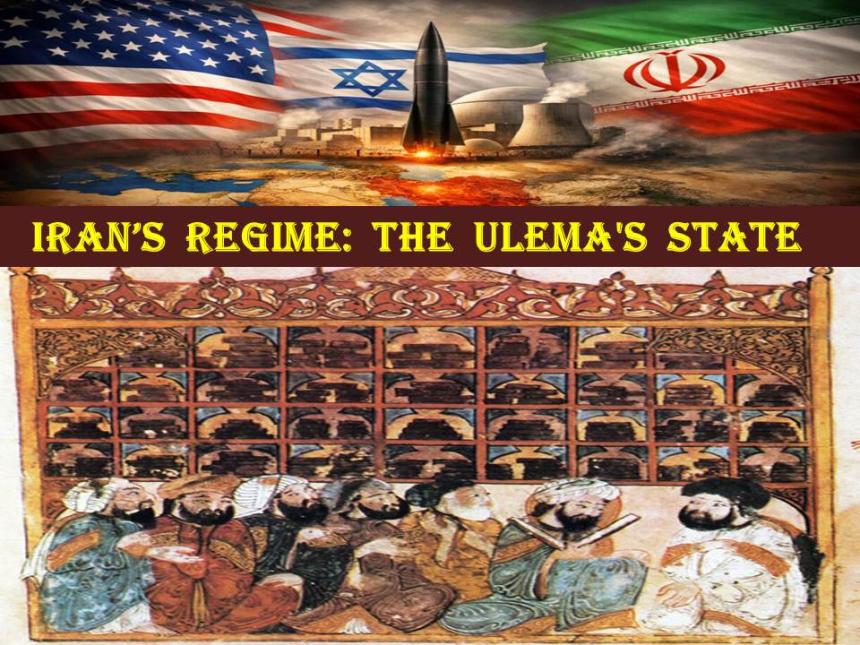

IRAN’s REGIME: THE ULEMA's STATE
Iranian civilization, one of the world's oldest continuous civilizations, known historically as Persia. The Islamic era of Iranian civilization (651 CE–present) began with the Arab-Muslim conquest of the Sasanian Empire. The highlights of US-Israel-Iran war 2026 are the heroic and valiant efforts presented by the people of Iran; making conflict a major text book lesson. This write up "IRAN’s REGIME: THE ULEMA's STATE" is based upon an opinion published on "The Montreal Review" with additional comments for wider audience discussion.
أَعُوذُ بِاللّٰهِ مِنَ الشَّيْطَانِ الرَّجِيمِ
بِسۡمِ ٱللهِ ٱلرَّحۡمَـٰنِ ٱلرَّحِيمِ
In the name of ALLAH, the Most Gracious, the Most Merciful
IRAN’s REGIME: THE ULEMA's STATE
IRAN’S REGIME: THE GUARDIANSHIP OF THE ULEMA By Ahmet T. Kuru
Published in "The Montréal Review", June 2026
The US-Israeli alliance has continued its attacks on Iran in violation of international law. Unlike the 2003 invasion of Iraq, this intervention has not been presented as a project of democratization. Its perpetrators have made little effort to conceal their imperial objectives or Israel's leading role in the campaign. Yet the two interventions share an important objective: regime change.
Some members of the Iranian diaspora in the North America and Europe have supported the attack, expecting the regime to collapse. Hatred of the regime is not limited to the diaspora. In early 2026, millions of Iranians participated in nationwide demonstrations. The regime, however, suppressed these protests with unprecedented violence. Estimates of the death toll range from 7,000 to 37,000, while the number of injured may have reached hundreds of thousands.
One feature that distinguishes the Iranian regime from many other authoritarian systems is that it has turned a significant portion of society against religion. Surveys conducted under difficult conditions suggest that approximately half of Iran's population has abandoned Islam as a result of political resentment toward the regime.
What, then, lies at the heart of a regime that has driven a substantial segment of its population into resistance?
Khomeini's Legacy
The Iranian regime is based on the concept of velayat-e faqih, articulated by Ruhollah Khomeini—the leader of the 1979 Revolution—a decade before the revolution and later incorporated into the Constitution. The concept means “the guardianship of the jurist” or, more plainly, the establishment of the guardianship of Islamic scholars (ulema) over the political system.
In this system, the Supreme Leader stands above the president, parliament, and judiciary. He also serves as the ultimate authority in military affairs.
This semi-theocratic system of governance, grounded in the guardianship of the ulema, rests on the simplistic logic of Islamism: Are we Muslims? Yes. Should we then be governed by Islamic law, that is, sharia? Yes. Who understands sharia best? The ulema. Therefore, should not the ulema rule?
After the revolution, although some prominent ulema challenged this reasoning, Khomeini silenced them by force. His understanding of sharia was rigid and literalist. He went so far as to argue that even the Prophet Muhammad and Imam Ali—whom Shiites regard as the first imam—could not alter religious rulings according to changing circumstances. In one of his recorded speeches, Khomeini illustrated this point with the example of adultery: “According to sharia, the punishment for adultery is one hundred lashes. If the Prophet Muhammad or Imam Ali were alive today, would they impose a different punishment? Would the Prophet have said one hundred and fifty lashes?”
While Islamists in other countries have advanced similar arguments, very few have succeeded in establishing a semi-theocratic regime like Khomeini's. This was because Khomeini both exploited the broad coalition of opposition forces against the Shah and benefited from the existence of a powerful clergy and the doctrine of the Mahdi in Twelver Shiism. According to the dominant Twelver Shi'i doctrine in Iran, the Twelfth Imam, Muhammad al-Mahdi, entered occultation in the tenth century and will reappear at the end of time. His return is awaited as the basis of a fully just and legitimate government. Khomeini fused the ulema's authority in matters of sharia with belief in the Mahdi, arguing that the ulema should exercise political authority in his name until his return.
If the religious foundations of the Iranian regime are so systematic, does a demand for regime change contradict Islam? Is the separation of religion and state possible in Islam?
The Ulema-State Alliance
Today, Islamists, for the sake of their political projects, and Islamophobes, to argue that Islam is incompatible with democracy, claim that Islam inherently rejects the separation of religion and state. My book Islam, Authoritarianism, and Underdevelopment: A Global and Historical Comparison, which has been translated into Urdu, refutes this claim through a historical analysis.
The book shows that between the eighth and eleventh centuries, there was a relative separation between the ulema and the ruling class in the Islamic world. Of 3,900 religious scholars identified in biographical sources from this period, only 9 percent received salaries from the state through official positions such as judgeship, while 91 percent earned their living independently.
This 13th-century Arabic manuscript illumination captures the flourishing intellectual culture of the Islamic Golden Age by depicting a gathering of turbanned scholars engaged in earnest literary and legal debate before rows of meticulously shelved books. The artwork, titled Scholars in a Library at Basra from the Maqamat of al-Hariri (Manuscript Arabe 5847, folio 5v), was created in 1237 CE by the master illustrator Yahya ibn Mahmud al-Wasiti using ink and opaque watercolor on paper, and it is currently held in the collection of the Bibliothèque Nationale de France in Paris.
In the early period of Islamic history, the ulema, as a matter of principle, prioritized not accepting salaries from rulers. They viewed close relations with the state as corrupting and as risking complicity in oppression. Therefore, most early ulema preferred to earn their living through trade. The founders of the four major Sunni schools of jurisprudence and prominent Shia figures like Ja'far al-Sadiq were independent scholars who did not accept state positions.
These scholars paid the price for not bowing to the demands of the rulers. Imam Malik was subjected to corporal punishment, Imam Shafi'i was chained, Ibn Hanbal was beaten in prison and narrowly escaped execution. Abu Hanifa's experiences became the most famous example of the prevailing mindset of that era. Abu Hanifa refused the offer of judgeship from the Abbasid Caliph Mansur, deeming himself unqualified for the position. The Caliph replied, “You are lying; you are the most qualified.” Abu Hanifa responded, “A liar cannot be a judge.” Ultimately, he was imprisoned and poisoned to death.
There is no explicit reference to the close connection between religion and state in the Quran or hadiths. Therefore, those who advocated for the brotherhood of religion and state after the eleventh century have invoked the following aphorism, which is actually a Sasanian proverb, as if it were a hadith: “Religion and the royal authority are twins. Religion is the foundation, and the royal authority is its guard. That which has no foundation collapses; that which has no guard perishes.”
In short, the ulema–state alliance was neither an essential component of Islam nor a foundational feature of early Islamic history. On the contrary, it was built during the Seljuk period in the eleventh century. It was later institutionalized and widespread during the Ayyubid, Mamluk, Ottoman, and Safavid periods.
In the twentieth century, Islamists elevated the ulema–state alliance from a pragmatic arrangement to a more ideological project. In Egypt, Hasan al-Banna, the founder of the Muslim Brotherhood, and later Sayyid Qutb; in Pakistan, Mawdudi, the founder of Jamaat-e-Islami; and in Iran, Khomeini constructed more totalitarian ideologies based on the medieval ulema–state alliance but extending beyond it, defining Islam as both religion and state.
As a result, the secular political trend that had been influential in most parts of the Islamic world between 1920 and 1980 gradually gave way to Islamist movements. Iran, which, along with Turkey, had pioneered secular reforms in the 1920s, became one of the leading centers of global Islamism after the 1979 Revolution.
This movement took distinct institutional forms across countries: the guardianship of the ulema in Iran; the alliance between the Wahhabi clergy and the Saudi monarchy in Saudi Arabia; the establishment of sharia courts by military regimes in Pakistan and Sudan; the alliance between the Al-Azhar ulema and the military regime in Egypt; and the alliance between the ulema and elected politicians in Malaysia.
If the Islamist regime in Iran falls, the repercussions will extend far beyond its borders, once again placing Iran at the center of a momentous transformation in the Muslim world. The collapse of the guardianship of the ulema would signal not only the failure of the most ambitious Islamist experiment of the modern era, but also the weakening of ulema-state alliances across the Muslim world and the possible emergence of a new secular political trend.
Ahmet T. Kuru is Professor of Political Science and Director of Center for Islamic and Arabic Studies at San Diego State University and the author of Islam, Authoritarianism and Underdevelopment, which has been translated into fourteenth languages, including French.
NOTE: The above is taken from this link https://www.themontrealreview.com/Articles/Iran_Regime_The_Guardianship_of_the_Ulema.php
The Concluding Remarks
The above article represents a particular mentality of scholars brought up under the colonial mindset. Such scholarship is cultured, supported and sponsored by western world powers and academia. In short, such mindset may be said to be "liberal and secular". The debate "State and Religion" is a favourite topic of liberal & secular with severe clash with Islamist.
The fundamental clash, between secular-liberal and Islamist worldviews over the topic of "State and Religion" represents opposing sources of authority; secularists advocate for a neutral state governed by human-made law, while Islamists argue that divine law (Sharia) must guide all political and social affairs. The western world's political model is governing all the world; except Islamic Republic of Iran.
The debate frequently hinges on the concept of sovereignty. Liberals emphasize popular sovereignty (the will of the people), while Islamists emphasize the concept of divine sovereignty as the ultimate foundation for the state. There is no other state in the world except Iran which is following the concept of "divine sovereignty"; under "valayat-e-faqih".
Secularists argue that religion should be separated from government to protect individual freedoms, ensure equal rights for minorities, and prevent religious coercion. They contend that civic legislation should reflect modern, pluralistic social consensus rather than specific religious doctrines.
Islamists reject the division of religion and state, viewing Islam as a comprehensive way of life that naturally encompasses politics. They argue that true justice and societal welfare can only be achieved by implementing divine laws and prioritizing religious values in governance.
The western political philosophy initiation with "Magna Carta"; French Revolution, American Civil War etc has been in place for last 500 years ago. The western political philosophy gave rise to modern world, which saw colonial rule of European Nations and two World Wars (1&2). The separation of state and religion remained in currency through out the last century, even during the cold war and fall of Berlin Wall.
The USA championed the democracy as the most powerful democratic country and became the sole super power after the 9/11 twin towers collapse and emerged as a "Vampire". The state separated by religion has became the governance by "Epstein Files and Baa'l Worshipers" and is now being represented by bunch of jokers and buffoons (view held on social media) at the highest level.
The world most powerful military force of USA along with "Invincible" IDF attacked Iran on 28 February 2026 and after a 40 day war a seize fire has been placed. However Iran under the so called uneducated and closed minds "Mullah" has proved better off even after 47 years of brutal economic sanctions, restrictions and strangulation from all means of honourable living; and has surely emerged as a credible world nation.
There is need to study the Iran's political model so as the real Islamic model of governance based on Islamic shariah as practiced in state of Medina under the Prophet Muhammad (PUBH) and four "Rightly Guided Caliphate may be enforced. This way a real Islamic civilization may come to fore and the humanity at large may benefit from the real peace emerging there off.
Flower Box Stand for Opening Ceremony and Condolences
Flower Box Stand for Opening Ceremony and Condolences


Looking for Tax Debt Relief Services in Canada? Read This Guide
Discover how tax debt relief services work in Canada, from CRA payment arrangements and ta...