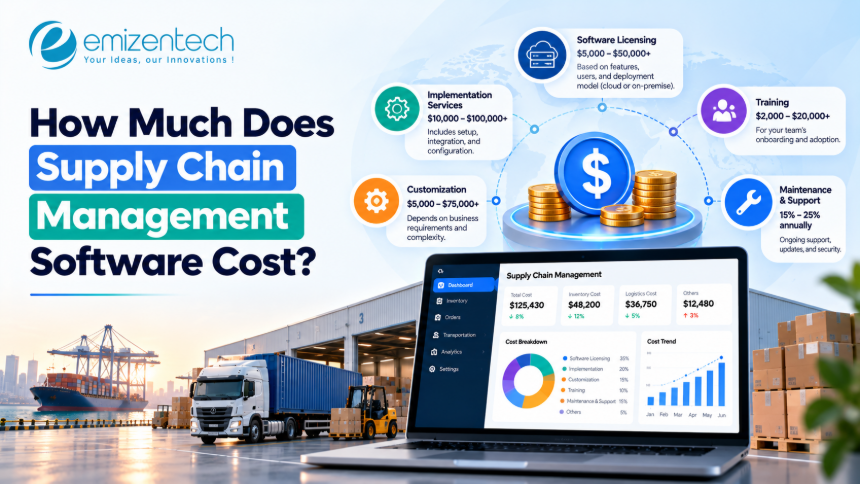

How Much Does Supply Chain Management Software Cost?
Understand supply chain management software costs, pricing models, key cost factors, and hidden expenses to plan your budget and maximize ROI.
The cost of building supply chain software depends on how a business manages procurement, inventory, warehousing, production, and logistics. A basic solution designed to track stock and orders requires a different investment from an enterprise platform that connects multiple warehouses, suppliers, transportation providers, and business applications.
Businesses must also account for integration, data migration, employee training, hosting, and ongoing maintenance when planning their budgets. Understanding these expenses before development begins helps organizations choose the right solution without paying for unnecessary features or overlooking critical requirements.
How Much Does Supply Chain Management Software Cost on Average?
Custom supply chain software development can cost approximately $15,000 to $500,000 or more, depending on functionality, integrations, and operational complexity. The following ranges are illustrative planning estimates, not fixed market prices.
Software complexityEstimated development costTypical capabilitiesBasic MVP$15,000–$60,000Inventory tracking, order management, basic reportingMid-level solution$60,000–$200,000Procurement, warehouse workflows, supplier management, system integrationsEnterprise platform$200,000–$500,000+Multi-location operations, advanced analytics, complex integrations, custom workflows
A business that only needs inventory visibility may not require an extensive custom platform. However, an organization coordinating manufacturing, multiple distribution centers, and international logistics may need significantly more development work. The overall supply chain management software cost depends on the complexity of these workflows and the level of customization required.
These estimates cover custom development rather than subscription licensing. SaaS platforms, implementation packages, and enterprise software licenses follow different pricing structures.
Supply Chain Management Software Cost by Pricing Model
The total investment depends on whether a business subscribes to an existing platform, customizes a commercial product, or develops software specifically for its operations.
1. Subscription-Based Software
Software-as-a-Service (SaaS) platforms typically charge recurring fees based on users, modules, transaction volumes, or business requirements. This model reduces the need for a large upfront development investment, although subscription costs continue throughout the software's use.
2. Off-the-Shelf Software With Customization
Prebuilt solutions offer established features that businesses can configure to match their workflows. Additional expenses may include implementation, integrations, custom modules, and vendor support. This approach is often suitable when existing features meet most operational requirements.
3. Custom Supply Chain Software Development
Custom development gives businesses greater control over workflows, integrations, and functionality. It generally requires a higher initial investment but can be appropriate for specialized operations that standard platforms cannot support efficiently.
Key Factors That Affect Supply Chain Software Development Cost
Several technical and operational decisions influence the final project estimate.
Features and Functional Complexity
Basic inventory tracking costs less to build than a platform combining procurement, warehouse management, transportation, and advanced demand forecasting. AI-powered analytics and real-time tracking can add further development and infrastructure requirements.
Integration With Existing Systems
Connecting the software to ERP platforms, eCommerce stores, accounting tools, warehouse systems, and shipping providers requires additional development and testing. Integration complexity can become a major cost driver, particularly when legacy systems use inconsistent data formats.
Data Migration and Security
Transferring product catalogs, supplier records, inventory data, and historical orders requires data cleaning, mapping, and validation. Security controls, access permissions, audit trails, and applicable compliance requirements also influence implementation effort.
Scalability and Deployment Architecture
A system supporting one warehouse has different infrastructure needs from a platform serving multiple locations and thousands of daily transactions. Expected growth, availability requirements, data volumes, and deployment architecture all affect cost.
Additional Costs Beyond Software Development
The initial development quote does not represent the full cost of ownership. Businesses should account for these additional expenses when preparing a budget.
- Implementation and testing: Configuration, quality assurance, and deployment.
- Data migration: Cleaning, transferring, and validating existing records.
- Training: Preparing employees to use the new system effectively.
- Hosting and infrastructure: Cloud computing, storage, backups, and monitoring.
- Maintenance and support: Bug fixes, security updates, technical assistance, and future enhancements.
Ongoing maintenance, hosting, and support can add a substantial recurring expense, depending on the architecture and service requirements. Some published development estimates use annual maintenance benchmarks of 15%–25% of the original build cost, but actual costs vary by system.
How to Reduce Supply Chain Software Development Costs
Reducing costs does not mean compromising essential functionality. It means prioritizing the features that solve the most expensive operational problems.
- Start with an MVP: Build essential inventory, order management, or procurement capabilities before expanding the platform.
- Prioritize integrations: Connect the systems that directly affect daily operations instead of integrating every application immediately.
- Finalize requirements early: Clear specifications reduce rework and unexpected development expenses.
- Choose customization carefully: Use standard functionality where it meets business needs and reserve custom development for genuine operational gaps.
- Implement in phases: Expand the system as business requirements and budgets allow.
A phased approach helps businesses control initial investment, validate functionality, and make expansion decisions based on actual operational results.
Is Custom Supply Chain Software Worth the Investment?
Custom development can be worthwhile when a business has specialized workflows, complex integrations, or operational requirements that existing platforms cannot adequately support.
However, building everything from scratch is not always the best decision. Businesses with standard inventory, procurement, and order management requirements may find an established platform more economical.
Before deciding, compare licensing, implementation, customization, maintenance, and future upgrade costs over several years. Also estimate measurable benefits, including reduced inventory waste, fewer fulfillment errors, lower administrative effort, and improved supplier coordination.
The right investment is the one that addresses genuine operational problems and delivers value relative to its total cost—not necessarily the platform with the most features.
Conclusion
The cost of supply chain management software depends on functionality, integrations, scalability, and implementation requirements. A basic solution may require a modest investment, while a complex enterprise platform can cost hundreds of thousands of dollars or more. EmizenTech helps businesses develop supply chain software aligned with their operational workflows, technical requirements, and growth objectives. A clearly defined scope and realistic budget are essential for making the right investment.
Frequently Asked Questions1. How much does it cost to build custom supply chain management software?
Custom development may cost approximately $15,000–$60,000 for a basic MVP, $60,000–$200,000 for a mid-level solution, and $200,000–$500,000+ for an enterprise platform. These are indicative estimates; actual quotes depend on scope and complexity.
2. Is subscription-based supply chain software cheaper than custom development?
Subscription software generally requires less upfront investment. Custom development may offer greater control over specialized workflows, but its long-term financial value depends on maintenance, usage, and business requirements.
3. What features increase supply chain software development costs?
Advanced demand forecasting, AI analytics, real-time shipment tracking, warehouse automation, multi-location inventory management, and complex third-party integrations can increase development costs.
4. How long does it take to develop supply chain management software?
A basic MVP may take approximately 2–4 months, while a mid-level platform may require 4–9 months. Complex enterprise systems can take 9–18 months or longer, depending on scope and integration requirements.
5. What are the ongoing costs of supply chain management software?
Recurring costs may include hosting, maintenance, technical support, software subscriptions, security updates, and additional integrations. Businesses should estimate these expenses before approving the initial development budget.






Loan Against Property loan in Pune | Offering Financial Services for S...
Explore Loan Against Property loan in Pune with Offering Financial Services. Understand el...