
Future Customer Expectations in the Pizza Business
Customer expectations in the pizza industry are shifting faster than ever. Discover the trends, technologies, and behavioral changes that will define what customers demand from pizza brands in the years ahead.
Introduction
Every pizza business owner has a version of the same experience: you figure out what customers want, build your operation around delivering it, and then watch the expectations slowly shift beneath your feet. What satisfied a customer three years ago barely registers today. What impresses them today will be table stakes tomorrow.
This isn't a complaint about fickle consumers. It's the normal pattern of how customer expectations evolve in any service industry — and in food service, that evolution has been accelerating. Digital ordering, delivery innovation, personalization technology, and the generational shift in who's buying pizza have all compressed the timeline between "cutting edge" and "expected standard."
For pizza business owners thinking about the next three to five years, the question isn't whether customer expectations will change. They already are. The question is which operators will build toward those changes now, and which ones will spend the next few years scrambling to catch up.
Customer expectations in any industry are shaped by the best experience a customer has had across all industries — not just within the pizza category. When Amazon makes same-day delivery standard for physical goods, the food customer begins to wonder why a pizza that's made five minutes away takes forty-five minutes to arrive. When Netflix anticipates viewing preferences before the user consciously forms them, the pizza customer starts to feel mildly irritated that their regular order isn't surfaced automatically after three months of weekly orders.
This cross-industry benchmark effect is accelerating. As digital experiences improve broadly, the floor of customer expectation rises uniformly — and every pizza business is evaluated against it whether they're competing with tech companies or not.
The Generational Shift in the Customer BaseMillennials are now the primary demographic driving food delivery spending, and Generation Z is moving rapidly into peak earning and ordering years. These cohorts don't experience digital ordering as a convenience on top of a default behavior — for them, digital ordering is the default behavior. The phone-in pizza order, the cash at the door, the paper menu with the fridge magnet — these are historical artifacts, not current expectations.
Understanding this generational shift matters because younger consumers carry a distinct set of values into their purchasing decisions: they expect brand transparency, are more responsive to personalization, care about a brand's community behavior, and have a demonstrably lower tolerance for friction in the ordering experience. They also form and express opinions publicly and rapidly, making reputation management more consequential for brands trying to earn their loyalty.
The convenience expectation is not going to plateau — it's going to intensify. Several converging developments will push this:
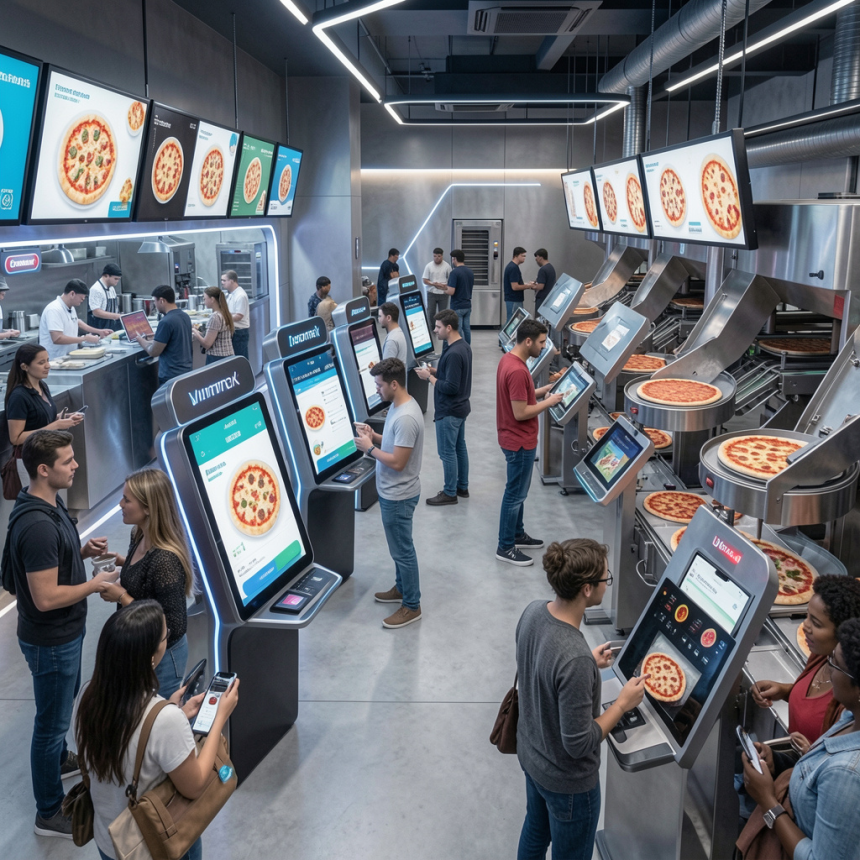
Predictive ordering technology is already becoming viable at scale, allowing platforms to surface a customer's most likely order before they open the menu. For pizza businesses, this means customers will increasingly expect the ordering experience to feel like it knows them — surfacing their usual order, anticipating modifications, and eliminating redundant steps they've completed dozens of times before.
Delivery speed expectations will compress further as more operators adopt advanced routing algorithms and hyperlocal fulfillment models. In major metropolitan markets, 20-minute delivery windows are already achievable and increasingly promoted. As those speeds normalize in major markets, they will migrate into customer expectations in secondary markets within a few years.
Voice and ambient ordering — through smart home devices and integrated car systems — will add entirely new ordering surfaces that the most future-facing pizza businesses are already beginning to support. The customer who can say "order my usual from [brand]" while driving home from work and receive confirmation without touching a phone represents the logical endpoint of convenience-driven ordering behavior.
Today, personalization in the pizza industry mostly means remembering a customer's past orders. That's valuable, but it represents a relatively shallow version of what personalization will mean within five years.
The next stage involves using order history, time patterns, household composition data, and behavioral signals to deliver genuinely anticipatory experiences. A family that orders a large pepperoni pizza and a vegetarian option every Sunday will expect a Sunday afternoon push notification with those items pre-loaded and perhaps a relevant offer — not a generic promotional email that ignores everything the business knows about them.
Personalization also extends to communication style. Customers who engage heavily with a brand's social media expect a different kind of communication than customers who order silently once a week and never interact beyond the transaction. The businesses that can calibrate their outreach to match individual customer profiles will generate meaningfully higher engagement and retention rates than those using broadcast communication strategies.
Loyalty programs are evolving from stamped punch cards and points-for-dollars mechanics toward behavior-responsive systems that actually shape purchasing patterns. A future-forward pizza loyalty program doesn't just reward frequency — it recognizes life events (a customer's birthday, a milestone order number, a long absence followed by a return), adapts offers based on purchasing patterns, and makes the customer feel genuinely seen rather than processed.
This kind of loyalty infrastructure requires investment in data systems that most smaller pizza operations haven't made yet. But the competitive gap between businesses that have this capability and those that don't will widen significantly over the next several years. Building toward it now is considerably easier than retrofitting it later.
Future customers — particularly younger ones — will hold food businesses to a higher standard of transparency than the industry has historically operated under. This is already visible in the growth of demand for ingredient sourcing information, allergen transparency, and honest communication about operational practices.
For pizza businesses, this trend has several practical implications. Menu transparency about ingredients and sourcing, where accessible, builds trust with customers who are making more considered food choices. Honest communication about delivery estimates, rather than systematically optimistic ones that consistently disappoint, will be rewarded with higher satisfaction scores and more forgiving review patterns.
The businesses most vulnerable to this trend are those that have built their customer relationships on marketing language that doesn't hold up to scrutiny. "Freshest ingredients" claims that can't be substantiated, delivery time promises that are routinely missed, and loyalty program benefits that are harder to redeem than advertised are all forms of small dishonesty that future customers will have less tolerance for — and more platforms on which to express that intolerance publicly.
One underappreciated dimension of shifting customer expectations is the growth of retail and frozen pizza as premium-positioned products rather than budget alternatives. The pandemic accelerated a reframing of frozen pizza that hasn't fully reversed — consumers who discovered high-quality frozen options during lockdowns have maintained some of those behaviors, and their expectations for frozen formats have risen accordingly.
For pizza businesses with the operational scale and brand recognition to consider retail channels, this creates a genuine strategic opportunity. Entering retail requires thinking about the product differently — shelf stability, packaging design, and the ability to communicate brand quality in a grocery environment rather than through a direct customer relationship. Operators who have invested in developing premium frozen products and use custom frozen pizza boxes that communicate quality and brand identity on a shelf are building a channel that didn't exist as viably even five years ago. It's a meaningful revenue diversification play for brands that have already established strong market recognition.
Sustainability concerns have moved from the margins of consumer behavior to the mainstream, and pizza businesses that aren't beginning to think about this are missing a developing expectation — particularly among younger customer segments.
This doesn't mean every pizzeria needs to become a sustainability showcase overnight. It means that the direction of travel is toward more sustainable operations, and customers are beginning to notice when businesses are moving in that direction versus standing still. Reduced food waste, more responsible sourcing practices, and packaging choices that signal environmental consideration are all becoming visible factors in how customers perceive brand values.
The most pragmatic approach for pizza operators is incremental: identify the highest-impact changes that align with operational reality, communicate those changes honestly without overclaiming, and build a track record over time. Customers are generally forgiving of where a brand is on this journey as long as they believe the brand is genuinely on it.
Pizza businesses that fall behind on customer expectations typically make one of a few recognizable errors:
Treating current satisfaction as a permanent state. A business that's meeting customer expectations today is not guaranteed to be meeting them in two years. The operators who assume stability and stop investing in experience improvement are the ones most surprised when competitors overtake them.
Delaying digital investment until it feels urgent. The time to build a functioning loyalty app, optimize the digital ordering experience, or integrate data systems is before losing customers to competitors who did it first — not after.
Underfunding staff development. As digital experiences improve, human interactions become more consequential, not less. The touchpoints that remain human — the in-store experience, the delivery handoff, the phone interaction — carry more weight precisely because they're increasingly rare. Businesses that invest in training those interactions will outperform those that don't.
The pizza businesses best positioned for the next five years share a common orientation: they treat future customer expectations as a design brief, not a forecast to worry about later.
Practically, that means investing in the digital infrastructure that enables personalization and frictionless ordering before competitors make it the standard. It means engaging with younger customer segments now to understand their preferences firsthand rather than inferring them from trend reports. It means making incremental sustainability improvements that build toward a credible brand narrative. And it means building a team culture that treats every customer interaction as an opportunity to exceed an expectation, not merely meet one.
Customer expectations in the pizza industry will keep rising, keep shifting, and keep rewarding the operators who take them seriously. The businesses that will grow over the next decade are not necessarily the ones with the best recipes or the most locations — they're the ones that understand where their customers are heading and make deliberate decisions today to meet them there.
The future of the pizza business belongs to operators who treat customer expectations as a moving target and build the agility to stay ahead of it. That agility isn't built overnight. But it starts with recognizing that the expectations customers hold right now are already the floor — not the ceiling.
Casino en Ligne : Une Plateforme Moderne et Fiable
Casino en Ligne : Une Plateforme Moderne et Fiable