
From Theory to Application: Handling Engineering Assessments at University
Learn how engineering students can handle university assessments effectively, apply theory to real problems, and benefit from structured engineering assignment help.
Engineering education at the university level is designed to challenge students intellectually while preparing them for real-world problem-solving. Unlike many theoretical disciplines, engineering requires students to move constantly between abstract concepts and practical applications. This transition—from theory learned in lectures to applied knowledge demonstrated in assessments—is where many students struggle. Understanding how to manage engineering assessments effectively is essential for academic success and long-term professional growth.
This article explores how engineering students can bridge the gap between theory and practice, what lecturers expect from assessments, common challenges students face, and how structured engineering assignment help can support learning without compromising academic integrity.
Engineering assessments are not just about testing memory or formula recall. Lecturers use assignments, projects, and reports to evaluate how well students can:
- Apply theoretical principles to practical problems
- Analyse real-world engineering scenarios
- Use appropriate methodologies and assumptions
- Communicate technical ideas clearly and logically
Whether it’s a design project, numerical problem set, simulation task, or technical report, assessments are designed to mirror professional engineering work. This means students must go beyond “getting the right answer” and demonstrate understanding, justification, and reasoning.
One of the most common difficulties engineering students face is applying theoretical knowledge to unfamiliar problems. Lectures often focus on ideal conditions and simplified examples, while assignments introduce complexity, constraints, and ambiguity.
For example:
- A formula taught in class may need modification based on assumptions.
- A design task may have multiple valid solutions.
- Real-world data may not behave as cleanly as textbook examples.
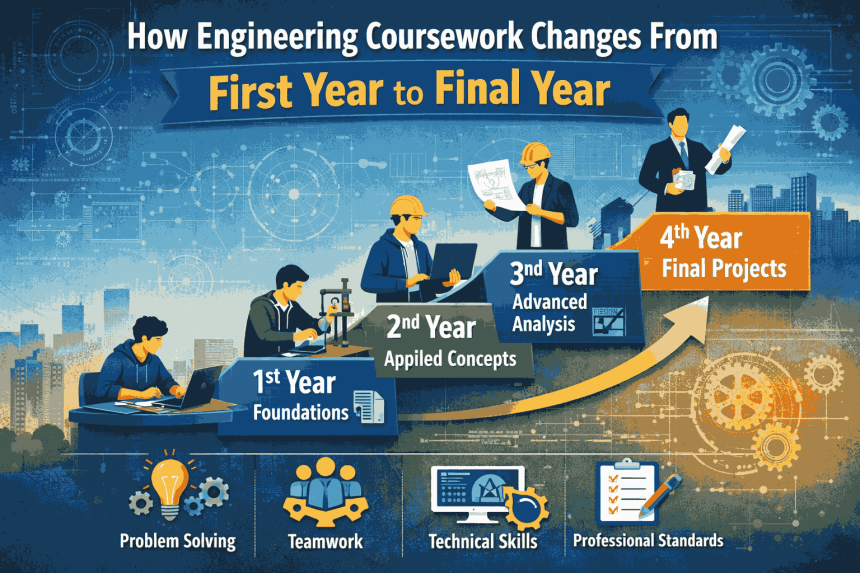
This gap can feel overwhelming, especially for first- and second-year students. Learning how to interpret questions, select appropriate methods, and explain decisions is a skill that develops over time.
High-scoring engineering assignments typically share several characteristics:
1. Clear Problem UnderstandingLecturers expect students to demonstrate understanding of the problem before attempting to solve it. This includes identifying objectives, constraints, and assumptions.
2. Correct Application of TheoryUsing the right equations or concepts is important, but so is explaining why they are appropriate. Unsupported calculations often lose marks.
3. Logical Structure and MethodologyAssignments should follow a logical sequence—from introduction and methodology to analysis and conclusion. Clear headings, labelled diagrams, and step-by-step reasoning improve readability.
4. Technical AccuracyErrors in units, calculations, or diagrams can significantly affect marks. Precision matters in engineering.
5. Professional PresentationWell-formatted reports, correct referencing, and clear language reflect professional standards expected in the engineering industry.
Despite strong effort, many students encounter recurring issues when handling engineering assessments:
- Difficulty choosing appropriate topics or design approaches
- Uncertainty about how much explanation is required
- Time management struggles due to heavy workloads
- Confusion around marking criteria and rubrics
- Stress caused by multiple overlapping deadlines
These challenges are not a reflection of a lack of ability but rather the demanding nature of engineering education. Learning how to navigate them is part of the academic journey.
Problem-solving lies at the heart of engineering. To improve assessment performance, students should focus on developing a systematic approach:
- Read the question carefully and identify what is being asked
- Break the problem into smaller parts
- Select relevant theories or models
- Apply calculations methodically
- Interpret results in context
Keeping a clear record of assumptions and decisions not only helps with marking but also mirrors professional engineering practice.
Many students turn to engineering assignment help when they feel stuck or unsure how to proceed. When used ethically, such support can be a valuable learning resource rather than a shortcut.
Quality engineering assignment help focuses on:
- Clarifying assignment requirements
- Explaining complex concepts in simpler terms
- Guiding students through problem-solving steps
- Improving report structure and academic presentation
Rather than replacing student effort, guided assistance helps students learn how to approach similar problems independently in the future.
Engineering students often manage multiple demanding subjects simultaneously. Poor time management can quickly lead to rushed submissions and unnecessary stress.
Practical strategies include:
- Starting assignments early, even with small steps
- Creating a realistic timeline for each task
- Breaking large assignments into manageable sections
- Seeking clarification or support early when issues arise
Using structured engineering assignment help during the planning or drafting stage can help students stay on track and avoid last-minute panic.
Universities place strong emphasis on academic integrity. Any external support used must align with institutional policies.
Ethical engineering assignment help:
- Supports understanding, not copying
- Encourages original work and independent thinking
- Helps students improve skills rather than bypass learning
Students who use support responsibly often develop stronger confidence and competence in their subject area.
Engineering assessments are a stepping stone toward professional practice. Skills developed through assignments—technical analysis, documentation, teamwork, and critical thinking—are directly transferable to industry roles.
By learning how to handle assessments effectively, students are not just aiming for higher grades but also preparing themselves for engineering careers where problem-solving under constraints is the norm.
Handling engineering assessments at university requires more than technical knowledge. It demands the ability to apply theory to practical situations, communicate ideas clearly, manage time effectively, and meet academic standards. While challenges are inevitable, they are also growth opportunities.
With the right strategies, mindset, and ethical engineering assignment help when needed, students can bridge the gap between theory and application successfully. This balanced approach not only improves academic performance but also builds the foundation for confident, capable engineering professionals.
Forzonax Deutschland: Preis, Wirksamkeit, Inhaltsstoffe & Kaufratgeber
Forzonax ist ein Nahrungsergänzungsmittel für Männer, das sich an erwachsene Männer richte...




The Padam Coin Beside the Face: Why the Lotus Is Separate
One-sided, face up, nearby — the listing’s instruction for the second coin.