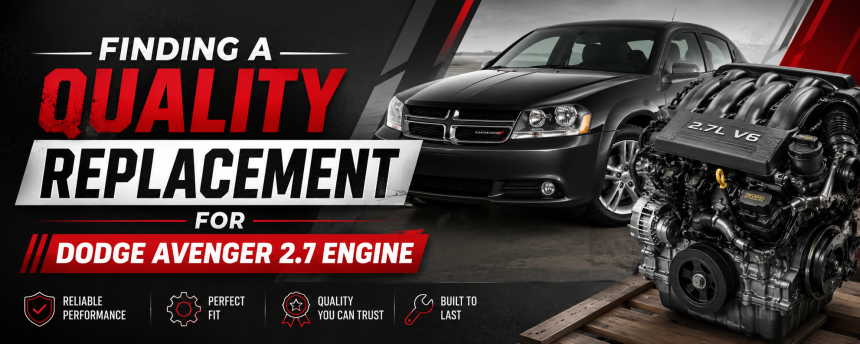

Finding a Quality Replacement For Dodge Avenger 2.7 Engine
Learn how to find a reliable replacement for the Dodge Avenger 2.7L engine, focusing on quality, common issues, and smart buying decisions.
The Dodge Avenger 2.7 engine has a reputation in the used car community that is worth addressing directly and honestly rather than talking around — because the buyers who need this information most are the ones who already know the reputation exists and want to understand what it actually means for their sourcing decision. The 2.7-liter V6 that powered the Avenger across its final production generation has been the subject of significant owner discussion regarding oil sludge, timing chain wear, and the maintenance sensitivity that defines its long-term reliability profile. This guide addresses all of it — the real issues, the real causes, and the real path to finding a replacement unit that avoids the failure modes that earned the engine its complicated standing.
What the 2.7-Liter V6 Is and Where It Came From
The EER 2.7 V6 engine is a 2.7-liter dual-overhead-cam V6 that Chrysler developed in the mid-1990s as the performance tier option for its mid-size sedan lineup. At its introduction, the engine was genuinely capable — 200 horsepower from 2.7 liters was a respectable specific output for a naturally aspirated V6 of its era, and the DOHC architecture gave it a responsive, willing character that suited the performance-oriented models it was specified for. The engine's design incorporated a relatively narrow 60-degree V-angle that enabled compact packaging, and the all-aluminum construction kept weight to a minimum appropriate for a mid-size sedan application.
The Avenger V6 motor in this configuration uses a timing chain system rather than a belt — which at first seems like a durability advantage, since chains are generally designed for the engine's life rather than requiring scheduled replacement. However, the timing chain in the 2.7-liter has become one of the primary documented failure concerns in this engine's ownership history, and understanding why reveals the core issue that defines the 2.7's reputation.
The Oil Sludge Issue — What Causes It and Why It Matters for Used Engine Evaluation
The timing chain wear, the bearing failures, and the internal damage that define the 2.7-liter's most discussed failure mode all trace back to a single root cause: oil sludge accumulation from extended oil change intervals. The 2.7L Chrysler V6 uses an oil circuit design that is sensitive to oil quality in ways that simpler, more robust oil circuit designs handle more forgivingly. When oil is not changed at the intervals the engine requires — Chrysler's official position has evolved over time, but most experienced mechanics recommend 3,000 to 5,000-mile intervals for this engine — the oil degrades into a sludge that progressively blocks oil passages, starves the timing chain tensioners of the hydraulic pressure they need to maintain chain tension, and eventually causes the chain to skip timing or fail catastrophically.
The important practical point for buyers searching for a Dodge Avenger engine problems resolution through replacement is that oil sludge is entirely preventable through maintenance discipline. Engines from vehicles where oil changes were performed consistently and on schedule are fundamentally different mechanical propositions from those where intervals were extended — and the difference is visible during inspection. A used 2.7-liter with clean, sludge-free valve covers, clean oil passages at the fill cap, and a timing chain that runs quietly without rattle at cold start is an engine whose maintenance history protected it from the failure mode that defines the bad-reputation examples.
The evaluation implications are direct and actionable: any supplier offering a used 2.7 V6 engine replacement unit should be able to specifically speak to the oil passage condition and the timing chain tensioner status of the unit they're selling. A supplier who can confirm clean passages, quiet timing chain operation, and absence of sludge deposits has provided meaningful assurance. One who offers only mileage and general condition claims is providing insufficient information for an engine whose maintenance-sensitivity makes the specific details genuinely consequential.
The Cooling System — The Second Critical Evaluation Area
Beyond the oil maintenance story, the 2.7-liter's cooling system deserves specific attention in any used engine evaluation. The engine's all-aluminum construction makes cooling system condition more consequential than it would be in an iron-block engine, and the failure mode that most commonly triggers Avenger 2.7 engine replacement — rather than the sludge issue — is a cooling system neglect event that leads to overheating damage. Coolant leaks from the water pump, thermostat housing, or deteriorated hoses can drain the cooling system gradually without producing obvious symptoms, eventually leading to an overheating event that damages the aluminum cylinder heads and head gaskets.
A used 2.7-liter evaluation should specifically request information about the cooling system condition at the time of removal — specifically whether the coolant was the correct color and opacity (indicating proper inhibitor content) and whether the engine showed any evidence of combustion gas contamination in the coolant (a diagnostic indicator of head gasket compromise). These two data points together with the oil system assessment described above provide the most complete picture of a 2.7-liter's actual condition that a used engine evaluation can produce.
Finding a Replacement That Breaks the Pattern
The path to a successful Dodge Avenger 2.7 engine replacement is straightforward when the evaluation criteria are applied honestly. The 2.7-liter is not an engine that is inherently unreliable — it is an engine that requires consistent maintenance and responds to neglect more visibly than simpler designs. A used 2.7-liter from a vehicle whose owner maintained it correctly is a genuine, capable replacement candidate that will deliver reliable service in the replacement application. The sourcing challenge is identifying that engine from the broader supply, which makes the specific oil system and cooling system evaluation questions the most important investment a buyer can make in the sourcing process.
Post-installation, the most important action is establishing the oil change discipline that the 2.7-liter genuinely requires. Setting a firm 5,000-mile oil change interval with quality conventional or synthetic 5W-30, monitoring coolant level monthly, and testing the coolant condition annually are the three maintenance practices that protect the replacement engine's service life in ways that the original engine's failure demonstrated were genuinely necessary.
🔧 Turbo Auto Parts — Honest Engine Assessment, Real Warranty Coverage
Turbo Auto Parts applies the specific inspection criteria that the 2.7-liter V6's maintenance-sensitive reputation demands. Every Avenger used engine they sell is assessed for oil passage condition, timing chain health, and cooling system integrity — not just mileage and general condition and backed by a 3-year parts warranty that protects buyers who do their homework with genuine long-term coverage. With free shipping anywhere in the continental United States, the replacement decision is supported by a supplier who addresses the real issues rather than avoiding them.
READ MORE : - A Smart Buyer's Roadmap to the Dodge Viper Engine Market
How to Choose the Right U Bolt for Your Industrial Application in Indi...

A Day in the Life of a Mental Health Support Worker
What is a normal day like for a mental health support worker? The answer can be different...


Goods in Transit Insurance: Protect Your Deliveries from Costly Setbac...



Why Choose a Professional Sign Company for Custom Building Signs in Wa...