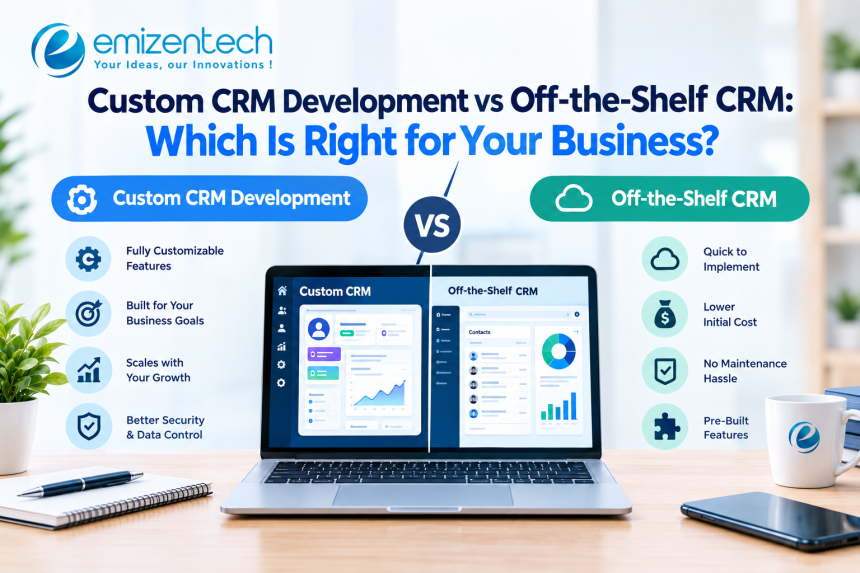

Custom CRM Development vs Off-the-Shelf CRM: Which Is Right for Your Business?
Comparing custom CRM development and off-the-shelf CRM software to help you choose the right solution based on cost, scalability, and business needs.
Every growing business eventually hits the same question: how do you manage relationships with customers without losing track of details, follow-ups, or opportunities? A CRM system is usually the answer, but the next question is trickier. Should you build something from scratch, or should you go with a ready-made solution? Both paths work for different companies in different situations, and understanding the trade-offs can save a lot of time, money, and frustration down the line.
What Is Custom CRM Development?
Custom CRM development refers to building a CRM system from the ground up, designed around the specific workflows, data structures, and goals of a particular business. Instead of adapting your processes to fit a tool, the tool is shaped to fit your processes.
This approach usually starts with a discovery phase, where developers map out how sales, support, and marketing teams actually work. From there, they build features one by one, whether that means a specific lead-scoring model, a unique approval chain for deals, or a dashboard that mirrors how a particular industry tracks its pipeline. A logistics company, for instance, might need CRM fields for tracking shipment schedules alongside client communication, something a generic system wouldn't offer out of the box.
What Is Off-the-Shelf CRM Software?
Off-the-shelf CRM refers to pre-built platforms that are ready to use almost immediately after signup. Think of tools like Salesforce, HubSpot, or Zoho CRM. These platforms are built to serve a broad range of industries and business sizes, offering standard features like contact management, pipeline tracking, email integration, and reporting.
The appeal here is speed. A sales team can be up and running within days, sometimes hours, using templates and pre-configured workflows that already reflect common business practices. Most of these platforms also offer tiered pricing, so a small business can start with basic features and upgrade as it grows.
Key Differences Between Custom CRM and Off-the-Shelf CRM
The core difference comes down to flexibility versus convenience, but it helps to break this down into a few specific areas.
Flexibility and Fit
A custom CRM software is designed around a specific set of needs, so it fits exactly how a business operates. An off-the-shelf CRM comes with a fixed set of features that many businesses share, so customization is often limited to what the platform allows through settings or add-ons.
Development and Deployment Time
Custom systems take longer to build since they're created from scratch, often requiring weeks or months of planning and development. Off-the-shelf platforms can be deployed almost immediately, since the infrastructure already exists.
Data Structure
Custom systems can be built to match exactly how a company categorizes customers, deals, or products. Off-the-shelf tools use a more generalized structure, which works fine for standard sales processes but can feel restrictive for businesses with unusual workflows, like a manufacturer that needs to track multi-stage production alongside customer orders.
Ownership and Control
With a custom build, the business owns the codebase and has full control over how data is stored and used. With off-the-shelf tools, the business operates within the vendor's infrastructure and terms of service.
Pros and Cons of Custom CRM Development
Pros:
- Built specifically around your business processes, not the other way around
- Full ownership of the codebase and data structure
- Scales in whatever direction the business grows, without licensing restrictions
- Integrates deeply with existing internal tools and legacy systems
Cons:
- Requires a larger upfront investment of time and budget
- Needs a dedicated team or partner for ongoing maintenance and updates
- Takes longer to launch compared to signing up for a ready-made platform
- Any bugs or gaps in functionality need to be resolved internally rather than through a support ticket
A retail chain with a loyalty program tied to in-store purchases, for example, might find that a custom CRM software handles that logic more naturally than trying to bend a generic platform around it.
Pros and Cons of Off-the-Shelf CRM
Pros:
- Quick to set up, often within days
- Lower initial cost, especially for smaller teams
- Backed by established support teams and regular updates
- Large communities and documentation available for troubleshooting
Cons:
- Limited ability to adjust core workflows or data models
- Ongoing subscription costs that can rise as the business scales
- Features you don't need often come bundled in, adding complexity
- Data ownership and portability can be restricted by the vendor's terms
For a small consulting firm just starting to formalize its sales process, an off-the-shelf CRM is usually more than enough, and switching to something custom-built wouldn't make sense until the business grows into more specific needs.
Cost Comparison
Cost plays out differently over time depending on which route a business takes, so it helps to look at the specific factors involved.
Off-the-shelf CRM costs typically include:
- A monthly or annual subscription fee per user
- Extra charges for premium features or higher storage tiers
- Add-on costs for third-party integrations
- Fees that increase as more team members are added
Custom CRM development costs typically include:
- A larger upfront investment covering planning, design, development, and testing
- Costs for ongoing maintenance, updates, and bug fixes
- Potential costs for hosting and infrastructure, depending on setup
- No recurring per-user licensing fees once the system is built
Off-the-shelf platforms keep the initial cost low, but subscription fees add up over several years, especially as more users are added or premium features are unlocked. Custom CRM development requires a bigger investment upfront, but once built, the total cost of ownership can become more predictable over time, since the business isn't paying repeatedly for something it already owns.
The right choice often depends on the size of the team, the complexity of the business's operations, and how long the company expects to use the system without major changes.
Scalability and Customization
Scalability looks different depending on the type of CRM. Off-the-shelf platforms scale by letting businesses upgrade to higher pricing tiers, which usually unlock more storage, more automation, or more integrations. This works well until a business hits a wall where the platform simply doesn't support a workflow it needs, no matter which tier it's on.
Custom systems scale according to the business's actual growth pattern. New features can be added exactly when needed, without waiting for a vendor's product roadmap to catch up. Many businesses that outgrow their off-the-shelf CRM eventually turn to a CRM Development Company to build something that matches their evolving operations more closely, particularly once their processes become too specific for generic templates.
Which Option Is Right for Your Business?
The right choice depends less on which option sounds more advanced and more on what your business actually needs. A small business with straightforward sales processes may find that off-the-shelf CRM covers everything required without added complexity. On the other hand, a business with unusual workflows, strict compliance requirements, or plans for significant scaling might benefit more from a system built specifically for them. Budget also plays a role if upfront capital is limited, a subscription-based tool may make more sense initially, even if a custom system would pay off later. Working with an experienced CRM Development Company in USA can help clarify which direction aligns with your long-term goals, since they can assess your existing processes before recommending a path forward.
Conclusion
Choosing between custom CRM development and off-the-shelf CRM software isn't about which one is objectively better, it's about which one fits how your business actually operates today and where it's headed. Off-the-shelf tools offer speed and simplicity, while custom-built systems offer precision and long-term flexibility. Taking the time to honestly assess your team's workflows, budget, and growth plans will make this decision much clearer. If you're weighing your options and want to talk through what might work best for your specific situation, EmizenTech can help you think it through.
FAQs
1. How long does it take to build a custom CRM?
It varies based on complexity, but most custom builds take anywhere from a few weeks to several months, depending on the number of features and integrations involved.
2. Is off-the-shelf CRM cheaper than a custom one?
Initially, yes. But over several years, subscription costs can add up, sometimes exceeding what a custom build would have cost upfront.
3. Can a custom CRM integrate with tools I already use?
Yes, custom systems are typically built with integration in mind, allowing them to connect smoothly with existing internal tools and legacy systems.
4. Can I switch from off-the-shelf CRM to a custom one later?
Yes, many businesses start with a ready-made platform and move to a custom solution once their processes outgrow standard templates.
5. Who maintains a custom CRM after it's built?
Ongoing maintenance is usually handled by the development team or partner who built it, or by an in-house team if the business has one.