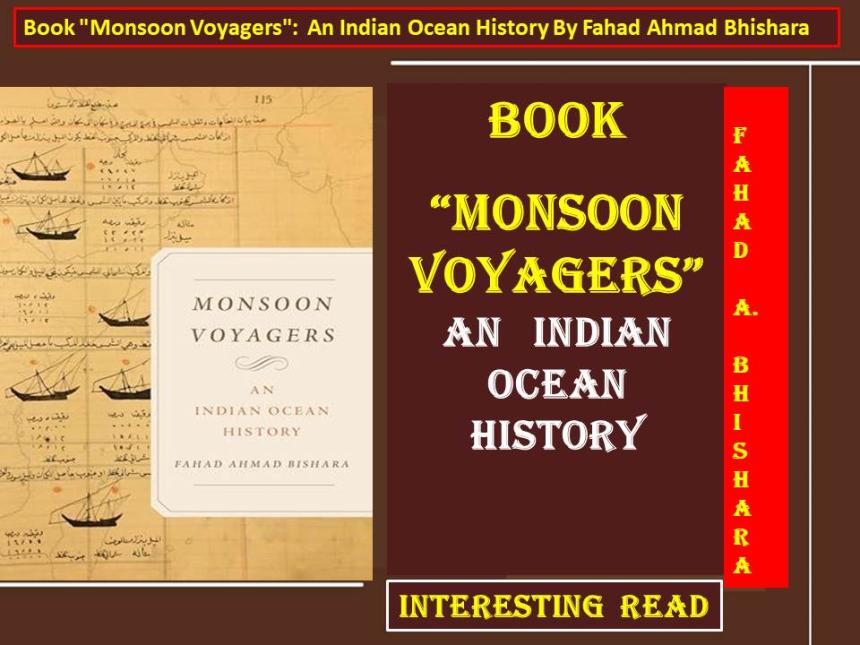

Book "Monsoon Voyagers": An Indian Ocean History By Fahad Ahmad Bhishara
Fahad Ahmad Bishara is a Kuwaiti historian who completed his Ph.D. in History at Duke University in 2012. He is an Associate Professor of History at the University of Virginia. He specializes in the economic and legal history of the Indian Ocean region and authored the acclaimed work "A Sea of Debt". "Monsoon Voyagers": An Indian Ocean History is a captivating historical book by Fahad Ahmad Bhishara. This write up is an introduction of Book "Monsoon Voyagers": An Indian Ocean History By Fahad Ahmad Bhishara and has been arranged for educational purposes from material available freely on Web Net.
أَعُوذُ بِاللّٰهِ مِنَ الشَّيْطَانِ الرَّجِيمِ
بِسۡمِ ٱللهِ ٱلرَّحۡمَـٰنِ ٱلرَّحِيمِ
In the name of ALLAH, the Most Gracious, the Most Merciful
Book "Monsoon Voyagers":An Indian Ocean History By Fahad Ahmad Bhishara
Fahad Ahmad Bishara is a Kuwaiti historian who was raised in an Arabic-speaking household in Kuwait. He completed his Ph.D. in History at Duke University in 2012. Fahad Ahmad Bishara is an Associate Professor of History at the University of Virginia. He specializes in the economic and legal history of the Indian Ocean region and authored the acclaimed work A Sea of Debt. His deep academic interest in the Indian Ocean world stems from a rich personal heritage; his ancestors were seafaring voyagers from Kuwait. His grandfather sailed regularly from the Gulf to East Africa and India up until the 1950s, while his father transitioned away from the sea to become an engineering professor in Kuwait.
Monsoon Voyagers: An Indian Ocean History is a captivating historical book by Fahad Ahmad Bishara, published in October 2025 by the University of California Press (388 page book). The book reconstructs the dynamic maritime world of the Western Indian Ocean during a transformative era. It is structured around the literal journey of a single Kuwaiti sailing vessel and serves as an immersive entry point into the history of transregional trade, capitalism, and empire.
The book follows a single Kuwaiti dhow named The Crooked (Al-Aʿwaji), alongside its captain (nakhoda) Al-Failakawi and his crew, as they sail from Kuwait across the Persian Gulf and the Western Indian Ocean from 1924 to 1925. Rather than focusing on a macro-history dictated by European colonial powers, Bishara uses the microcosm of this specific voyage to illustrate how local Gulf merchants actively shaped their destiny. They repurposed technologies of British colonial capitalism—such as telegraphs, modern banking, railroads, and steamships—to expand and secure their regional bazaar economy. The book beautifully demonstrates that the history of the Gulf was written across the waves just as much as on the desert sands.
Bishara brings this oceanic society to life by relying heavily on unique, intimate primary sources:-
The Ship’s Logbook (Ruznamah): The narrative’s backbone relies on the first-person daily sailing logs kept by Captain Al-Failakawi.
Commercial Material: Private merchant letters, financial accounts, legal notes, and debt ledgers scattered across various port cities.
Cultural Frameworks: Oral accounts, seafaring poems, and maritime songs (sangani) that colored the daily life of the crew.
The book follows a geographical organization mapping the dhow's journey and historical documentation:-
Journey Segments: Moves from the prologue and early stops in Kuwait and the Gulf (chapters 1–3) through South Asian ports like
Karachi, Bombay, and Malabar (chapters 4–7), before returning via Muscat and Bahrain (chapters 8–11).
Book "Monsoon Voyagers": An Indian Ocean History By Fahad Ahmad Bhishara Explains
Monsoon Voyagers: An Indian Ocean History chronicles the seasonal voyage of the Kuwaiti dhow The Crooked, tracing its journey from the Persian Gulf to the trading hubs of South Asia and back. The book explores the complex maritime credit contracts, bazaar economies, and legal frameworks that structured these commercial ventures. It highlights how Arab voyagers utilized imperial infrastructure and local networks to navigate the Indian Ocean, framing the region as a dynamic highway that shaped the modern Middle East.
Chapters 1–3: Departure and The Inner Gulf
The book’s opening chapters chronicle the initial launch of the Kuwaiti dhow, The Crooked (Al-Aʿwaji), from its home waters into the northern stretches of the Persian Gulf. Focusing on the ports of Kuwait and the Shatt Al-ʿArab, Bishara introduces the foundational mechanics of the regional bazaar economy. Readers are introduced to the captain (nakhoda), his specialized crew, and the highly complex web of maritime credit contracts that funded the journey. The primary focus of this initial leg involves sailing to the river systems of southern Iraq to load their heavy cargo of fresh dates. This section establishes how local merchants relied on legal frameworks, debt inscriptions, and strict passenger logs to transform a traditional seafaring venture into a highly structured capitalistic enterprise right under the nose of British imperial oversight.
Chapters 4–7: Crossing the Sea to South Asia
This section tracks the dhow as it passes the Sea of Oman and braves the open waters of the Arabian Sea to hit major global trading hubs in South Asia. Spanning from Karachi to Kathiawar, Bombay, and down the Malabar coast, these chapters reveal the true transregional scale of Gulf business networks. Bishara meticulously shows how these Arab voyagers did not simply survive colonial globalization—they actively exploited it. By embedding themselves within major British-controlled ports, the crew utilized imperial infrastructure, including international postal services, telegraphs, legal currency conversions, and rapid banking systems, to process financial transfers and scale up their trade. The text blends these rigid economic realities with the vibrant, sensory experiences of a bustling Indian Ocean diaspora.
Chapters 8–11: The Long Journey Home
The final segment documents the arduous return trip back to the Arabian Peninsula. Moving through the critical waypoints of Muscat and Bahrain, these chapters examine the cultural and psychological life of the crew as they navigate back into the home stretch of the Gulf. Bishara weaves financial ledgers and precise business balance sheets alongside human elements like maritime poetry, navigational maps, and shared oral accounts. It covers how the captain meticulously squared away complex crew debts, calculated freight profits, and distributed earnings to the vessel's land-bound owners. Ultimately, this section concludes The Crooked’s seasonal voyage, providing a powerful historical argument that the modern identity, wealth, and destiny of the Gulf were forged over the waves just as much as on the land.
The Conclusion
Monsoon Voyagers concludes with a formal epilogue titled "Epilogue: Triumph and Loss".
The conclusion beautifully ties together the human and historical themes of the book through the end of the seasonal voyage:-
The Micro-Level Return: Physically, the book concludes as the dhow The Crooked finishes its seasonal circuit, navigating back up the Arab coast to safely anchor back in its home port of Kuwait. It tracks the literal settling of accounts: squaring away crew debts, calculating profits, and distributing the earnings to land-bound investors.
The "Triumph" of the Network: Historically, Bishara shows that the journey was an economic success. The crew proved that local Gulf merchants did not just survive European imperialism; they actively triumphed by appropriating British colonial capitalism (telegraphs, banking, and infrastructure) to expand their own local bazaar economy.
The "Loss" to Modern Memory: The overarching thematic conclusion delivers a poignant look at how this vibrant, multi-ethnic "oceanic society" was ultimately lost to time and political shifts. With the mid-20th-century rise of territorial nation-states and the oil boom, the Gulf's history was rewritten to focus almost entirely on land, desert borders, and oil wells.
Ultimately, Bishara closes with a powerful historical argument; "the modern identity, wealth, and destiny of the Gulf were fundamentally forged across the monsoon seas, and ignoring its maritime past leaves our understanding of the Middle East incomplete".
Vigortrix Review: Is It Worth Trying? Results, Pricing & Where to Buy
What Is Vigortrix? Vigortrix is a men's vitality dietary supplement designed to support e...



Golden Touch Fusion CBD – Premium Quality and Natural Wellness Support
What Are Golden Touch Fusion CBD? Golden Touch Fusion are a cannabidiol (CBD) supplement...