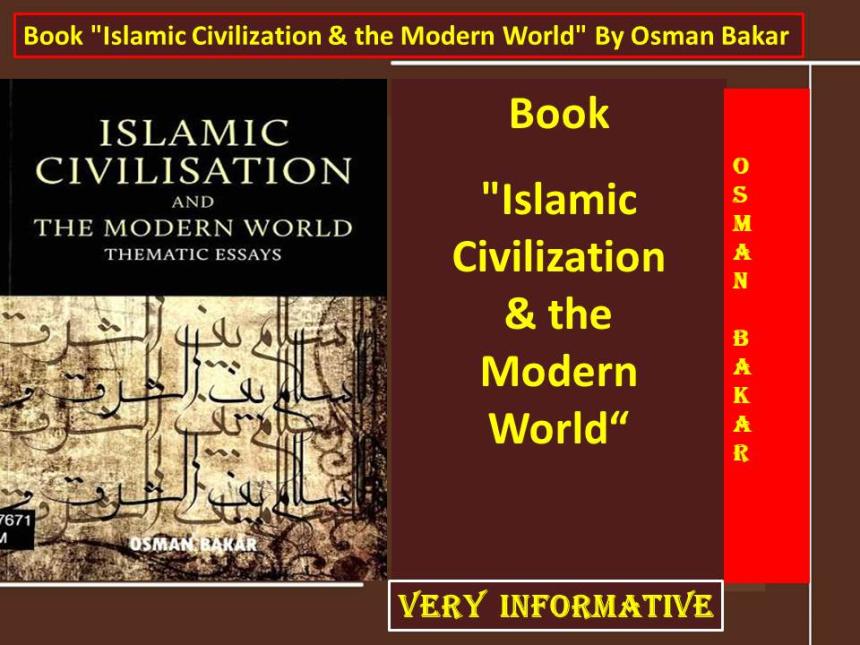

Book "Islamic Civilization & the Modern World" By Osman Bakar
Dr. Osman Bakar is a prominent Muslim philosopher and scholar and an internationally recognized expert in Islamic thought and the philosophy of science. Dr Bakar is an author of 18 books and more than 300 articles on various aspects of Islamic thought and civilization. The book "Islamic Civilisation and the Modern World": Thematic Essays; examines how traditional Islamic principles can help Muslims navigate today's modern, secular world. This write up is an introduction of the book "Islamic Civilisation and the Modern World" and has been arranged for educational purposes.
أَعُوذُ بِاللّٰهِ مِنَ الشَّيْطَانِ الرَّجِيمِ
بِسۡمِ ٱللهِ ٱلرَّحۡمَـٰنِ ٱلرَّحِيمِ
اللہ کے نام سے شروع جو بڑا مہربان نہایت رحم کرنے والا ہے
In the name of ALLAH, the Most Gracious, the Most Merciful
Book "Islamic Civilization & the Modern World" By Osman Bakar
Dr. Osman Bakar is a prominent Muslim philosopher and scholar and an internationally recognized expert in Islamic thought and the philosophy of science. He holds the Al-Ghazali Chair of Epistemology and Civilizational Studies at the International Islamic University of Malaysia (IIUM). The book "Islamic Civilisation and the Modern World": Thematic Essays; examines how traditional Islamic principles can help Muslims navigate today's modern, secular world.
Osman Bakar, a doctorate in Islamic philosophy from Temple University, Philadelphia (USA) is currently Chair Professor and Director of Sultan Omar ‘Ali Saifuddien Centre of Islamic Studies (SOASCIS), Universiti Brunei Darussalam. Formerly Malaysia Chair of Islam in Southeast Asia at the Prince Talal al-Waleed Center for Muslim - Christian Understanding, Georgetown University, Washington DC he is also Emeritus Professor of Philosophy of Science at the University of Malaya. Dr Bakar is an author of 18 books and more than 300 articles on various aspects of Islamic thought and civilization, particularly Islamic science and philosophy. His most well-known books are Classification of Knowledge in Islam (1992) and Tawhid and Science (1992).
This Book "Islamic Civilization & the Modern World" By Osman Bakar presents a thematic treatment of Islamic civilisation. Each of the fourteen chapters comprising this book treats at least one of the major themes that are characteristic of this youngest religiously-based civilisation of the world. The author’s thematic approach is primarily meant to promote a better appreciation of the living nature of Islamic civilisation. The book’s content provides ample evidence that Islamic civilisation is not merely a passing historical phenomenon. The various themes it discusses clearly demonstrate the continuing relevance of Islamic civilisation to the present and future humanity.
Among the many interesting ideas explored in the book are the three types of a civilisation’s global presence, the Qur’anic theory of the identity of the Muslim ummah and the identity of Islamic civilisation, tawhidic epistemology, the core content of a knowledge culture, the wisdom of medical pluralism, the theory of Islam and the three waves of globalisation, the marriage between ethnicity and religiosity to produce certain types of civilisations,and civilisational renewal in relation to Maqasid al-shari’ah. There are many appealing features of the book that would help attract positive responses and critiques from readers thereby helping to contribute to a more enlightened discourse on Islamic civilisation.
Among the many interesting ideas explored in the book are the three types of a civilisation’s global presence, the Qur’anic theory of the identity of the Muslim ummah and the identity of Islamic civilisation, tawhidic epistemology, the core content of a knowledge culture, the wisdom of medical pluralism, the theory of Islam and the three waves of globalisation, the marriage between ethnicity and religiosity to produce certain types of civilisations, and civilisational renewal in relation to Maqasid al-shari’ah. There are many appealing features of the book that would help attract positive responses and critiques from readers thereby helping to contribute to a more enlightened discourse on Islamic civilisation.
The central theme of the book "Islamic Civilization and the Modern World" by Osman Bakar revolves round the need for Muslims to reclaim the spiritual and ethical foundations of knowledge. The book argues that Islam provides a living framework to solve modern crises like secularism and environmental harm.The book tackles the ongoing clash between traditional Islamic values and modern Western culture. Here are the main ideas he explores:-
Tawhidic Epistemology (Unity of Knowledge): Bakar explains that all knowledge comes from God. Science, nature, and religion should work together, not apart.
Civilizational Renewal: Bakar uses the goals of Islamic law (Maqāssid al-Sharī'ah) to show how Muslims can adapt to modern times without losing their identity.
Science and Values: Modern science often forgets morals. Bakar believes Islamic civilization can bring back ethics to modern science and technology.
In the book "Islamic Civilization and the Modern World" the author Osman Bakar suggests to think of modern civilization like a car with a powerful engine (technology) but no steering wheel (ethics). Bakar argues that traditional Islamic civilization offers that steering wheel. It guides humanity to use knowledge for the greater good.
Book "Islamic Civilization & the Modern World" By Osman Bakar Explains
In Islamic Civilization and the Modern World, Osman Bakar explains that Islamic civilization is still relevant today. He explores how core Islamic ideas, like Tawhid (the oneness of God), can fix modern problems caused by strict secularism. The book shows how Muslims can rebuild modern knowledge using true faith and reason. The book features 14 essays that explain several key ideas:
Epistemological Renewal: Bakar argues for a fix to the modern "knowledge crisis". He shows that true science and religion work as one team.
The Three Waves of Globalization: He explains how Islam connects with world trade and culture.
Medical Pluralism: He highlights the historical and modern wisdom of using multiple healing methods.
Civilizational Renewal: He details how modern Muslim communities can adapt while keeping true to their faith.
The book "Islamic Civilization & the Modern World" By Osman Bakar while discussing the idea of civilisation says that "civilization as constituting a particular cultural species has its basis in the Qur'an. The key term in the Qur'an pertaining to this idea is ummah, which in its noun form appears in its text sixty-four times in different contexts and with different connotations. This word conveys the core meaning of an organised community that is governed by certain laws, usually divine. In one verse, the Qur'an describes the animal species as forming communities (umam, plural of ummah) similar to human communities. This verse permits us to speak of ummah as a genus of living organisms comprising two species, namely animal species in the natural world and cultural species in the human world. By cultural species is meant a human community together with the cultural environment it has created.
There are many different cultural species in as much as there are human communities with different sizes, belief systems and worldviews, diversity patterns, both ethnic and religious, and depths and breadths of cultural achievements. Therefore, in the perspective of the Qur'an, cultural species is akin to animal species, having as it were many similarities with the latter. The largest and most complex of cultural species is what we call civilisation just as the largest animal species to have ever lived on earth but now extinct is identified, at least in the popular imagination of modern man if not in real natural history, with what are called the dinosaurs. In between, we have the intermediate cultural species such as villages, towns, cities, states, kingdoms, sultanates, caliphates, and empires. Thus Islamic Civilization is as much a concept as applicable to modern civilization.
A Dive into Book "Islamic Civilization & the Modern World" By Osman Bakar
Islamic Civilization and the Modern World: Thematic Essays is another masterpiece of the renowned author which has made a thematic presentation of Islamic civilization. This book consists of fourteen chapters along with an “introduction”. Each chapter deals at least with a major theme of Islamic civilization. This book explores many interesting ideas such as the three types of a civilization’s global presence, the Qur’anic theory of the identity of the Muslim ummah and the identity of Islamic civilization, tawhidic epistemology, the core content of a knowledge culture, the wisdom of medical pluralism, the theory of Islam and the three waves of globalization, the marriage between ethnicity and religiosity to produce certain type of civilizations, and civilizational renewal in relation to Maqasid al-shari’ah.
Introduction; Chapter 1: Islamic Civilisation as a Global Presence with Special Reference to its Knowledge Culture; Chapter 2: The Qur’anic Identity of the Muslim Ummah: Tawhidic Epistemology as its Foundation and Sustainer; Chapter 3: Islam’s Destiny: A Civilisational Bridge between the East and the West; Chapter 4: Comparative Notes on Qutb al-Din al-Shirazi’s and Ibn Khaldun’s Classifications of the Sciences: A Turning Point in Islamic Intellectual History; Chapter 5: The Spiritual and Ethical Foundation of Science and Technology in Islamic Civilisation; Chapter 6: Islamic Medical and Public Health System; Chapter 7: The Role of Cosmology in the Cultivation of the Arts: Addressing Aesthetic Needs in Islamic Civilisation; Chapter 8: Environmental Health and Welfare as an Important Aspect of Civilisational Islam; Chapter 9: The Golden Age of Science in Islamic Spain; Chapter 10: Islam’s Contributions to Human Civilisation with Special Reference to Science and Scientific Culture; Chapter 11: Islam and the Three Waves of Globalisation: The Southeast Asian Experience; Chapter 12: Islam as a Shaping Force of Cultural Identity in Southeast Asia: The Case of the Malay-Islamic Identity; Chapter 13: The Identity Crisis of the Contemporary Muslim Ummah: The Loss of Tawhidic Epistemology as Its Root Cause; Chapter 14: The Place and Role of Maqā_id al-Sharī‘ah in the Ummah’s Twenty-First Century Civilisational Renewal. Bibliography, Index.
In the first chapter, the most important theme of Islamic civilisation discussed is its global presence, particularly in the domain of knowledge culture. The various types of a civilisation's global presence are explained. The second chapter is primarily concerned with the theme of the identity of the Muslim ummah and by extension the identity of Islamic civilisation itself. In the third chapter, the central theme treated is the destined role of Islam the religion and its civilisation as the bridge between the East and the West. In the fourth chapter, the central theme under treatment is classification of knowledge and of the sciences, which was of much importance to classical Islamic civilisation but which is only beginning to be appreciated in our times as an intellectual pursuit of civilisational significance. Classification of knowledge and of the sciences was, without doubt, a major dimension of Islam's knowledge culture of the classical period. The theme was discussed with reference to two of the most eminent Muslim thinkers in history, namely Qutb al-Din al-Shirazi (1236 - 1311) and Ibn Khaldun (1332 - 1406), both of whom were noted for their respective classifications of the sciences.
The fifth chapter is mainly concerned with the theme of the spiritual and ethical foundations of science and technology in Islamic civilisation. This is yet another theme that is closely related to knowledge culture. In fact, properly speaking, it is a subtheme of knowledge culture, to which we may refer as Islam's scientific and technological culture. Chapter six takes up the theme of Islam's medical and public health systems to which the modern West owed a great deal. Islam's traditional medical system was apparently pluralistic in nature with its scientific medicine and medical practices coexisting with several other forms of medicine. The wisdom of medical pluralism is the belief that no single medical system, modern or traditional, could claim exclusive efficacy in the treatment of diseases or curing the sick. It is only if all the epistemologically valid and legally legitimate medical systems are allowed to flourish side by side that human society could be assured of a better health deal for the public. In chapter seven, the main theme discussed is the role of cosmology in the cultivation of the arts. This theme is hardly separable from the broader themes of knowledge culture as understood and practiced in Islam. The eighth theme addresses the theme of environmental health care and welfare as an extremely important aspect of Islamic civilisation.
Chapters nine and ten both deal with science and technology, which is thus related to the central theme of chapter five. These three chapters show quite clearly that the pursuit of science and technology was one of the major themes of classical Islamic civilisation. However, these three chapters emphasize different aspects of Islamic science and technology. Chapter five focuses on the issue of the spiritual and ethical nature of the foundation of Islamic science and technology. Chapter nine deals with the theme of Islam's golden age in the field of science but with specific reference to Andalusian science or science in Muslim ruled Spain. This theme is discussed within the framework of the theory of the rise and decline of Islamic civilisation in general and of Islamic science in particular.
Chapter ten concentrates on some of the most noteworthy contributions of Islamic civilisation to humanity particularly in the field of science and technology. We are very much aware of the many works that have been done in this area of studies of Islamic civilisation. Thus we are more interested in this book in pointing out to Muslim contributions to scientific and technological culture that have lasting values for humanity such as in its institution building and value-enrichment for its sustainability rather than to their discoveries of such and such a theory that could be devalued any day by newly discovered theories. For this reason also, chapter ten receives the shortest treatment in the book.
In the eleventh chapter the main theme discussed is Islam and globalisation in world history. We propose here a theory which we call "Islam and the three waves of globalisation. This theory posits the role of Islam as the first prime mover of globalisation in human history as this word is understood today by many theorists of the globalisation phenomena. It is in the light of this theory that the coming of Islam to Southeast Asia, particularly the Malay world, and its history of expansion and consolidation into the most dominant religion and civilisation in the region are sought to be understood. The theme of this chapter is thus related to that of the first chapter in a number of ways. In a sense, this chapter further explains the meaning of Islam's spirit of globalism and the globalisation process it generated that was touched only briefly in chapter one. It was Islam's induced globalisation that made possible the global presence of its civilisation in all the continents of the world.
The twelfth chapter pursues the theme of Islamic civilisation in Southeast Asia a little further by delving into the issue of its identity. It addresses specifically the issue of the identity of Malay Islamic civilisation, which is undoubtedly one of the major branches of the global Islamic civilisation. This chapter discusses the application of the theory of ummatic and civilisational identity formulated in chapter two to Malay ethnicity that resulted in the formation of Malay-Islamic identity. In the thirteenth chapter the central theme is the identity crisis of contemporary Muslim ummah and its civilisation. The chapter identifies the eclipse of tawhidic epistemology as the root cause of this identity crisis.
In the last chapter, the central theme discussed is the place and role of Maqasid al-shari'ah in the civilisational renewal of the Muslim ummah of the twenty-first century. However, it is the restoration of tawhidic epistemology discussed in chapter thirteen that is presented as the key element in the envisaged civilisational renewal. Civilisational renewal (al-tajdid al-hadari) is a newly introduced theme in contemporary Islamic thought. Conceptually, it is the fruit of an application of the traditional idea of tajdid (“renewal") to Islamic civilisation viewed as a whole. This kind of application signifies a major departure from previous understandings of tajdid that appeared to be always directed at the renewal and reform of some particular sectors of Muslim ummatic life and thought such as their spirituality, educational system, and legal and political thought rather than the whole of it.
When it comes to Maqasid al-shari'ah we know that it is not a new idea or theme in Islamic thought. However, in contemporary Islamic thought, its rethinking acquires a new significance particularly in the face of rampant legalism that is oblivious of the higher purposes of Islamic Law and habitual piecemeal approaches to finding solutions to the problems of the ummah. The idea of Maqasid alshari'ah serving as the chief instrument for the realisation of the ummah's civilisational renewal is indeed new to our times.
The Conclusion
The book "Islamic Civilization & the Modern World" By Osman Bakar takes up a monumental challenge of defining Islamic Civilization because even Muslim Scholars are divided on the concept. The Author says "the term "Islamic" as applied to civilisation, the attendant point of contention pertains to the criteria of Islamicity of ideas, technology, and institutions of non-Islamic origin that have entered into the cultural space of Muslim societies. With regard to the term Islamic Civilisation as a Global Presence "Islamic civilisation" itself Muslim scholars argue with each other over the terminological issue of which Arabic word would best convey the Islamic idea of civilisation in the light of the teachings of the Qur'an and the Prophetic Traditions".
The Book "Islamic Civilization & the Modern World" By Osman Bakar explains "the meaning of a civilisation's global presence, which exists at three different levels, namely territorial presence, cultural presence, and intellectual-spiritual presence". It argues that "in the case of Islamic civilisation, its global presence exists at all the three levels. The book highlights "Knowledge Culture" as "the very heart of Islamic civilisation, given the fact that Islam claims to be the religion of knowledge par excellence" and the Book "Islamic Civilization & the Modern World" By Osman Bakar provides some important aspects of the knowledge culture originating from Islamic civilisation that have become accepted through the West as integral parts of our common modern civilisation."
A gg Trusted Destination for Modern Online Entertainment
A gg Trusted Destination for Modern Online Entertainment


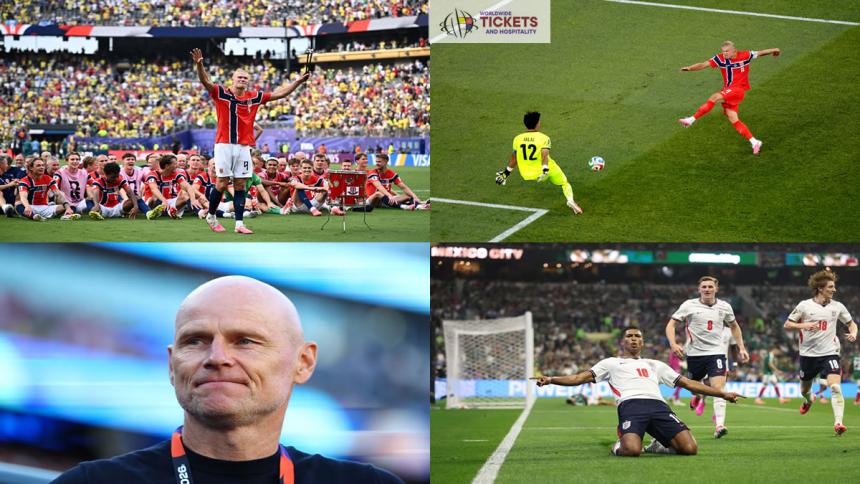
Norway vs England Tickets: Norway Eyes England Despite FIFA World Cup...
