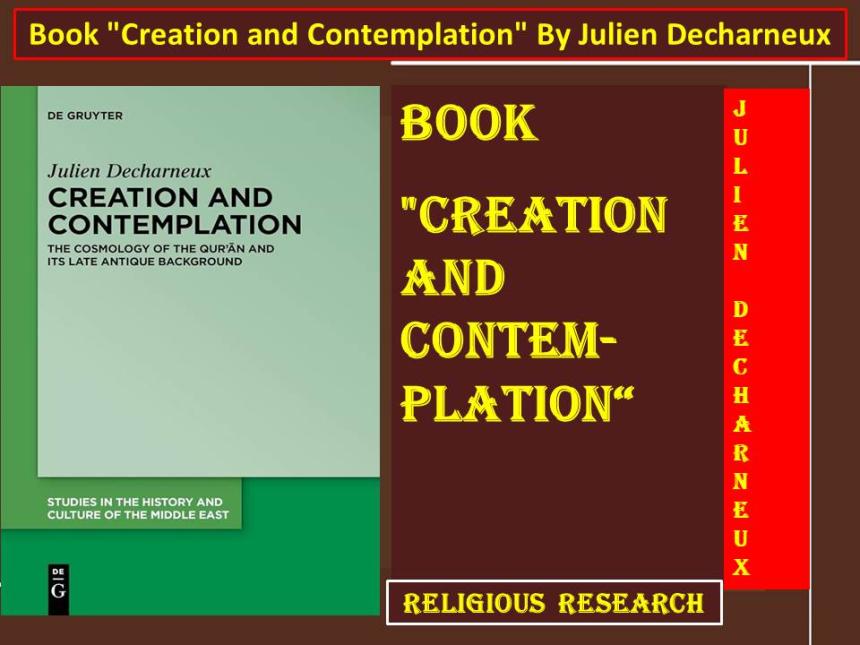

Book "Creation and Contemplation" By Julien Decharneux
Julien Decharneux (23 September 1993) is Wiener-Anspach Junior Research Fellow at the University of Oxford (Wolfson College). This book "Creation and Contemplation": "The Cosmology of the Qur'ān and Its Late Antique Background"; is a published version of Decharneux’s PhD thesis submitted to the Free University of Brussels in 2021. This write up is an introduction of this book for discussion.
أَعُوذُ بِاللّٰهِ مِنَ الشَّيْطَانِ الرَّجِيمِ
بِسۡمِ ٱللهِ ٱلرَّحۡمَـٰنِ ٱلرَّحِيمِ
In the name of ALLAH, the Most Gracious, the Most Merciful
Book "Creation and Contemplation" By Julien Decharneux
Julien Decharneux (23 September 1993) is Wiener-Anspach Junior Research Fellow at the University of Oxford (Wolfson College). This book "Creation and Contemplation": "The Cosmology of the Qur'ān and Its Late Antique Background"; is a published version of Decharneux’s PhD thesis submitted to the Free University of Brussels in 2021. The Book "Creation and Contemplation" By Julien Decharneux explores the connections between the cosmology of the Qur’ān and various cosmological traditions of Late Antiquity, with a focus on Syriac Christianity. Winner of the 2022 Marie-Antoinette Van Huele Prize and the 2023 Richard Kreglinger Prize (both Faculty of Philosophy and Social Sciences), Free University of Brussels.
The author uses both intratextual and extratextual approaches to the Qur’an and states his goals as follows:
1) Put the Qur’ān into dialogue with the biblical cosmological traditions, especially the Christian one, so as to throw light on the qur’anic cosmology and its formation.
2) Show the continuities and discontinuities between the Qur’ān and the late antique Christian sources on cosmology’.
The first part of the book studies how, in exhorting its audience to contemplate the world, the Qur’ān carries on a tradition of natural contemplation that had developed throughout Late Antiquity in the Christian world. In this regard, the analysis suggests particularly striking connections with the mystical and ascetic literature of the Church of the East, which was in effervescence at the time of the emergence of Islam.
The second part argues that the Qur’ānic cosmological discourse is built so as to serve the overarching theological message of the text, namely God’s absolute unity. Despite the allusive, and sometimes obscure, way in which the Qur’ān talks about the world’s coming into being and its maintenance in existence, the text betrays its authors’ acquaintance with cosmological debates of Late Antiquity.
The first chapter analyses what I call the Qur’ānic natural theology. In multiple places,the Qur’ānsuggests that an active contemplation of the signs (’āyāt) left by God in the cosmos allow the believer to acquire knowledge about the Creator and his plan for Creation. More than a simple exhortation to wonderment,I show that the multiple calls to observe the regularity of the cosmos and acknowledge its benefaction for human beings, should be read within the larger context of the Qur’ān’s spiritual program.¹⁸ Moreover,I suggest that the text here echoes a tradition of natural contemplation rooted in Hellenistic Judaism already and which flourished throughout the late antique period in the Christian world. This theme is particularly analysed in light of the sixth-century East-Syrian school movement and the texts emanating from this cultural sphere.
In the second chapter, I analyse the role of man with in the contemplative framework studied in the first chapter.The text here deploys technical terminology and imagery to describe how one should behave in order to reach the necessary state of purification to contemplate God’s signs in the world. The Qur’āndevelops in this context arange of motifs and technical terms that come at times extremely close to the East-Syrian ascetic tradition, particularly lively at the time of the emergence of the Arabic text.
The third chapter tackles the notion of creation in light of some of the most important cosmological themes developed in the late antique Christian tradition. We show that although the Qur’ānrecurrentlyinsists on the fact that God is the only creator of the universe and that it draws from arepertoire of well-known late antique rhetorical arguments to counter heterodox views on the matter, it also strangely displays no knowledge of some of the greatest cosmological themes developed throughout that period.
The fourth chapter addresses the Qur’ānic doctrine of the maintenance of the universe (creatio continua). In seeking to support the claim of God’s supremacy over Creation, theQur’ānstresses that God continuously sustains the world and steers it towards an appointed end. The motifs deployed to illustrate this doctrine find particularly striking counterparts in the homilies of Jacob of Sarugh.
Chapters five and six are dedicated to the Qur’ānic descriptions of three cosmic entities about which the Qur’ān is most talkative: heavens, angels, and men. The fifth chapter studies the Qur’ānic account of the creation of the heavenand the eclectic Qur’ānic repertoire used to talk about its structure. The sixth chapter finally studies the Qur’ānic creation of angels and men. It shows how the Qur’ān is indebted to biblical exegesis in this respect,but also proceeds to a number of small, yet significant,theological shifts from previous traditions.
INTRODUCTION: In the Qur’ān, cosmology is everywhere and nowhere at the same time.While a quick glance at the text reveals that pretty much every surah deals with cosmological matters in one way or another, one is also forced to admit that none of these cosmological passages really provide us with a detailed picture of the universe, its coming into being, or its functioning. Most cosmological pericopes merely constitute allusions to cosmic phenomena without ever extensively describing them. Simply put,the Qur’ānthematizes cosmology without really theorizing it. Any attempt at studying the “cosmology” of the Qur’ānthus needs to start off by solving this paradox: why is the Qur’ān so prone to talk about the cosmos without ever really describing it?What are its motivations in talking about the universe?
Throughout our study, it will become increasingly clear that the Qur’ān’sinterest in the cosmos is eminently theological. Although the Qur’ān repeatedly alludes to the cosmos and its natural phenomena, a close scrutiny of the text indicates that, in most of its layers, the universe is regarded as nothing but a web of signs pointing towards the higher and deeper realities of divine nature. The cosmos is depicted as a drama in which God’s bounty, sovereignty, justice, and power unfold, and thus, as an object worthy of contemplation. In short,the Qur’ānoffers a cosmological experience of God.
In studying the Qur’ān through the prism of Late Antiquity, this book contributes to our understanding of the emergence of Islam and its relationship with other religious traditions of the time.
" Qur’ānic cosmology is entirely subsumed to the Qur’ān’soverarching theological claim. For its authors, the cosmos points towards the existence of a single God, who created and guides the universe on his own. This fairly simple theological message is conveyed by means of two intertwined strategies in the text, an ethical one and a doctrinal one. On the one hand, the Qur’ānconstantlyinvites its audience to engage in the contemplation of Creation and to find in it the traces of the existence of its unique creator.On the other hand, the Qur’āndeploys a range of doctrinal arguments – mainly in the form of polemics – aiming at supporting the idea that the world is divinely originated and guided. Both theory (doctrine of creation) and practice (contemplation) thus point towards the same reality: the divine authorship and guidance of the universe."
Conclusion
Julien Decharneux’s book Creation and Contemplation investigates how the cosmological descriptions in the Qur’an—far from being mere descriptions of the universe—are fundamentally designed to serve its overarching theological message: God's absolute unity.
Decharneux explores how the Qur’an's calls to "contemplate" the natural world and the wonders of the cosmos belong to a broader tradition of natural contemplation. The text shows striking similarities with the mystical and ascetic literature of East Syriac Christianity. The book argues that the Qur'an adapts older, widely circulating cosmological imagery from the ancient Near East and Late Antiquity to cement its core doctrine of tawhid (the oneness of God).
Rather than presenting a neat, systematic scientific model, the Qur'an use the natural world as a theological "sign" (or ayah) of divine power, unity, and continuous creative involvement. Every one who engages with Quran must remember that Qur'an is "Divine
Holy Scripture" revealed upon the Prophet Muhammad (PBUH); who is the last of Prophets; therefore, Qur'an is the last Holy Book. The source of all the holy books revealed upon Prophets Jesus, David, Moses or Abraham (peace be upon all of them) is ALLAH and, all the books were revealed for the same purpose, therefore, they all must contain similarity and may use common terminology, structures, and ideas.
The purpose of all the Holy Scriptures has been the same; as Quran says "This is the Book! There is no doubt about it—a guide for those mindful ˹of Allah;" and "who believe in the unseen, establish prayer, and donate from what We have provided for them". (Al-Baqarah: 2,3).
It must be remembered that Holy Scriptures are not books of philosophy, history or science and as the Qur'an says ALLAH Al-Mighty has provided "Ayats" about Cosmos and Universe as a sign for contemplation by "Ulul Albab (أولوا الألباب) "people of understanding," "men of intellect," or "people of reason". Therefore the message is clear for guidance as in following verses:-
"How can you deny Allah? You were lifeless and He gave you life, then He will cause you to die and again bring you to life, and then to Him you will ˹all˺ be returned."
"He is the One Who created everything in the earth for you. Then He turned towards the heaven, forming it into seven heavens. And He has ˹perfect˺ knowledge of all things." (Al- Baqarah: 28,29)
The Quran is the Holy Book from ALLAH and if one desires to research on it must take up the challenge of proving its statement "wrong" (about any thing as described; and they are many which humanity is still not even knowing about) ar simply accept the "Divine Guidance" as "True" and final. There is a need for Muslims to took up the challenge of researching on the elements of nature and universe mentioned in Quran.


How to Sell Post Office Building Assets: A Guide for USPS Property Own...
Looking to sell post office building assets? This practical guide covers valuation, qualif...