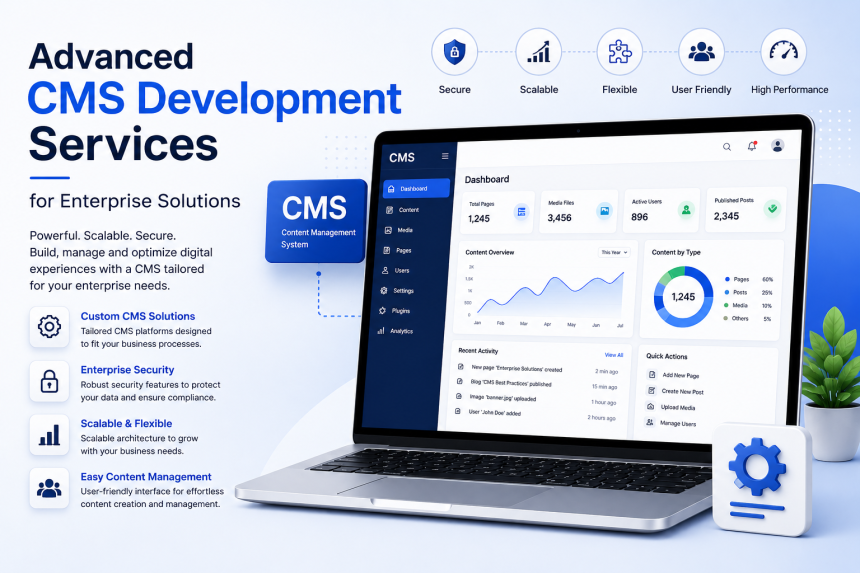

Advanced CMS Development Services for Enterprise Solutions
Transform your digital presence with advanced CMS development services. Build secure, scalable, and flexible content management solutions for enterprise growth.
In today’s fast-moving digital landscape, businesses need more than just an online presence to remain competitive. Organizations are constantly creating, managing, and distributing content across websites, mobile applications, customer portals, e-commerce platforms, and digital marketing channels. Managing this growing volume of digital content efficiently requires a structured, scalable, and user-friendly system. This is where content management systems have become essential for modern enterprises.
A content management system, commonly known as a CMS, enables businesses to create, edit, organize, publish, and manage digital content without requiring advanced technical expertise. From small websites to large enterprise platforms handling thousands of pages, multimedia assets, and multiple user roles, a well-developed CMS serves as the foundation of efficient digital operations. As enterprises continue investing in digital transformation, custom CMS solutions are becoming critical for long-term growth, operational efficiency, and enhanced customer experiences.
Understanding Content Management Systems
A content management system is a software platform that allows organizations to manage website content and digital resources through an intuitive administrative interface. Instead of relying on developers for every content update, businesses can empower internal teams to update pages, publish blogs, upload media, manage product catalogs, and maintain digital assets independently.
A CMS separates content from design and functionality, allowing organizations to manage information without affecting the overall website structure. This flexibility improves productivity and ensures faster content updates across multiple digital channels.
Modern CMS platforms support text content, images, videos, downloadable resources, forms, landing pages, product listings, customer information, and interactive features, making them a core component of digital business operations.
Why Businesses Need Advanced CMS Solutions
As organizations grow, managing digital content becomes increasingly complex. Businesses often operate multiple websites, regional pages, customer portals, product catalogs, and marketing campaigns simultaneously. Traditional website management approaches can quickly become inefficient and difficult to scale.
Advanced CMS solutions provide centralized content management, streamlined workflows, version control, role-based access, automated publishing, and seamless collaboration across teams. Marketing departments can launch campaigns faster, content creators can update information independently, and administrators can maintain consistency across all digital channels.
This level of control allows businesses to adapt quickly to changing market demands while maintaining brand consistency and operational efficiency.
The Role of CMS in Digital Transformation
Digital transformation requires businesses to deliver personalized, engaging, and consistent experiences across multiple touchpoints. Whether customers access content through desktop websites, mobile devices, online portals, or digital marketplaces, they expect accurate and relevant information.
A modern CMS acts as the backbone of digital communication by enabling organizations to create, manage, and distribute content efficiently. Businesses can update promotions, launch products, publish articles, manage support resources, and personalize user experiences without delays.
A robust CMS not only improves operational efficiency but also strengthens customer relationships through timely and relevant content delivery.
Key Features of Modern CMS Platforms
An enterprise-grade CMS includes powerful features designed to support business growth and operational excellence. These platforms typically include intuitive content editors, media libraries, user role management, workflow automation, multilingual support, SEO optimization tools, analytics dashboards, version control, and API connectivity.
Role-based access ensures that users can only access content relevant to their responsibilities. Version control allows teams to track changes and restore previous content when needed. Workflow automation streamlines content approval processes, reducing delays and improving collaboration.
Integration with third-party systems such as marketing automation tools, customer relationship management software, analytics platforms, and e-commerce systems further enhances operational efficiency.
Custom CMS vs Off-the-Shelf Solutions
Many businesses begin with pre-built CMS platforms, which can provide basic functionality for simple websites. However, as operational complexity increases, generic solutions often become restrictive.
Custom CMS development offers complete flexibility. Businesses can create unique workflows, personalized dashboards, custom modules, advanced security features, and integrations tailored to their exact requirements.
A custom platform eliminates unnecessary features while focusing on the functionality that truly supports business objectives. This leads to better performance, improved usability, and long-term scalability.
Security in Content Management Systems
Security is a major concern for organizations managing sensitive customer data, internal documents, digital assets, and proprietary business information. A secure CMS protects against cyber threats, unauthorized access, data breaches, and content manipulation.
Modern CMS platforms implement secure authentication, encrypted communication, role-based permissions, activity logging, vulnerability monitoring, and regular software updates. Multi-factor authentication and secure hosting environments add additional layers of protection.
Compliance with data protection regulations also becomes easier when security is built into the platform architecture from the beginning.
Scalability for Enterprise Growth
As businesses expand, their digital content requirements continue to grow. New products, services, regional websites, customer portals, marketing campaigns, and multilingual content all increase operational complexity.
A scalable CMS ensures that organizations can handle growing content volumes, increasing user traffic, and expanding business operations without compromising performance. Cloud infrastructure, optimized databases, caching systems, and modular architecture support long-term growth.
Businesses can add new features, integrate additional systems, and expand into new markets without rebuilding their digital foundation.
Business Efficiency Through Automation
Automation is one of the biggest advantages of enterprise CMS platforms. Manual content publishing, approval workflows, scheduling, updates, and asset management can consume significant time and resources.
Automation streamlines these processes by enabling scheduled publishing, automated notifications, approval chains, content expiration management, and personalized content delivery.
At this stage of digital transformation, organizations are increasingly investing inCMS Development Services to create scalable, secure, and efficient content ecosystems that support operational excellence and long-term digital growth.
SEO and Content Optimization
Search engine visibility plays a critical role in digital success. A modern CMS includes built-in tools that support search engine optimization and content discoverability. Businesses can manage page titles, meta descriptions, structured URLs, image optimization, schema implementation, internal linking, and mobile responsiveness directly from the CMS dashboard. This allows marketing teams to optimize content without technical assistance.
A search-engine-friendly CMS improves organic traffic, strengthens brand visibility, and supports long-term digital marketing goals.
Integration with Enterprise Systems
A CMS rarely operates in isolation. Enterprise organizations often integrate their CMS with customer relationship management systems, analytics platforms, e-commerce solutions, marketing automation software, and enterprise resource planning tools.
These integrations create a connected digital ecosystem where content, customer data, analytics, and operational workflows work together seamlessly.
Real-time synchronization improves data accuracy, reduces manual work, and supports smarter decision-making across departments.
Emerging Trends in CMS Development
The future of CMS technology is being shaped by artificial intelligence, machine learning, personalization, voice search optimization, and predictive analytics.
AI-powered content recommendations, automated tagging, intelligent search capabilities, and personalized user experiences are transforming how organizations manage digital content.
Cloud-native architectures, API-first platforms, and composable digital experiences are becoming standard in enterprise content management. Businesses that adopt these innovations early gain stronger competitive advantages and improved operational capabilities.
Choosing the Right Development Partner
Selecting an experienced development team is essential for successful CMS implementation. A reliable partner understands enterprise requirements, scalability challenges, security standards, and emerging digital trends.
Businesses should look for technical expertise, industry experience, transparent communication, and long-term support capabilities. The right development partner transforms digital strategies into practical, high-performing solutions.
Conclusion
Content has become one of the most valuable business assets in the digital age. Managing it efficiently requires more than basic website tools. Organizations need secure, scalable, and intelligent platforms that support collaboration, automation, and long-term growth.
A professionally built CMS empowers businesses to manage content effectively, optimize digital experiences, improve search visibility, and adapt to evolving market demands. By investing in advanced content management solutions, enterprises can build stronger digital foundations that support innovation, efficiency, and sustainable success.
How Can the Best Orthodontist Near Me Make Braces More Comfortable?
Orthodontic technology has advanced dramatically over the years. Today's braces are smalle...

What Should You Expect from Professional Hyperbaric Medicine Training?

Smart Door Locks for Secure, Keyless & Connected Living | Dorset
Dorset smart door locks offer advanced security, keyless convenience, and seamless access...

Healthcare SaaS Market Drives Innovation in Healthcare IT
The Global Healthcare Software As A Service Market Size is expected to be worth around US$...