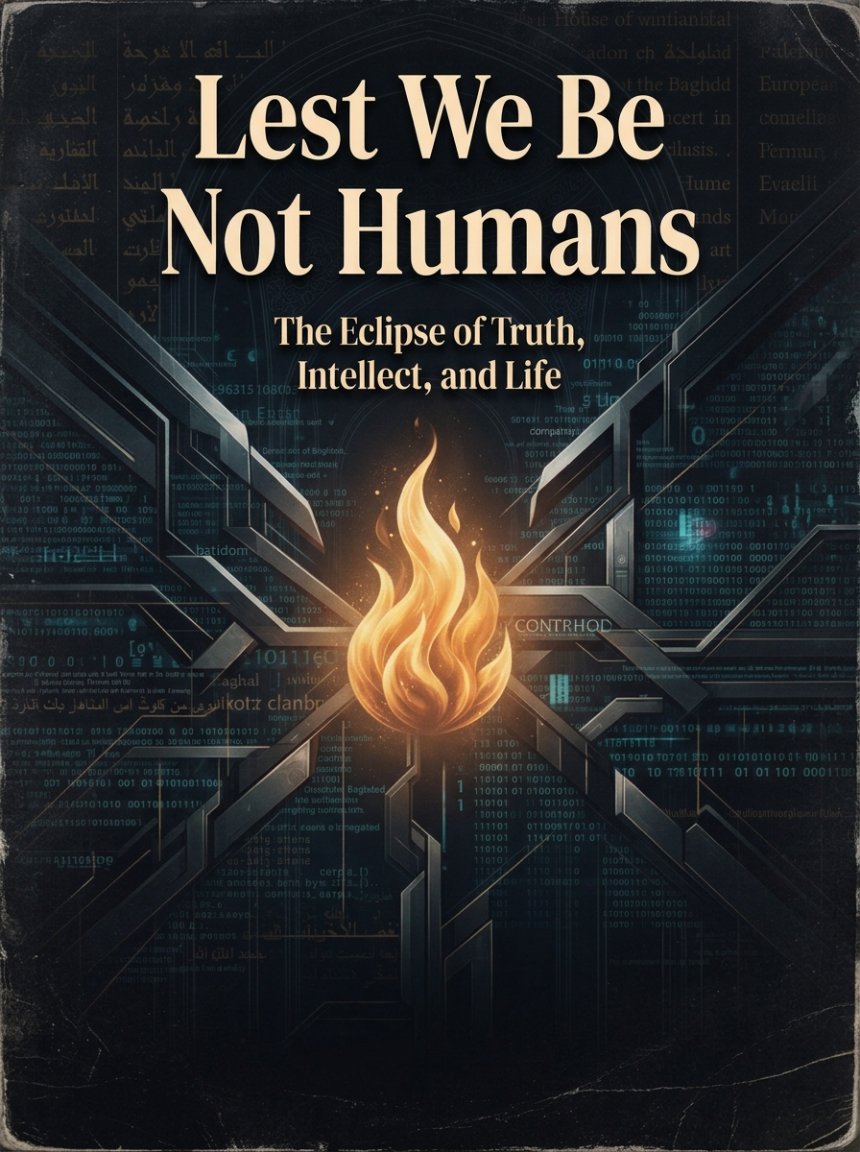

Lest We Be Not Humans
This essay examines the modern crisis of human identity, characterizing it as a systemic dismantling of the essential triad that sustains civilization: the semantic integrity of language, the transmission of classical education, and the preservation of conscious moral agency. The scope of this critique extends globally, mapping the decline of rigorous, independent thought from the abandonment of Western classical lineages (from Homer to Milton) to the post-colonial intellectual capitulation in Muslim lands, where rich legacy centers like historic Baghdad and Andalusia have been hollowed out in favor of superficial, utilitarian foreign paradigms. The paper argues that modern structural, cultural, and political battlegrounds are merely symptoms of a deeper existential conflict.
أَعُوذُ بِاللّٰهِ مِنَ الشَّيْطَانِ الرَّجِيمِ
بِسۡمِ ٱللهِ ٱلرَّحۡمَـٰنِ ٱلرَّحِيمِ
In the name of ALLAH, the Most Gracious, the Most Merciful
Lest We Be Not Humans
The Eclipse of Truth, Intellect, and Life
Abstract
This essay examines the modern crisis of human identity, characterizing it as a systemic dismantling of the essential triad that sustains civilization: the semantic integrity of language, the transmission of classical education, and the preservation of conscious moral agency. It analyzes how contemporary socio-political forces deliberately weaponize language through semantic engineering, destabilizing objective truths—such as biological realities and the boundary between "want" and "need"—to enforce social compliance and generate structured collective anxiety.
The scope of this critique extends globally, mapping the decline of rigorous, independent thought from the abandonment of Western classical lineages (from Homer to Milton) to the post-colonial intellectual capitulation in Muslim lands, where rich legacy centers like historic Baghdad and Andalusia have been hollowed out in favor of superficial, utilitarian foreign paradigms. By synthesizing Allama Iqbal’s philosophical diagnosis of the destruction of the Self (Khudi) with the practical existential awakening urged in Rose Milligan’s poetry, the essay underscores that the erosion of human reason reduces conscious individuals to spiritual soot and inner servitude.
Ultimately, the paper argues that modern structural, cultural, and political battlegrounds are merely symptoms of a deeper existential conflict. It concludes with a moral call to arms, asserting that the primary imperative of our time is an active, defiant choice to reclaim historical memory, reject linguistic distortion, and preserve human freedom by actively spreading the virtues and plain-spoken goodness intrinsic to human nature.
Introduction
The primary requirement, virtue, and beauty of being human lie in our capacity for conscious moral agency, deep empathy, and the pursuit of objective truth. Unlike the rest of the natural world, which moves by blind instinct, or the machine world, which operates on cold calculation, to be human is to possess a soul capable of self-reflection, artistic expression, and independent reason. The beauty of our existence is found in our ability to choose a life of purpose, to cherish beauty, to experience profound love, and to stand as guardians of truth. However, this unique dignity is not an immutable birthright; it is a fragile state of grace that must be consciously maintained.
The distinctiveness of human civilization relies on a fragile triad: the integrity of language to anchor truth, the inheritance of classical wisdom to cultivate reason, and the conscious choice to live deeply rather than succumb to sterile routine. When any part of this triad fractures, humanity undergoes a subtle but profound decay—a "death of the self" that reduces a conscious being to spiritual soot. Today, we are witnessing a systemic attack on the foundational pillars of our nature. Through the deliberate weaponization of language, the systematic abandonment of intellectual lineage, and the modern tendency to prioritize trivial anxieties over existential purpose, we risk surrendering the very qualities that separate us from mere automatons.
The Linguistic Distortion and the War on Reason
Man is a social animal, and the most striking element of our nature is being a "talking animal." We build societies and civilizations by talking to each other, and crucially, by talking sensibly and logically. Because of this, education has always been the foremost challenge and requirement for becoming truly human.
As Confucius famously observed, “When words lose their meaning, people lose their freedom.” Language is not merely a tool for communication; it is the scaffolding of objective truth and moral reality. In contemporary discourse, the deliberate redefinition of words has transcended mere semantic drift to become a calculated political strategy. By controlling the vocabulary, architects of social engineering seek to govern the limits of thought itself.
Under this regime of semantic inversion, objective realities are systematically dismantled:
- "Safety" is invoked to justify the heavy hand of censorship.
- "Education" is transformed into an apparatus for ideological propaganda.
- "Pride" is used to validate moral and behavioral perversion.
- "Tolerance" is demanded to mask absolute intellectual cowardice.
- "Hate" becomes the label affixed to standard expressions of patriotism.
When foundational biological realities like "man" and "woman" are reduced to fluid, subjective "identities," and when basic disagreements are rebranded as acts of "violence," reason itself comes under direct attack. This collapse of meaning is not accidental; it is tactical. When truth is severed from objective reality, it becomes an instrument of power—defined entirely by whoever holds the authority to enforce the current lexicon. To preserve human freedom, society must resist this linguistic distortion and focus on speaking plainly once more.
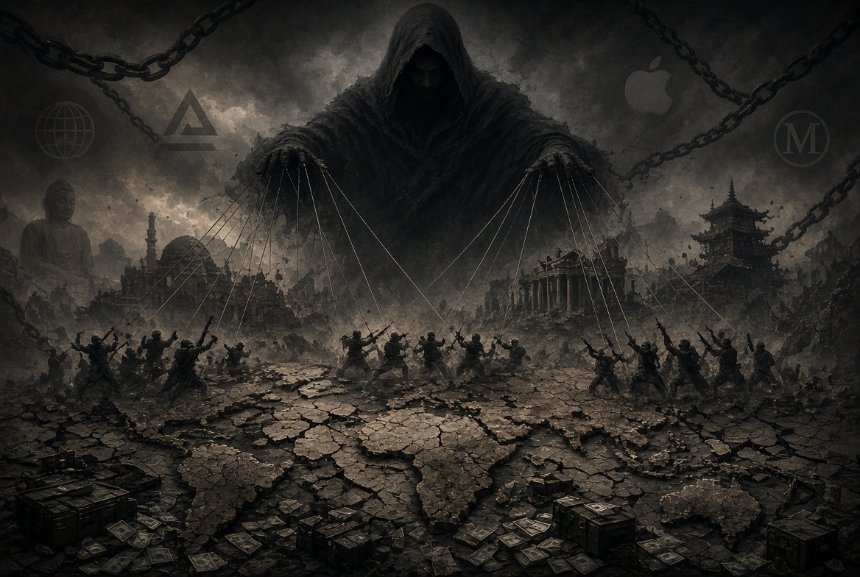
The Abandonment of Classical Thought and Identity
The vulnerability of modern societies to linguistic manipulation stems directly from the degradation of education. Classical education was built upon a vital premise: a young person must learn how to think before being told what to think. This was achieved through the rigorous study of foundational disciplines designed to cultivate a fully realized human being:-
┌──────────────────────────────┐
│ CLASSICAL TRIVIUM │
│ & FOUNDATIONAL TRADITION │
└──────────────┬───────────────┘
│
┌───────────────────────┼───────────────────────┐
▼ ▼ ▼
LOGIC RHETORIC HISTORY
To recognize bad To express complex To comprehend the
arguments. ideas clearly. depth of human nature.
When supplemented by philosophy to interrogate difficult moral questions, literature to build deep empathy for others, and mathematics to ground the mind in strict reasoning, this curriculum served as an essential preparation for life rather than a narrow training pipeline for employment.
Today, this rich intellectual inheritance has been largely discarded. Students routinely complete their formal schooling without reading a single complete work by the foundational thinkers of Western civilization—Homer, Plato, Aristotle, Cicero, Augustine, Dante, Shakespeare, or Milton. Stripped of the texts that shaped the moral and philosophical contours of their own culture, generations are left rootless. Without a standard of historical excellence and logical rigor to lean on, the modern mind is easily swayed by fleeting slogans and manufactured consensus.
The Legacy of Intellectual Capitulation in Post-Colonial Lands
This systemic uprooting is not unique to the West; its shadow falls heavily across the post-colonial Muslim world, where the betrayal of intellectual inheritance has taken an even more tragic form. In a collective rush toward modernization, these societies did not merely adapt—they discarded their own profound educational traditions to mimic a hollowed-out, utilitarian Western model in a nearly suicidal manner. Lands that once birthed the global seats of learning have allowed their academic legacy to collapse into a sterile imitation of foreign paradigms.
┌────────────────────────────────────────────────────────┐
│HISTORIC SEATS OF TRANSLATION │
│ & INTELLECTUAL EXPLORATION │
└───────────────────────────┬────────────────────────────┘
│
┌──────────────────┴──────────────────┐
▼ ▼
BAGHDAD (BAYT AL-HIKMA) GRANADA & CORDOBA (ANDALUSIA)
Pioneered the integration of reason, Fostered Europe's scientific and
philosophy, and the prophetic tradition. philosophical renaissance via the pen.
There was a time when the House of Wisdom (Bayt al-Hikma) in Baghdad and the vibrant libraries of Andalusia (Moorish Spain) stood as the intellectual capitals of the world. In these centers, the cultivation of knowledge was considered a divine mandate, driven by the foundational concept of the pen (Qalam) and the book. Scholars here did not just preserve human thought; they integrated logic, science, and metaphysics with moral responsibility, illuminating a dark age across Europe.
Today, that brilliant synthesis has been replaced by a modern mimicry that prioritizes rote compliance and vocational training over deep spiritual or philosophical inquiry. By prioritizing technical skills at the expense of historical depth, independent reason, and their own rich classical literature, post-colonial societies have severed their ties to their past. Stripped of the intellectual rigor that once defined Islamic civilization, the contemporary mind in these regions is left uniquely defenseless—rootless at home, chasing a superficial foreign template abroad, and easily dominated by global currents of manufactured consensus.
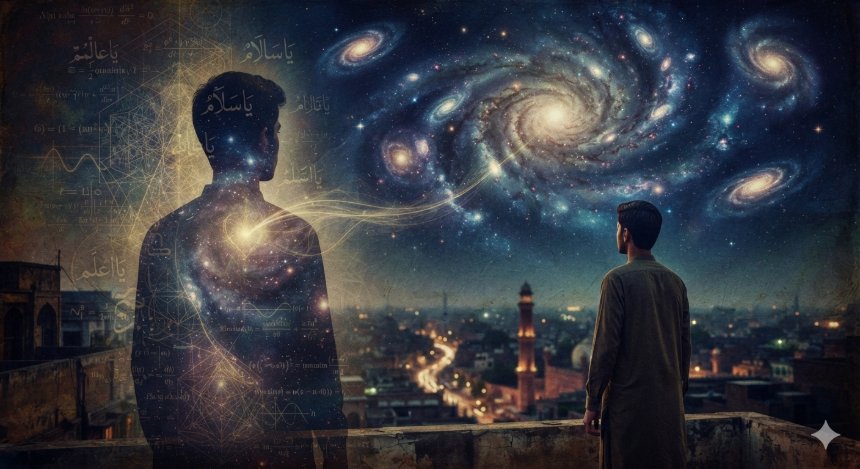
Semantic Engineering: Rewriting "Want" and "Need"
The damage caused by the weaponization of language extends far beyond political debate; it alters the domestic and psychological fabric of daily life. By destabilizing definitions, modern consumerist and ideological forces have systematically engineered how we perceive our deepest desires. Specifically, the fundamental boundary between a "want" and a "need" has been deliberately blurred.
In a healthy civilization, a "need" represents the essential requirements for human flourishing—truth, liberty, community, critical thought, and spiritual alignment. A "want" represents the transient, superficial desires of the material world. Today, however, semantic engineering has flipped this hierarchy entirely:
- Manufactured Needs: Society has been conditioned to treat luxury, compliance, algorithmic entertainment, and state-sanctioned validation as absolute "needs." Disconnect from the digital hive-mind is framed as an existential threat.
- Marginalized Wants: Conversely, the vital requirements of the soul—the pursuit of objective truth, the freedom to dissent, and the preservation of cultural memory—are downgraded to optional "wants" or luxury pastimes for the eccentric.
By controlling this definitions matrix, the ruling apparatus ensures that people exhaust their life energy chasing synthetic needs while completely abandoning the genuine prerequisites of human freedom. We are left trapped in an endless loop of manufactured anxiety, focusing on the trivial while the essential is forgotten.
From the Captive Self to Existential Awakening
To lose one's language, intellectual heritage, and capacity to distinguish authentic needs from superficial desires is to invite a profound inner servitude. In his philosophical frameworks, Allama Iqbal recognized this vulnerability as an inherent struggle within human nature. He observed that the desire for height, excellence, and true sovereignty (Sardari) resides in everyone's heart. Iqbal does not condemn this innate ambition for growth; rather, he places an absolute condition upon it. True height cannot exist in a state of intellectual captivity. When an individual surrenders their moral agency, adopts a corrupted lexicon, and conforms to a manufactured reality, it results in a resounding case of slavery and loud apostasy. This is the ultimate existential tragedy: the destruction of the Self (Khudi), a state in which a human being is reduced to spiritual soot.
When the Self is extinguished by the quiet tyranny of compliance, the individual ceases to live and merely exists, consumed by the mundane tasks dictated by an oppressive structure. To break out of this spiritual soot, one must undergo an existential awakening—a sudden, clear-eyed realization of how our short lifetimes are squandered on trivialities. This urgent call to shatter the chains of domestic oblivion and reclaim the vitality of the soul is beautifully laid bare in Rose Milligan’s verse published in 1998:-
Dust If You Must
Dust if you must, but wouldn't it be better
To paint a picture, or write a letter,
Bake a cake, or plant a seed;
Ponder the difference between want and need?
Dust if you must, but there's not much time,
With rivers to swim, and mountains to climb;
Music to hear, and books to read;
Friends to cherish, and life to lead.
Dust if you must, but the world's out there
With the sun in your eyes, and the wind in your hair;
A flutter of snow, a shower of rain,
This day will not come around again.
Dust if you must, but bear in mind,
Old age will come and it's not kind.
And when you go (and go you must)
You, yourself, will make more dust.
Where Iqbal provides the grand philosophical diagnosis of the captive Self, Milligan provides the intimate, practical antidote. Her poem challenges the reader to look past the artificial "needs" manufactured by modern systems and instead focus on the authentic, time-bound experience of being alive. The physical world will inevitably reclaim us, and we will all eventually become dust. The true danger, however, is allowing that dust to settle upon our minds, hearts, and intellects while we still breathe—trading the sun in our eyes and the wind in our hair for the sterile safety of compliance.

Conclusion
The phrase "Lest We Be Not Humans" serves as a stark warning and a call to arms for the contemporary age. If we continue to permit the corruption of our language, we forfeit our access to truth. If we continue to neglect the masterworks of our civilization, we lose our capacity for independent reason. And if we choose the safety of conformity and mundane routine over the pursuit of deep, conscious living, we succumb to a spiritual slavery that extinguishes the self.
Ultimately, the structural and political battles of our time are merely symptoms of a much deeper, existential conflict. The real battle shall be to be Humans and spread the goodness associated with being human. Defeating systemic control does not merely mean winning an intellectual debate; it means actively restoring our capacity for love, compassion, honor, and truth. To remain human is an active, defiant choice. It requires us to reject linguistic manipulation, reclaim our intellectual inheritance, and deliberately flood a cynical world with the virtues, beauty, and plain-spoken goodness that define our highest nature.
Furadeira de Impacto: Como Escolher, Utilizar e Aproveitar Seus Benefí...
Furadeira de Impacto: Como Escolher, Utilizar e Aproveitar Seus Benefícios


Convenient Ways to Buy Wine Online Ontario
Exploring options to buy wine online Ontario helps wine enthusiasts discover selections fr...