
أَعُوذُ بِاللّٰهِ مِنَ الشَّيْطَانِ الرَّجِيمِ
بِسۡمِ ٱللهِ ٱلرَّحۡمَـٰنِ ٱلرَّحِيمِ
In the name of ALLAH, the Most Gracious, the Most Merciful
Poem "When You are Old" by W B Yeats
William Butler Yeats (1865–1939) was a towering figure of twentieth-century literature, a pillar of the Irish Literary Revival, and the winner of the 1923 Nobel Prize in Literature. Known for blending Irish mythology, mysticism, and deeply personal emotion, Yeats wrote some of the most enduring poetry in the English language.
Published in his 1893 collection The Rose, "When You Are Old" is one of his most celebrated lyric poems. Loosely adapted from a sixteenth-century French sonnet by Pierre de Ronsard, the poem was written for Maud Gonne, an Irish revolutionary and actress whom Yeats loved deeply and unsuccessfully for decades. Through this personal plea, Yeats created a universal meditation on aging, memory, and the nature of true devotion.
Poem "When You are Old" by W B Yeats-Central Theme and Summary
The central theme of "When You Are Old" is the contrast between superficial, fleeting affection based on physical beauty and profound, enduring love rooted in a person's inner spirit.
In the poem, the speaker addresses his beloved and asks her to imagine herself decades in the future. Elderly, tired, and sitting alone by a warm fire, she picks up a book of poetry—implied to be written by the speaker himself. As she reads, she recalls her youthful charm and the many admirers who flocked to her during her prime. She then remembers the one man who loved her inner essence—her "pilgrim soul"—and remained devoted even as her face aged and changed. The poem closes on a poignant note of quiet regret as she realizes that genuine love has slipped away.
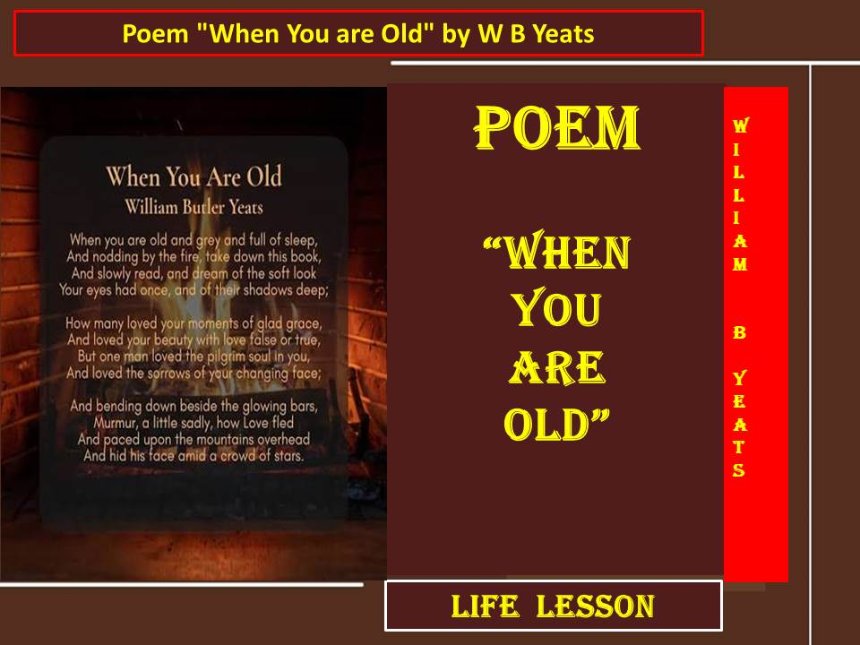
Poem "When You are Old" by W B Yeats
When you are old and grey and full of sleep,
And nodding by the fire, take down this book,
And slowly read, and dream of the soft look
Your eyes had once, and of their shadows deep;
How many loved your moments of glad grace,
And loved your beauty with love false or true,
But one man loved the pilgrim soul in you,
And loved the sorrows of your changing face;
And bending down beside the glowing bars,
Murmur, a little sadly, how Love fled
And paced upon the mountains overhead
And hid his face amid a crowd of stars.
Poem "When You are Old" by W B Yeats-Stanza-by-Stanza Explanation
- First Stanza: Yeats sets a quiet, drowsy, and reflective atmosphere. The beloved is "old and grey and full of sleep," nodding off beside a hearth. Taking down the book, she drifts into memories of her youth, specifically recalling the gentle, captivating depth her eyes once held.
- Second Stanza: The speaker draws a sharp line between his love and the affection of others. In her youth, crowds admired her "moments of glad grace"—her physical beauty and social charm—with feelings that were often shallow ("false or true"). In contrast, the speaker ("one man") loved her "pilgrim soul," a phrase suggesting a restless, searching, and sacred inner spirit. Crucially, he also loved "the sorrows of your changing face," meaning his devotion embraced her imperfections, pain, and aging rather than fearing them.
- Third Stanza: Returning to the fireside scene, the imagery shifts from warmth to loss. Leaning toward the "glowing bars" of the fireplace, the woman whispers with gentle sorrow about how "Love"—now capitalized and personified—departed. Love has retreated far out of human reach, pacing high on the mountains and hiding among the stars, leaving her alone with her memories.
Poem "When You are Old" by W B Yeats- Lessons to Learn
The poem offers a timeless lesson on how we evaluate human relationships:
- Look beyond the surface: Physical beauty and social charm are temporary. Building a life around external validation leaves a person isolated once those traits fade.
- Value spiritual and emotional depth: True intimacy requires loving someone's evolving character—their struggles, growth, and imperfections—not just their highlights.
- Recognize genuine devotion in the present: The quiet sorrow at the end of the poem serves as a warning not to take sincere, unconditional love for granted until it is too late.
Poem "When You are Old" by W B Yeats-Relevance in the Digital Age
More than a century after it was written, "When You Are Old" feels remarkably relevant in the era of social media and digital dating. Modern online culture thrives on curated appearances, instant gratification, and "moments of glad grace"—the filtered photos, highlight reels, and fleeting likes that mirror the shallow admirers in Yeats's second stanza.
In a digital landscape where people are easily swiped past and algorithms reward surface-level appeal, Yeats reminds us that digital validation cannot keep us warm by the fire in old age. Authentic connection still requires patience, vulnerability, and an appreciation for another person's "pilgrim soul" behind the screen.
Conclusion
"When You Are Old" endures because it captures a universal human truth with quiet grace and emotional honesty. While rooted in Yeats's personal heartache over Maud Gonne, the poem transcends its biographical origins to speak to every generation. By contrasting the fading glow of youthful beauty with the lasting warmth of soul-deep devotion, Yeats leaves readers with a poignant reminder to cherish genuine love while it is still within reach.
Poem "When You are Old" by W B Yeats-Echoes in Literature: Shakespeare’s "Sonnet 116"
Yeats’s central message closely echoes William Shakespeare’s famous "Sonnet 116" ("Let me not to the marriage of true minds"). Just as Yeats contrasts fleeting physical attraction with love for the "pilgrim soul," Shakespeare argues that genuine love does not alter when youth fades or when "rosy lips and cheeks" fall within the reach of Time’s sickle. Both poets affirm that while physical beauty is temporary, authentic love remains steadfast against age and change.