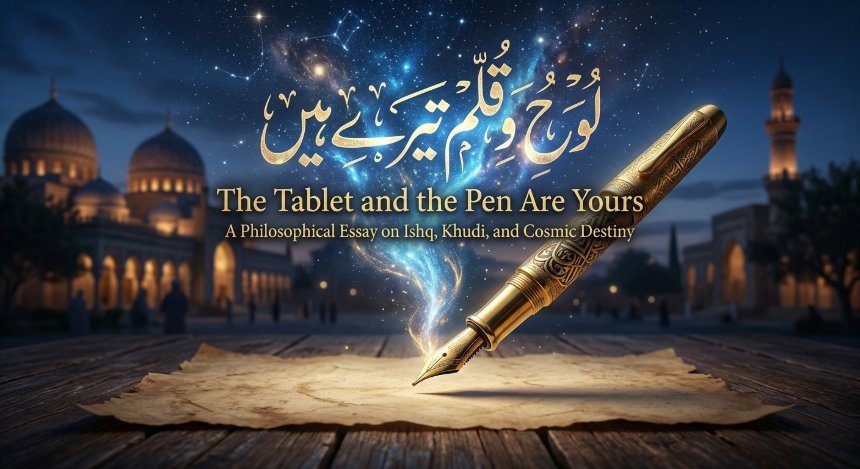

“Write Yours Own Destiny”
This powerful essay mirrors Allama Iqbal's profound philosophy of Khudi (Selfhood) and Ishq-e-Rasool (love for the Prophet ﷺ) to explore the cosmic weight of the written word. By tracing the historical journey from the first revelation of 'Allama bil-Qalam to the majestic spires of Andalusia, the text underscores the pen as the ultimate guardian of the human story. It diagnoses the modern-day tragedy of Generation Z's digital enslavement and prescribes a radical return to the sacred pedagogy of writing with hand and Seerah education. Ultimately, the narrative serves as an inspiring clarion call to reclaim the pen, asserting that absolute devotion to Prophet Muhammad ﷺ empowers humanity to master its own destiny and command the global canvas.
أَعُوذُ بِاللّٰهِ مِنَ الشَّيْطَانِ الرَّجِيمِ
بِسۡمِ ٱللهِ ٱلرَّحۡمَـٰنِ ٱلرَّحِيمِ
In the name of ALLAH, the Most Gracious, the Most Merciful
“Write Yours Own Destiny”
(Lawh-o-Qalam Tere Hain)
The status that Hakim al-Ummat Allama Muhammad Iqbal holds in breaking the chains of servitude and instilling a sense of intellectual freedom in modern-day Muslims is a golden chapter in history. Allama Iqbal was not merely a conventional poet; he was a sublime philosopher, visionary thinker, and forward-looking leader who showed the dream of freedom to the oppressed and enslaved Muslims of the subcontinent. He observed that the Muslim Ummah had fallen into the abyss of both material and mental slavery. Consequently, he discovered the remedy for this decline in his "Philosophy of Khudi" (Selfhood / The Self). Khudi signifies the recognition of one's inner self, Islamic honor, and the resolute determination never to bow before anyone except Allah. Iqbal assured Muslims that if they awakened their Khudi, they could rewrite the destiny of the entire universe.
From Shikwa to Jawab-e-Shikwa: An Intellectual Evolution
Amid this profound intellectual restlessness, Allama Iqbal wrote a poem titled "Shikwa" (The Complaint) in his world-renowned book Bang-e-Dara. In this poem, departing from traditional norms, he lamented the miserable plight of Muslims as a heart-stricken servant directly in the court of the Almighty. When this poem was published, it caused a massive uproar among the superficial, literalist classes of the time, unleashing a storm of objections. However, Iqbal's objective was not to complain but to awaken the Ummah. Consequently, after some time, he penned its reply in the form of "Jawab-e-Shikwa" (The Response to the Complaint). In this masterpiece, the causes of the Muslims' decline were articulated from the Divine perspective, revealing that they had abandoned the Qur'an and the exemplary path of the Prophet ﷺ. The final couplet of this timeless poem is the absolute essence of Islamic philosophy and the grandest truth of the cosmos:
"Ki Muhammad se wafa tu ne to hum tere hain
Yeh jahan cheez hai kya, lawh-o-qalam tere hain!"
(If you are faithful to Muhammad, then I am yours;
What is this world? The Divine Tablet and the Pen are yours!)
Commentary and Understanding of the Couplet:
An eternal and cosmic covenant between Allah and His servant is articulated in this verse. Iqbal argues that the ultimate solution to all material, political, and spiritual declines of Muslims lies in the love for the Holy Prophet ﷺ and his absolute emulation. If you remain truly faithful to Muhammad Mustafa ﷺ, adopting the faith and character he brought, then the Master of the cosmos becomes yours. This world is merely a fleeting, trivial thing; the "Lawh" (The Divine Tablet) upon which the universe's destiny is inscribed, and the "Qalam" (The Cosmic Pen) that executes it, will be placed at your command. In other words, you will become the leaders of the age and the masters of destiny. This philosophy aligns perfectly with Quranic teachings, which explicitly decree: "Obey Allah and obey the Messenger." The sole pathway to reaching Allah, earning His pleasure, and experiencing His love remains hidden within absolute servitude to the Master of the Universe ﷺ.
The Prophet’s System of Knowledge and the "Knowledge of the Tablet and Sovereignty"
When the Holy Prophet ﷺ arrived amidst the dark streets of Makkah, he brought about a revolution not by the sword, but through knowledge and character. He prioritized knowledge over material gains and made his followers learn by heart that very first lesson of the Cave of Hira, which commenced with the word "Iqra" (Read). The Prophet ﷺ declared, "Seeking knowledge is an obligation upon every Muslim." Allama Iqbal elucidates this very reality by stating that worldly pomp, majesty, and royal grandeur hold absolutely no value if a human being is devoid of that knowledge which unlocks the hidden secrets of the universe:
"Amarat kya, shikoh-e-khusravi kya, kuch nahin uski
Agar hasil na ho insan ko ilm-e-lawh-o-sultani!"
(What is wealth? What is royal majesty? It is nothing—
If man does not possess the knowledge of the Divine Tablet and Sovereignty!)
Ilm-e-Lawh-o-Sultani refers to that esoteric and cosmic knowledge which liberates man from material servitude and grants him absolute mastery over time and space. The Holy Prophet ﷺ placed the pen into the hands of his Ummah, guiding them out of the depths of ignorance and illuminating them with the light of this majestic knowledge.
The True Master of the Tablet and the Pen: "The Embodied Book"
In a stanza of his epoch-making poem "Masjid-e-Qartaba" (The Mosque of Cordoba), Allama Iqbal raises the relationship between the love of the Prophet ﷺ and the pen and book to its absolute zenith. This stanza is the very soul of this essay. Lamenting the current plight of the Ummah while expressing his own inner creative yearning, Iqbal proclaims:
"Aya-e-kainat ka ma'ni-e-deer-yab tu
Niklay teri talash mein qafila haaye rang-o-boo
Jalwateyan-e-madrasa koor nigah-o-murdah-zauq
Khalwateyan-e-maikhada kam talab-o-tihi kadoo
Main ke meri ghazal mein hai aatish-e-rafta ka suragh
Meri tamam sarguzasht khoye huon ki justaju
Baad-e-saba ki mauj se nashwo-numaye khar-o-khas
Mere nafas ki mauj se nashwo-numaye aarzoo
Khoon-e-dil-o-jigar se hai meri nawa ki parwarish
Hai rag-e-saaz mein rawan sahib-e-saaz ka lahoo
‘Fursat-e-kashmakash madah ein dil-e-be-qarar ra
Yak do shikan ziyada kun gaisuye tabdar ra’"
(You are the deeply hidden, profound meaning of the universe's cosmic verse;
Caravans of color and fragrance have set forth in your search.
The scholars of the academies are dim-sighted and devoid of taste;
The mystics of the hermitages are lacking in yearning and empty-handed.
I am the one whose poetry contains the trace of a forgotten fire;
My entire life-story is a relentless quest for what has been lost.
While the morning breeze nurtures the growth of weeds and straw;
The wave of my breath nurtures the growth of cosmic desire.
My voice is nourished by the blood of my heart and liver;
The blood of the musician flows through the very strings of the instrument.
'Grant no respite of struggle to this restless heart—
Add a curl or two more to your radiant tresses!' )
Iqbal laments that the educators in today's schools have become blind-sighted and dry-spirited, while those in hermitages are lacking in deep spiritual ambition. He asserts that his writings, his pen, and his poetry contain the clues to that forgotten grandeur which the Ummah has lost. This pen is no ordinary tool; its nurturing is born out of "the blood of the heart and liver" of the thinker. When this pen immerses itself completely in the love of the Holy Prophet ﷺ and completes its journey, it reveals the supreme reality that Iqbal presented as an offering of devotion to the Master of Creation ﷺ:
"Lawh bhi tu, Qalam bhi tu, tera wajood Al-Kitab
Gunbad-e-aabgeena rang tere muheet mein hubab!"
(The Tablet are you, the Pen are you, your very being is the Book;
This crystal-colored dome of the sky is but a bubble in your vast ocean!)
Commentary on this Timeless Stanza:
Upon reaching this point, the entire philosophy of the "Tablet and the Pen" attains its ultimate realization. Iqbal proclaims: O Messenger of Allah ﷺ! You are the cosmic Tablet of Destiny, and you are the Pen that inscribes that destiny. Nay, your blessed existence is itself "Al-Kitab" (The Ultimate Book and the physical manifestation of the Qur'an). This sapphire sky and the entire material universe are merely a transient bubble (hubab) within the shoreless ocean of your knowledge, grace, and spiritual stature.
"‘Allama bil-Qalam" and the Intellectual Cultivation of Children
When we observe the current state of the Muslim world today, a harrowing reality surfaces. Although Muslim nations appear independent on the global map with physical control over their lands and territories, in reality, a shackle of intellectual and educational slavery hangs tightly around their necks—borne out of compulsion in some places, and worn with pride in most. We have blindly adopted Western frameworks of thought, their languages, their digital screens, and their material educational models to such an extent that our own unique civilization is fading into oblivion.
If the Muslim nation is to unite once again and gather under the expansive mantle of mercy of Prophet Muhammad ﷺ, we must first diagnose and cure this internal intellectual decay. The only path forward is to restore the sanctity and inviolable dignity of the pen and the book within our societies, restructuring our entire educational and pedagogical systems along Quranic lines. The path to intellectual freedom begins by placing a pen into the hands of our children and teaching them the art of writing the epic of their own Khudi. Iqbal emphasized that any education which does not empower a human being to conquer the universe, and instead only teaches the art of mimicking others, is not true knowledge, but a sophisticated new form of slavery:
"Asr-e-hazir malik-ul-maut hai tera jis ne
Qabz ki rooh teri de ke tujhe fikr-e-maash"
(The modern age is your angel of death, which—
Has seized your soul by trapping you solely in the worry of livelihood.)
When a child enters this world, their mind is like a pure, blank sheet of paper. When that child holds a pen and binds letters together for the very first time (joining letters to spell out "Abba" and "Amma"), the union of ink and raw clay births the most beautiful and sacred relationships in the universe. Neuroscience reveals that as these letters are physically woven on paper, at that precise moment, the child's brain cells (neurons) are busy weaving new cognitive pathways and connections. Over the last two decades, when we distanced children from the physical pen in the name of modernization and accustomed them to digital screens, the capacity for deep thinking and creative imagination in Generation Z became severely scarred. We must liberate their awakened hearts from purely materialistic thoughts, for:
"Dil-e-bendar farigh hai maadi afkar se
Ke yeh woh tadap hai jo insan ko karti hai tarash"
(The awakened heart is detached from purely material thoughts—
For this is the spiritual yearning that carves and sculpts a true human being.)
The pen is not merely a material object or a tool; it is the doorway to an entire civilization, through which the enduring treasure of human intellect, understanding, and perception is woven.
The Sacred Seerah ﷺ and the Awakening of Khudi
If the Muslim Ummah wishes to cast off this yoke of intellectual bondage, we must return to that very first lesson of the Cave of Hira. We must return the pen to the delicate hands of our children and remember that every secret of the universe and all eternal excellence can only be attained through absolute devotion to Prophet Muhammad ﷺ. We must teach our children the sacred Seerah (the life history of the Prophet ﷺ). The story of the Seerah rejuvenates the mind, heart, and soul, and awakens that Khudi which harbors an intense yearning for freedom. According to Allama Iqbal, the survival and strengthening of Khudi lies solely in obedience to the Prophet ﷺ and the emulation of his beautiful character (Uswah-e-Hasanah). In Bal-e-Jibril, he proclaims:
"Tarh-e-nau afgan ke ma jidat pasand uftada ain
Ein che hairat khana-e-imroz-o-farda sakhta"
(Lay down a new foundation, for we are seekers of innovation;
Why have you imprisoned yourself within this bewildering maze of today and tomorrow?)
In another instance, Allama Iqbal states this truth in an exceptionally unequivocal and definitive manner, emphasizing that any path away from the Prophet's example leads only to spiritual ignorance:
"Ba Mustafa rasan khoesh ra ke deen hamma ost
Agar ba o na raseedi, tamam Bu Lahabi ast!"
(Bring yourself close to Muhammad, for he is the entirety of the Faith;
If you fail to reach him, your everything is nothing but the path of Bu Lahab!)
The Message of the Sufis and the History of the Subcontinent
The thousand-year history of the subcontinent bears witness that Islam did not spread here by the force of the sword, but through the sublime character, profound love, and deep devotion to the Prophet ﷺ sown by our venerable Sufi saints (such as Hazrat Data Ganj Bakhshؒ, Khwaja Gharib Nawazؒ, and Mujaddid Alif Saniؒ). They planted the seeds of love for the Prophet ﷺ in the soil of human hearts, changing the intellectual and spiritual landscape for centuries to come. They liberated people from chains of worldly servitude, offering them the sweetness of divine worship and true devotion to the Messenger ﷺ. They conquered hearts, and through the power of this spiritual love, Muslims attained a civilizational height unparalleled in history. If we wish to reclaim our ascension to the highest heights (Surayya), we must integrate this same spiritual yearning and love for the Prophet ﷺ into our contemporary educational systems.
The Power of Love and the Name of Muhammad ﷺ (Conclusion)
The greatest, most authentic, and living treasure of human civilization is the pen and the book, because it is through them that the story of mankind is written. The ultimate theme of the grandest book in existence, the Holy Qur'an, is "Man" and "The Human Story."
Today, man is losing his story, hiding behind digital screens and Artificial Intelligence (AI). AI can aggregate data, but it can never write the sorrow of a human heart, the yearning of a human soul, or that intense sweetness of the love of the Prophet ﷺ which only a pen held by a true lover can spill onto paper. Without a doubt, as long as this love is not awakened within the chest of the Ummah, it cannot regain the heights of Surayya. These verses from Allama Iqbal's immortal poem Jawab-e-Shikwa are the ultimate summary of this entire essay and the grandest truth of the cosmos:
"Quwwat-e-ishq se har past ka bala kar de
Dahr mein Ism-e-Muhammad se ujala kar de!"
(Exalt every lowliness through the absolute power of love;
Illuminate the entire world with the sacred Name of Muhammad ﷺ!)
When we reconnect ourselves with this educational and spiritual light brought by the Master of Creation ﷺ, the Master of the cosmos will unfold the reality of the material world before us. The Tablet will be ours, and the Pen will be ours. We will then be empowered to write our own destiny with our own hands, just as Iqbal declared:
"Tu apni sarnowisht khud apne qalam se likh
Khali rakhi hai khama-e-haq ne teri jabeen!"
(Write your own destiny with your very own pen;
The Divine Quill of Truth has left your forehead a blank page!)
And the path to this ultimate success is entirely clear, direct, and beautifully simple:
"Ki Muhammad se wafa tu ne to hum tere hain
Yeh jahan cheez hai kya, lawh-o-qalam tere hain!"
Therefore, step forward, hold fast to the pen, kindle the love of the Prophet ﷺ within your chest, and teach the world the sublime art of storytelling!
Cold Rolled Coil Price Trend 2026 | Q3 Forecast, Chart, Prices and Ind...

Hypertension Treatment in Rishikesh: The Week That Reads the Log
Hypertension treatment in Rishikesh at Modi Yoga Retreat — a paced week that keeps antihyp...

Employee Wellbeing in the Workplace: How UK Businesses Can Create Heal...
Discover how UK businesses can improve employee wellbeing, support mental health and build...

UK Financial Regulation Course: Understand Compliance and Professional...
CIFA lists the course as intermediate level, with 160 CPD hours, ten chapters, chapter moc...