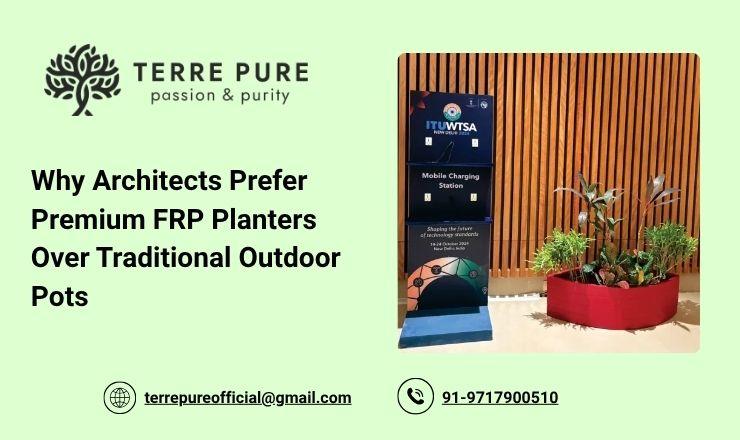

Why Architects Prefer Premium FRP Planters Over Traditional Outdoor Pots
Upgrade empty commercial corners with FRP Planters and Large FRP Planter designs built for durability, aesthetics, and long-term value. Contact now.
Walk through a newly built hotel lobby or a Grade-A office courtyard and you will notice something quickly. The old cement tubs and chipped ceramic pots are disappearing. Architects now specify FRP Planters, not because they are fashionable, but because traditional outdoor pots keep failing in commercial environments where maintenance budgets, loading limits, and appearance standards actually matter.
A cracked planter outside a five-star property is not a decoration issue. It becomes a replacement issue, a labour issue, and eventually a reputation issue. That is exactly why demand for Premium FRP Planters and every well-designed Large FRP Planter category has increased sharply across commercial projects in India since 2021, especially in hospitality and mixed-use developments.
Why Traditional Outdoor Pots Keep Losing Commercial ProjectsConcrete pots absorb moisture. Ceramic breaks during handling. Metal corrodes faster than most buyers expect in humid outdoor zones.
And yet many procurement teams still buy purely on price.
That mistake usually shows up 14 months later when maintenance teams begin patching cracks near drainage holes or repainting faded surfaces. A supplier quoting 18% lower rarely mentions the replacement cycle cost.
FRP Material Composition Actually MattersNot every FRP Pot performs the same way.
The resin blend, fiberglass layering thickness, UV coating quality, and mould finishing process directly affect durability. Low-grade fiberglass planters often develop surface chalking after prolonged UV exposure. We have seen projects where cheaper imports faded unevenly within 11 months because suppliers reduced gel coat thickness to cut production cost.
A proper commercial-grade FRP planter normally includes:
- Fiberglass reinforcement layers
- UV-stable exterior coating
- Moisture-resistant inner lining
- Drainage management system
- Lightweight structural composition
Which means a 42-inch planter can often be moved by two workers instead of requiring lifting equipment.
The Weight Detail Most Buyers IgnoreArchitects care about dead load calculations more than most buyers realise.
Large concrete planters installed on terraces or elevated decks increase structural load significantly. A comparable Large FRP Planter can weigh nearly 65–75% less depending on dimensions and wall thickness. That difference affects transport cost, installation time, and structural engineering decisions during large commercial projects.
Nobody tells you this early enough.
Surface Finish Is Not Just About LooksCommercial architects increasingly demand matte stone textures, metallic finishes, and custom RAL colours because planters now function as architectural elements instead of simple gardening accessories.
Cheap suppliers often outsource finishing to third-party workshops. The colour variation becomes obvious once 40 units arrive at site.
A factory-controlled finishing process matters more than catalog photography.
The Spec Detail Most Buyers Skip During Vendor EvaluationUV Resistance CertificationMany FRP Pot Manufacturers mention “weatherproof” in brochures without providing accelerated weather testing data.
Ask for actual UV performance details.
A vague answer like “suitable for outdoor use” usually means the supplier does not have documented testing.
Drainage EngineeringPoor drainage destroys indoor landscaping budgets quietly.
Water accumulation weakens roots, damages flooring, and creates staining around installation zones. Commercial-grade FRP systems generally include raised drainage bases or controlled outlet positioning.
That detail is harder to retrofit later than buyers expect.
Wall Thickness ConsistencyExperienced architects check planter wall thickness at corners and base joints.
Why? Because low-cost manufacturers reduce material density in hidden areas to save resin usage. The planter looks fine during delivery but cracks after repeated movement or soil pressure.
A supplier who avoids thickness specifications during discussion is usually hiding production inconsistency.
Five Supplier Evaluation Criteria Procurement Teams Should Use1. Ask About Production Capacity, Not Just Catalog SizeSome suppliers display 200 designs online while manufacturing only 12 regularly.
Bad answer:
“We arrange production depending on order volume.”
That usually means outsourcing.
2. Verify Lead Time StabilityCommercial projects run on deadlines, not promises.
Reliable FRP Planters Manufacturers maintain mould inventory and structured production schedules. If delivery estimates keep changing during quotation discussions, expect bigger problems after PO confirmation.
3. Inspect Finishing Uniformity Across Multiple UnitsOne sample piece proves almost nothing.
Most buyers never inspect batch consistency. That is where cheaper factories fail.
4. Check Export Packaging StandardsEven domestic buyers should care about this.
Manufacturers already supplying export shipments to UAE, Singapore, or Europe generally maintain stronger packaging systems and handling processes. Broken edge complaints drop sharply when proper internal support packaging is used.
5. Ask What Happens After Surface Damage ComplaintsHere’s the uncomfortable truth.
A supplier saying “we’ll review issues case by case” does not have an after-sales policy. That becomes your problem after installation.
Why Premium FRP Planters Protect Commercial BudgetsLower Replacement FrequencyQuality Premium FRP Planters commonly last several years longer than painted metal or ceramic alternatives in outdoor commercial spaces. Fewer replacements reduce maintenance disruption inside operational properties like hotels and retail plazas.
Faster InstallationLightweight structures reduce labour hours during installation. On larger projects involving 150–200 units, installation time differences become significant.
Better Design FlexibilityArchitects prefer FRP because moulding allows shapes difficult to achieve economically in stone or concrete.
Curved entrance planters. Tall lobby installations. Long divider troughs.
FRP handles those formats efficiently.
Reduced Transport DamageTraditional ceramic pots crack during interstate movement more often than suppliers admit. Fiberglass structures absorb vibration better during long-distance transport.
That directly reduces project loss.
Consistent Branding Across PropertiesHospitality chains increasingly standardise planter colours and finishes across multiple locations.
Reliable Premium FRP Planters Manufacturers can reproduce identical finishes for expansion projects months later. That consistency matters for branded commercial spaces.
Availability Across India and Why Greater Noida Became a Manufacturing HubDemand for FRP Pot Manufacturers in India and FRP Planters Manufacturers in India has increased rapidly around metro construction corridors including Delhi NCR, Bengaluru, Hyderabad, Pune, and Ahmedabad.
Greater Noida has quietly become an important manufacturing location because it connects efficiently to North Indian logistics routes and container movement infrastructure. That matters for bulk dispatches.
Most large commercial buyers now prefer sourcing from organised facilities near NCR because interstate freight coordination becomes easier compared to fragmented small workshops.
Which also explains why searches for Large FRP Planter Manufacturers in India and Premium FRP Planters Manufacturers in India have grown consistently among architects and procurement consultants handling hospitality and corporate developments.
What We’ve Learned After Years of Manufacturing Commercial FRP PlantersAt Terre Pure, we work closely with architects, landscape consultants, builders, and procurement teams handling large commercial installations across India.
We have seen projects delayed because buyers approved samples without checking production consistency. We have also seen expensive imported planters fail in Indian UV conditions within two summers.
Back in 2021, we stopped using one polyester resin blend after repeated feedback from clients in Rajasthan and Gujarat about surface fading under extreme heat exposure. We changed the formulation instead of arguing with customers. Factory-floor decisions like that rarely appear in brochures, but they determine long-term performance.
Our manufacturing facility in Greater Noida focuses on commercial-grade durability, controlled finishing quality, and bulk production capability for hospitality, retail, institutional, and corporate projects.
Send Specifications First — It Saves Everyone TimeIf you are sourcing FRP Planters, send the actual requirement sheet first.
Include:
- Dimensions
- Quantity
- Indoor or outdoor usage
- Finish preference
- Project delivery location
- Drainage requirements
We normally respond within one working day with production feasibility, MOQ details, and estimated dispatch timelines.
For large commercial projects, MOQ generally starts from 10–15 units depending on size and finish customisation.
ConclusionArchitects are choosing Premium FRP Planters because commercial projects cannot afford repeated replacement cycles, transport breakage, and inconsistent finishing quality anymore. A properly manufactured FRP Pot solves structural, aesthetic, and maintenance problems at the same time. The market is shifting toward lighter, longer-lasting, specification-driven products, and buyers who still purchase only on upfront price will keep paying for it later. Commercial landscaping is becoming more design-sensitive every year, and planter quality is now part of that conversation.
FAQsWhy do architects prefer Large FRP Planter designs for commercial spaces?Because large commercial projects need lightweight structures that still look premium. A Large FRP Planter reduces structural load on terraces and elevated decks while allowing oversized designs that are difficult to execute in concrete or ceramic.
What should I consider to analyze the quality of FRP Pot Manufacturers before placing a bulk order?Determine consistency of batches, UV resistance, delivery reliability, and packaging quality. There are many examples where FRP Pot Manufacturers in India present attractive samples and then outsource the actual production after they receive the order.
Can Premium FRP Planters survive the hottest regions in India?It depends, but mostly, yes. Resin quality is a concern. Lower quality FRP Planters quickly fade in the high UV regions like Rajasthan or the coastal regions. Good Premium FRP Planters Manufacturers in India would have UV-stable and decently exterior finish tested coatings.
How long do FRP planters last on average?Good quality FRP planters last decently long (as in several years) for outdoor commercial use. They can last many more years depending on the conditions of the install, quality and type of coatings, and the work put to maintain them.
FRP Planters Manufacturers in India have noticed a rapid increase in commercial queries. what is the reason?Commercial architects prioritizing lightweight materials coupled with an improvement in the speed of the installation and consistency of the finish across the full spectrum of complexities of the commercial architecture.
. That shift has increased demand for organised FRP Planters Manufacturers handling large-volume production.
Do FRP planters crack like ceramic pots?Not under normal commercial use. Severe impact can still damage them, especially thinner low-cost variants. Thickness specification matters more than many buyers realise.
Can Premium FRP Planters Manufacturers customise colours and finishes?Yes. Most established Premium FRP Planters Manufacturers offer matte, textured, metallic, and stone-inspired finishes. Customisation may increase lead time for smaller quantities though.

dry cleaning services palm jumeirah
dry cleaning services palm jumeirah