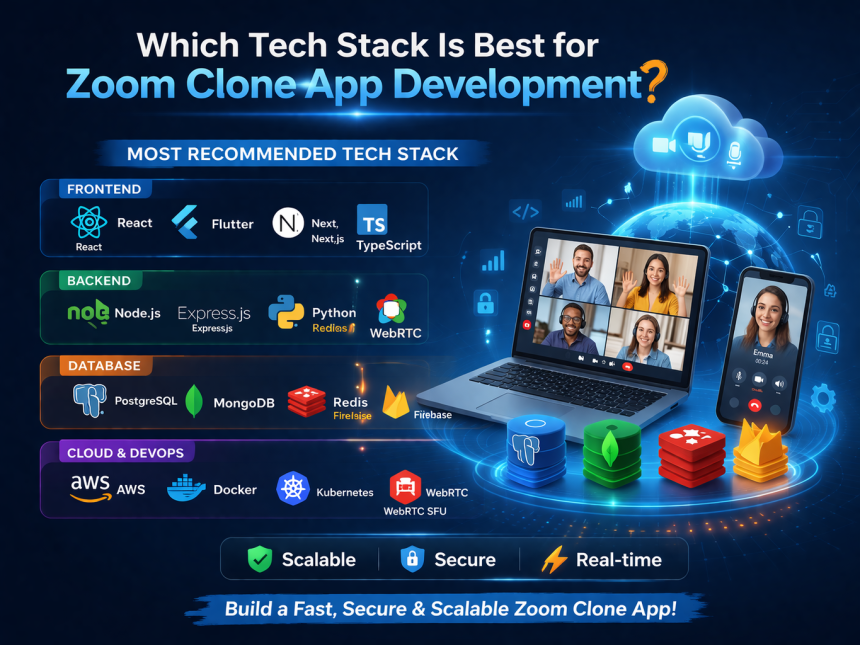

Which Tech Stack Is Best for Zoom Clone App Development?
The rise of remote work, online education, and virtual collaboration has dramatically increased the demand for video conferencing applications. Platforms like Zoom have set a benchmark for seamless communication, reliability, and scalability. As a result, many startups and enterprises are now exploring Zoom clone app development to build their own customized video conferencing solutions. However, the success of such an app depends heavily on one critical factor—the technology stack. Choosing the right tech stack ensures high performance, real-time communication, security, and scalability. In this blog, we’ll explore the best tech stack for Zoom clone app development, including frontend, backend, real-time communication tools, databases, and cloud infrastructure.
What Is a Zoom Clone App?
A Zoom clone app is a video conferencing platform that replicates core features of Zoom such as:
- HD video and audio calls
- Screen sharing
- Chat and file sharing
- Meeting recording
- Virtual backgrounds
- Multi-user conferencing
These apps can be customized based on business needs, whether for corporate meetings, telemedicine, online classes, or webinars.
Key Requirements for Zoom Clone App Development
Before selecting a tech stack, it’s important to understand the essential requirements:
1. Real-Time Communication
The app must support low-latency audio and video streaming.
2. Scalability
It should handle thousands (or even millions) of concurrent users.
3. Security
End-to-end encryption and secure authentication are crucial.
4. Cross-Platform Compatibility
The app should work across web, Android, and iOS devices.
5. High Performance
Minimal lag and fast load times are essential for user experience.
Best Frontend Technologies
The frontend is responsible for the user interface and experience.
React.js
React is one of the most popular JavaScript libraries for building dynamic and responsive UI.
Benefits:
• Fast rendering with virtual DOM • Reusable components • Strong community support
Flutter
Flutter is a great choice for cross-platform mobile app development.
Benefits:
• Single codebase for Android and iOS • High performance • Beautiful UI components
Next.js
For server-side rendering and SEO-friendly web apps, Next.js is highly effective.
Backend Technologies
The backend manages business logic, APIs, and server operations. Node.js Node.js is widely used for real-time applications. Benefits: • Non-blocking architecture • High scalability • Ideal for WebSocket communication Python (Django/Flask) Python frameworks are great for building secure and scalable backend systems. Benefits: • Easy to develop and maintain • Strong libraries for AI and analytics NestJS NestJS is a modern framework built on Node.js, offering a structured architecture.
Real-Time Communication Technologies
This is the core of any Zoom clone app.
WebRTC (Web Real-Time Communication)
WebRTC is the most important technology for video conferencing apps. Features: • Peer-to-peer communication • Low latency • Secure data transmission
Socket.IO
Used for real-time messaging and signaling.
Twilio / Agora / ZEGOCLOUD
These are third-party APIs that simplify real-time communication. Advantages: • Faster development • Scalable infrastructure • Built-in features like recording and chat
Database Options
A robust database ensures efficient data storage and retrieval. PostgreSQL • Relational database • Strong consistency • Ideal for structured data MongoDB • NoSQL database • Flexible schema • Suitable for real-time apps Redis • In-memory database • Used for caching and session management
Cloud & DevOps Technologies
Cloud infrastructure is essential for scalability and reliability. AWS (Amazon Web Services) • Global infrastructure • Auto-scaling • High availability Docker • Containerization for easy deployment Kubernetes • Container orchestration • Load balancing and scaling NGINX • High-performance web server • Load balancing
Recommended Tech Stack for Zoom Clone App
Here’s a balanced and powerful tech stack: Frontend: • React.js (Web) • Flutter (Mobile) Backend: • Node.js with Express or NestJS Real-Time: • WebRTC + Socket.IO • Agora or Twilio (optional for faster deployment) Database: • PostgreSQL + Redis Cloud: • AWS + Docker + Kubernetes
Native vs Third-Party APIs: Which Is Better?
Native Development (WebRTC) Pros: • Full control • Cost-effective long-term Cons: • Complex development • Requires expertise Third-Party APIs Pros: • Faster development • Built-in features Cons: • Higher cost • Less customization
Key Features to Include
To compete with Zoom, your app should include: • Video conferencing (HD quality) • Screen sharing • Chat and messaging • Meeting recording • User authentication • Calendar integration • Virtual backgrounds • Breakout rooms
Cost of Zoom Clone App Development
The cost depends on several factors: • Features and complexity • Tech stack • Development team location • Third-party integrations Estimated Cost: • Basic app: $10,000 – $25,000 • Medium app: $25,000 – $60,000 • Advanced app: $60,000+
Development Timeline
• Planning & Research: 1–2 weeks • UI/UX Design: 2–3 weeks • Development: 8–16 weeks • Testing & Deployment: 2–4 weeks
Challenges in Zoom Clone App Development
1. Latency Issues Solution: Use WebRTC and CDN 2. Scalability Solution: Cloud infrastructure and load balancing 3. Security Solution: End-to-end encryption 4. Network Variability Solution: Adaptive bitrate streaming
Future Trends in Video Conferencing Apps
• AI-based noise cancellation • AR/VR meetings • Real-time transcription • Advanced analytics • 5G-powered ultra-low latency
Conclusion
Choosing the best tech stack for Zoom clone app development is crucial for building a high-performance, scalable, and secure application. Technologies like React, Node.js, WebRTC, and AWS provide a strong foundation for creating modern video conferencing solutions. Whether you’re a startup or an enterprise, investing in the right tools and technologies will help you launch a successful Zoom-like app that meets user expectations and stands out in the competitive market.



UAE Business News: Key Trends, Investments, and Market Opportunities S...

What Makes a Dubai Yacht Journey Worth Every Minute?
Quick Answer: Why Is a Dubai Yacht Journey Worth the Time Investment?

Scorestreak Strategy by U4GM for Modern Warfare 4
Killstreaks and scorestreaks can swing a Modern Warfare 4 match fast, but they're not magi...
U4GM Breakdown of PoE 2 0.5 Skill Gem Changes and New Options
Skill Gems have always been the heart of Path of Exile 2, and Patch 0.5 brings several cha...