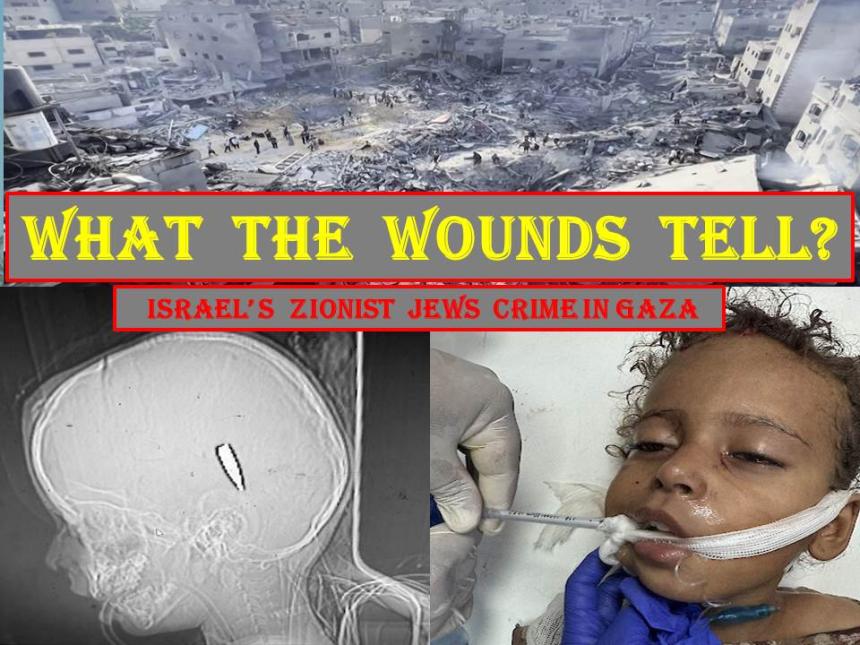
What the wounds tell? Israel’s Zionist Jews Crime in Gaza
The Israel – Palestine Conflict is century old and it engrosses the three major factions of Abrahamic Religions. The Israel-Gaza War has shown the dark face of Zionist Jewish State of Israel and IDF. The crime committed by IDF were never witnessed even during WW-1&2. This write up "What the wounds tell? Israel’s Zionist Jews Crime in Gaza" is about single gunshot wound to the head or chest of children of Gaza, published last year and the trend in continuing even today with insane ugliness.
أَعُوذُ بِاللّٰهِ مِنَ الشَّيْطَانِ الرَّجِيمِ
بِسۡمِ ٱللهِ ٱلرَّحۡمَـٰنِ ٱلرَّحِيمِ
In the name of ALLAH, the Most Gracious, the Most Merciful
What the wounds tell? Israel’s Zionist Jews Crime in Gaza
Doctors in Gaza observed a disturbing pattern: children with a single gunshot wound to the head or chest, a sign that they were shot at deliberately. This is revealed in an investigation by de Volkskrant , which spoke with the medics who are among the last international eyewitnesses.
By Maud Effting and Willem Feenstra; Published on September 13, 2025.
Key Findings
Fifteen international doctors told de Volkskrant that, during their work in hospitals in Gaza, they saw children aged 15 and under with gunshot wounds to the head or chest. According to the most conservative count, they saw a total of 114 children with such wounds, the majority of whom died.
Eyewitnesses told the doctors that the bullets mostly came from snipers or drones of the Israeli army (IDF).
According to former Commander of the Land Forces Mart de Kruif, the chance that these are coincidences is nil, because the doctors describe more than a hundred cases.
Nine doctors tell de Volkskrant that they have seen wounds possibly caused by controversial fragmentation weapons.
The Israeli army refuses to answer questions about shooting at children and states that it 'neither possesses nor uses' fragmentation weapons.
The Detailed Report as Published
It is a sweltering day when American doctor Feroze Sidhwa walks into the intensive care unit of the European Hospital in Gaza. On the hospital grounds, it smells of excrement and exploded explosives; inside, the smell of decay hangs in the air. Of dead bodies.
Sidhwa is a 43-year-old trauma surgeon and intensivist from California, where he works at Stockton Hospital. He is highly regarded among his colleagues, partly due to his international work. He never takes more than a week of vacation, except for humanitarian missions. He has worked in crisis areas such as Zimbabwe and Haiti, and trained surgeons in Burkina Faso and Ukraine. He wants to be where he is needed most.
It is March 2024, and this is his first day at the Gazan hospital. A Palestinian nurse is showing him around. Suddenly, his eye falls on two little boys lying motionless in bed. They are 8, 10 at most. Their heads are wrapped in bandages, and they are on ventilators. Otherwise, their bodies are unharmed.
"What happened?" he asks. The nurse barely speaks English. But she points to their heads. "Shot, shot," she says. At first, Sidhwa thinks she is mistaken. Are children being shot at here? But a moment later, he sees on the scans that she is right.
As they walk into a second ward, they see two more little boys, in the same condition. "I thought: what the hell?" he says on the phone in his deep bass voice to de Volkskrant . "How is it possible that here in this small hospital, within 48 hours, four children have come in who have been shot in the head?"
The little boys will all die. That evening, he makes a note in the diary on his phone. There is no time to think yet. But in the thirteen days that follow, he encounters nine more children with a single gunshot wound to the head or chest, children who were likely targeted. 'I thought my hospital might be near a crazy sniper,' says Sidhwa. 'Or a drone team that was shooting children for fun.'
Once home, at a conference, he coincidentally meets an American fellow doctor who worked at another hospital in Gaza just before him. When Sidhwa brings up the children, the man nods. 'To my surprise, he said: yes, I saw that too. Almost every day.' The doctor in question, Thaer Ahmad, confirms this to de Volkskrant .
'This was the moment,' says Sidhwa, 'when I decided: I *must* find out what is happening here.'
The Last to Give Evidence
Feroze Sidhwa is not the only doctor who feels he must make his voice heard after returning from Gaza.
Doctors like him have been witnessing Israel's atrocities in Gaza in their operating rooms for nearly two years. They must endure how shot toddlers suffocate in their own blood in their arms because there are no ventilators. They must be able to plunge their scalpel into a teenager's chest without anesthesia, because otherwise they won't have time for the next one. They must be able to watch their floors littered with dead children.
There are doctors who are worn down by it. But there are also doctors who decide to speak out. These doctors are among the last international eyewitnesses, because Israel does not allow foreign journalists.
They can speak from their own observation about the consequences of the genocidal violence that has entered its next pitch-black phase with the downing of Gaza City.
It presents them with a major dilemma. Almost all of them want to return to Gaza. But if they speak publicly about what they see, the chance that Israel will deny them entry in the future increases. According to the United Nations, this has already happened to more than one hundred foreign healthcare workers since March 2025. In almost all cases, Israel provided no substantive explanation.
But many doctors have come to accept this threat. According to them, not talking is no longer an option.
Over the past few months, De Volkskrant spoke with seventeen doctors and a nurse from the United States, the United Kingdom, Australia, Canada, and the Netherlands. Since October 2023, they have worked across six hospitals and four clinics throughout Gaza, often for multiple periods. Most have extensive experience working in crisis areas such as Sudan, Afghanistan, Syria, Bosnia and Herzegovina, Rwanda, and Ukraine.
At the request of the newspaper, the doctors shared hundreds of photos and videos of patients, X-rays, medical notes, and diary entries. They talked for hours about what they saw in their operating rooms. And they all answered the question: what do the wounds tell us about this war?
An Absolute Hell
British professor and transplant surgeon Nizam Mamode (63) was already half-retired when he received a phone call in the summer of 2024 from an aid organization, Medical Aid for Palestinians. They asked if he could go to Gaza in August. 'I had the time and knew I had the skills,' says Mamode. 'I have worked in Rwanda. In Sudan. In Lebanon. So I said yes. Some people say it was a brave decision. But that is not the case. To be honest: I had no idea what I was getting myself into.
It is only when he drives through Gaza in armored vehicles of the UN convoy with more than thirty others that the reality sinks in. 'The doors were locked,' he says. 'We were given instructions: never unlock them. If the Israeli army shoots at you and shouts that you must come out, do not get out.' 'Try not to get killed,' says the leader of the convoy. 'Two weeks later, the same vehicles were shot at by Israel,' says Mamode.
Shortly before that, their luggage was searched at a checkpoint by people in black uniforms. There is a shortage of almost all medical supplies in Gaza. Doctors have therefore brought basic supplies with them themselves. But often everything is taken away. Even the baby food. It happens at multiple missions, the doctors tell de Volkskrant .
British plastic surgeon Sarmad Tamimi, who crossed the border into Gaza on June 24 of this year, had already been warned by colleagues about the confiscations. But he also knows about the starvation in Gaza and the dramatic consequences for babies. "I took nutritional supplements for babies out of the box and put them in my luggage wrapped only in the plastic," he says. "I told the soldiers it was for myself."
American emergency room doctor Mimi Syed manages to smuggle two laryngoscopes under her clothes – indispensable for intubating patients. "I was scared," she says. "But as a doctor, I need them to save lives. Normally, you throw a laryngoscope away after one use. In Gaza, I used it on at least fifty patients. It was: wipe and move on."
"I don't understand why they take away baby food from doctors who cross the border," says British plastic surgeon Victoria Rose. "I don't understand why they take away medicines from doctors. I don't understand why half of the doctors are refused. There are many things I don't understand."
In a response, the IDF states that the claims regarding the seizure of baby food are "completely false." The army is actually facilitating humanitarian aid. According to the IDF, since May 19, 2025, "5,000 tons of baby food alone have been imported into Gaza, alongside large quantities of other relief supplies."
The doctors interviewed by de Volkskrant worked in multiple hospitals and field clinics during the war, including the Nasser, Al-Aqsa, European, and Al-Shifa Hospitals. Some doctors worked in clinics of Doctors Without Borders and organizations that do not wish to be named for fear that they will no longer be able to perform their work. They are general surgeons, orthopedic surgeons, intensivists, plastic surgeons, trauma doctors, and emergency room physicians. A few were still in Gaza at the time of the interview. The newspaper also spoke to a trauma nurse with war experience.
The situation in the Gazan hospitals, which have been largely destroyed, is much worse than the doctors had anticipated. "I had to cut off a woman's leg with scissors because nothing else was available," says Mimi Syed. "Without pain medication. I had no other choice."
The smell of burned limbs hangs in the wards. "We heard people screaming continuously," says Rotterdam doctor Salih el Saddy. "In our hospital, we had anesthetics, but no painkillers. Patients woke up in extreme pain after amputations. We couldn't do anything for them."
In the operating rooms, staff are busy keeping flies out of patients who have been cut open. Nizam Mamode watches as a fellow doctor attends to a child in the intensive care unit whose ventilator is not working properly. When he removes the tube from the child's throat, he sees that it is clogged. 'Full of maggots,' says Mamode, 'from the child's throat.'
According to several doctors, the MRI and dialysis machines are unusable because they have been riddled with bullets. Some operating rooms have been set on fire. Ultrasound cords have been cut.
The doctors don't have much time to think. But every now and then, at unexpected moments, disbelief suddenly strikes. Mamode experiences this when he operates on an 8-year-old girl. "She was bleeding to death, so I asked for gauze to remove the excess blood and help locate the wound," he recounts. He is told that they have run out of gauze. "Suddenly, I thought of the irony of it. According to tradition, the word 'gauze' comes from Gaza, because Gazans were famous for their fabrics. There I stood, in the birthplace of gauze, and I couldn't get it. I had to scoop the blood out of her body with both hands."
Emergency room doctor Adil Husain recorded a video letter for his young child and wife before his departure, just in case they never saw him again. Others arranged their wills. All the doctors de Volkskrant spoke to felt a strong intrinsic urge to go. 'I am a surgeon. I want to go where the need is greatest,' says a doctor who will soon return to Gaza and wishes to remain anonymous for fear of problems with Israel. 'My work there matters. It is a signal to the people in Gaza: we have not forgotten you.'
International doctors usually stay in Gaza for two to six weeks – after which they are relieved. Many of them sleep in the hospital and hardly leave for weeks. At Nasser Hospital, about fifteen surgeons are crammed together in a room on the fourth floor, close to the operating theaters. At night, it is nearly 40 degrees there. Surgeon Nizam Mamode therefore moved to the stone staircase next to it. 'I slept on those stairs every night, hoping that I was safe there from the drones.'
Last month, he saw how the upper part of that same staircase was destroyed by an Israeli attack, which received a lot of international attention because there were video images of the moment aid workers and journalists were killed.
By far the majority of the injured are caused by explosions of bombs and grenades: they are hit by the blast waves, the heat, flying shrapnel, and collapsing buildings. Shrapnel flies straight through tents. And also through the bodies of a great many children, who make up a total of over 40 percent of the population in Gaza.
'I have had countless children in front of me whose brains were hanging out,' says nurse Jack Latour of Doctors Without Borders. 'Sorry. I understand that no one wants to hear that. But that is exactly what is happening.' The first time surgeon Goher Rahbour found himself in a mass casualty event – a large-scale incident where the hospital is flooded with victims – he saw a 5-year-old girl without a foot. 'It was lying next to her on the floor. The next child no longer had a lower leg. Then another child came. I froze. I thought: this is absolute hell.'
According to Gazan health authorities, more than 64,000 Gazans have died so far, including nearly 20,000 children. Israel says it does not trust those figures because the ministry is under the authority of Hamas. A group of international researchers concluded in the medical journal The Lancet that the ministry's figures are actually an underestimate.
Children of Gunshot Wounds
Of all patients, there is one group that particularly shocks doctors: children with gunshot wounds to the head or chest and a body that is otherwise unharmed.
A single shot in these body parts is a key indication that the children were targeted. That is a war crime. In other conflict zones, doctors rarely encountered this.
On August 14, 2024, emergency room physician Mimi Syed writes in her diary. The sentences are short and staccato.
Syed is an American emergency room doctor who worked in Gaza for two four-week periods, at Nasser Hospital in Khan Younis and Al Aqsa Hospital in Deir al-Balah. "Like most people, I followed the war via livestreams on my phone," she says. "But I couldn't do it anymore. I am a mother. I couldn't just keep watching and doing nothing."
She describes Mira, a 4-year-old girl she sees in the Nasser. Her parents bring her in. 'They said she had been shot by an armed quadcopter (a drone, ed.) while walking around in the humanitarian zone established by Israel. I was told by colleagues that we were going to let her die. Their verdict was, unfortunately, that there wasn't much more we could do. I looked at her and saw her move a little. There was something in her face that made me think: I'll try anyway. She was so young.'
Syed intubates the girl with the laryngoscope she smuggled in herself. Moments later, she looks bewildered at the scan of her head: there is a bullet in it.
With the help of colleagues, Syed manages to keep Mira alive. Later, she will wake up and start talking again – a small miracle. Much later still, the bullet will be removed from her head by another doctor.
But Mira is not the only child with a bullet in her head that Syed sees. She decides to photograph them. 'I thought: I have to capture this. I realized: these are war crimes.' Under extremely stressful circumstances, she photographs eighteen children who have been shot in the head or chest. They are all single shots, she says.
De Volkskrant asked doctors how many children aged 15 and under they saw who had been shot with a single bullet through the head and/or chest. The newspaper chose to limit the question to this age group because, based on their appearance, there can generally be no doubt that these children are children.
Fifteen of the seventeen doctors stated that they found children aged 15 and younger with such gunshot wounds. In total, they named 114 children, a large proportion of whom died. Some doctors took photos or made notes of the children, while others relied on their memory. At the request of this newspaper, those doctors conducted the most conservative count; children about whom they had doubts were not included. Children who also had gunshot wounds in other parts of the body were not included in the count either, because targeted fire is less certain in those cases.
The doctors suspect that the total number of children shot in the head or chest is many times higher than the number they themselves saw. For instance, according to the doctors, children who died instantly usually did not end up in their wards. Moreover, the doctors did not work in all hospitals in Gaza, and were there for only a limited period.
At the request of the newspaper, doctors provided homemade photos and videos as evidence. In total, de Volkskrant saw images of dozens of children with gunshot wounds to the head or chest. The newspaper is not publishing the majority because the images are too gruesome.
De Volkskrant presented dozens of images of children with gunshot wounds and various X-rays to two forensic pathologists. They confirmed that the injuries were caused by bullets, and not by flying shrapnel. 'In all likelihood, these were long-range shots aimed at the head and/or neck with military ammunition,' responded forensic pathologist Wim Van de Voorde, emeritus professor at the University of Leuven. According to Van de Voorde, the photos are of insufficient quality for legal conclusions, 'understandable given the very difficult local circumstances'.
Forensic pathologist Frank van de Goot: 'On the X-ray images, I see the heads of children containing bullets. The bullets must have lost a lot of energy along the way, because children have thinner skulls than adults; otherwise, they would have gone straight through them. These children were therefore shot at from a considerable distance.'
That finding is consistent with statements from eyewitnesses, who described to the doctors how the bullets were usually fired by armed drones or snipers from the Israeli army (IDF). Snipers can determine who to hit and where from a great distance, sometimes more than a thousand meters. The IDF declined to answer questions regarding the shooting of children by snipers.
According to former Commander of the Land Forces Mart de Kruif, the chance that these are accidental hits is nil, because the doctors describe more than a hundred cases. 'Just consider the surface area of the entire body where the head is located. If you have a lot of gunshot wounds in the vicinity of the heart and the head, that is not collateral damage. That is truly targeted fire.'
Israeli Prime Minister Netanyahu and the military leadership systematically deny that soldiers fire specifically at Palestinian civilians. However, anonymous soldiers have repeatedly admitted in the Israeli newspaper Haaretz that this does indeed happen. Breaking the Silence, an Israeli organization of army veterans, also revealed, based on hundreds of conversations with soldiers, that they were ordered to shoot at anyone entering a designated area . "An adult man: kill," says a captain in the investigative report The Perimeter . "You shoot at anything that could pose a risk to our troops."
In August, the British news channel BBC published the results of an investigation into over 160 children who were shot in Gaza. In 95 cases, the shooting involved the head or chest; in 59 instances, the BBC spoke to eyewitnesses. According to them, the bullet came from the IDF 57 times and from Palestinians twice.
Most of the doctors the Volkskrant spoke to would have liked to gather more evidence in hindsight, but were unable to do so in the chaos of Gaza. Or they did not dare to. Orthopedic surgeon Mark Perlmutter (69), who carried out forty humanitarian missions: 'I wish I had had the presence of mind to record more.'
American anesthesiologist and intensivist Ahlia Kattan (38): 'What I regret most is that I didn't document more. But I was treating patients. It just didn't occur to me at the time. I wish someone had told me beforehand that I should have acted like a journalist too.'
"Beforehand, the NGOs told us as doctors: don't record anything, don't take notes, don't take photos," says Feroze Sidhwa. "They are terrified that otherwise Israel won't let them back into Gaza." But their memories of the children are sometimes extremely detailed.
'During a mass casualty incident, I was walking through the emergency room,' Perlmutter recounts. 'Children were lying everywhere. I turned them over to see who I could help. And then I saw two little boys. They were dead. They had been shot through the chest and the head. 6 or 7 years old. I examined them. I asked the medical assistant to take pictures of them.' The photos are in the possession of this newspaper.
Perlmutter heard the man who was with one of the little boys screaming. 'He didn't understand why a shooter had hit the child, and not him – an adult.' A moment later, he sees the man crying. He is sitting on the ground in shock, while the child has been taken to the morgue. Perlmutter takes a photo with his iPhone.
Anesthesiologist and intensivist Ahlia Kattan tells the story of a little girl brought in by her mother: 'She was not even 2 years old. She was very pale, she looked perfect, so I actually thought she had an internal hemorrhage.
'I saw that she was no longer alive. But her mother screamed heartbreakingly. It had taken her years to have a child. We started CPR and I intubated her – I wanted to show her that I had tried everything. We do that often with small children. While I was doing that, someone handed me the scan. And then I saw it: a bullet in her head. I saw the blood. A perfect shot to the temple.'
"I took a photo from the foot of the bed," says Kattan. "It is one of the few photos I took in Gaza. But I was so surprised that I thought: otherwise, no one will believe me."
The longer the doctors are in Gaza, the more they realize: these are not incidents, this is structural. These bullets were fired with intent.
Research By NYT
Feroze Sidhwa reaches the same conclusion in the fall of 2024. After the conference in the US, where he heard that another doctor saw the same thing as he did, he begins an investigation together with The New York Times . They have 64 American healthcare providers who worked in Gaza fill out a questionnaire.
The results, published by The New York Times on October 9, 2024, are concerning. In the article "65 Doctors, Nurses, and Paramedics: What We Saw in Gaza," 44 respondents state that they saw multiple children aged 12 or younger shot in the head or chest. 25 respondents saw newborn babies returned to the hospital and die from dehydration, starvation, or infections. 52 participants saw young children who were suicidal or said they wished they had died.
At that time, Joe Biden was still President of the US. In an open letter to him, doctors had previously expressed their concerns about the large number of young children dying. But Biden, who was struggling with differing opinions on the subject within the Democratic Party, did not respond.
Sidhwa expects the NYT article will change that. "It is very unusual for 65 American healthcare professionals to assert themselves publicly like this," he says, "because they are focused on saving patients. The article has also been read millions of times."
But the publication causes no storm of indignation, as Sidhwa had assumed. Nor does a political shift in course materialize. 'It was effectively just ignored by the Biden administration.'
Gamification By Warfare
For a brief moment, there is a glimmer of hope in Gaza when a ceasefire is in effect for two months in early 2025. But on March 18, around half past two in the morning, it is wiped away. With large-scale bombardments, Israel ushers in an intensified phase of its campaign of destruction, which continues to this day, including the frontal attack on Gaza City.
Doctors are seeing the situation in the hospitals deteriorate by the day. Mass casualty incidents are becoming increasingly frequent, sometimes occurring multiple times a day. Patients arriving often already bear scars from previous bombings. Due to starvation, patients and staff are becoming severely weakened. Wounded children who have no family members left are now officially a new medical category: WCNSF, Wounded Child, No Surviving Family .
Feroze Sidhwa, who is on his second mission in March, wakes up as the door to the sleeping quarters is blown open. Israel has broken the ceasefire. In the dark, the doctors stare groggy ahead for a minute. They listen to the bombs. 'We have to go down,' says one of them.
Tonight, hundreds of patients arrived within a few hours. Sidhwa herself started in the emergency room. 'For the first ten minutes, there was only one thing we did there: pronounce children dead. The worst part was, most of the children's hearts were still beating. But we picked them up and gave them to a family member. I don't speak Arabic, but I did know one word: ghalas, Arabic for 'enough'. We had to make choices so that we could treat others. It meant they had to go to another part of the hospital to die there.'
Perlmutter was at Al-Aqsa Hospital that same night. He saw a little boy lying on the floor, his face completely covered in gray dust. "He was lying in a pool of blood; he no longer had a leg," says Perlmutter. "I wanted to walk on. But at that exact moment, he grabbed my trouser leg. He couldn't speak anymore, but he did look at me. I saw the pool of blood growing. I hesitated for a moment and then pulled my leg free so I could help another child."
Perlmutter cries on the phone. "I've gotten over him," he says. He can't get the little boy out of his head.
During mass casualty incidents, doctors are overwhelmed by seriously injured patients. As a result, it is difficult to maintain an overview. Nevertheless, amidst the chaos, there are two patterns that doctors continue to notice and that may point to war crimes by Israel. They find evidence of the use of highly controversial weapons and the gamification of war violence.
Among the many people with mutilations and burns, doctors see patients coming in with small wounds who are nevertheless in very poor condition. They turn out to have been struck by tiny pieces of metal in the shape of a cube or cylinder. These are so small—a few millimeters—that doctors sometimes cannot even locate the entry or exit wounds. But inside the body, according to the doctors, they cause 'horrific damage': organs are pierced, and nerves and blood vessels are hit. With all the consequences that entails: patients suffer fatal internal bleeding or have to undergo major amputations.
According to Thaer Ahmad, an emergency room physician from Chicago, the impact wounds are so unremarkable that patients are sometimes sent home. 'Some came back with a stomach full of blood. One of them died while waiting for surgery.'
Nine doctors told de Volkskrant that they found these cube- or cylindrical particles in patients. Some sent de Volkskrant photos and videos of patients and the particles. Earlier, weapons experts stated in the British newspaper The Guardian that the injuries are consistent with Israeli-made fragmentation weapons . These are believed to be explosives enriched with large quantities of metal particles.
Mark Perlmutter, a board member of the American Association of Neuro- and Orthopedic Surgeons, says that he regularly found these particles. "I have operated on at least ten people who had them." He states that he smuggled two metal particles out of Gaza in his luggage. "I have handed them over to the International Criminal Court." According to Perlmutter, they were tungsten.
Tungsten is a metal that is extremely hard and nearly twice as heavy as steel. As a result, it can cause extensive damage if it flies around after an explosion. Its use in densely populated areas, such as Gaza, is highly controversial because it is aimed at causing as many casualties as possible and makes no distinction between civilians and combatants. Amnesty International has long stated that Israel uses such weapons in Gaza.
According to the IDF, the claim that Israel uses weapons that cause fragmentation injuries is "a flagrant falsehood." "The IDF neither possesses nor uses such weapons. This accusation is not based on facts and is a deliberate distortion of reality," the IDF stated in response to questions regarding this matter.
Since early March, Israel has completely blocked aid to Gaza. Two months later, almost all supplies in the area have run out, and more and more people are dying from systematic starvation. International criticism of Israel is mounting.
In response, starting in late May, Israel is opening four controversial food distribution points in Gaza, where Palestinians are required to travel for aid. From the very beginning, these prove to be life-threatening places. Civilians waiting are shot indiscriminately. In the Israeli newspaper Haaretz, soldiers even admit it: on orders from commanders, they shoot at groups of civilians who pose no danger.
'It is a killing field,' says one soldier. 'Shooting is our form of communication.' Only when the shooting stops do civilians 'know', according to him, that they are allowed to come to the food point. Another says that soldiers compare this among themselves to a well-known children's game, Salted Fish (Annemaria Koekkoek, ed. ), in which children try to approach a tagger without being caught moving.
Every time a food point opens, doctors in hospitals see dozens of civilians with gunshot wounds. They are mostly boys—teenagers and young adults. They are brought in in large numbers at once on donkey carts. Some still have the empty food bag with them.
Several doctors notice a pattern in the injuries. The affected body part differs from day to day, as if it were a pre-arranged plan, they state.
British surgeon Goher Rahbour says he saw five or six patients in one day who had been shot in both arms and both legs, according to eyewitnesses by the IDF. 'Was this for fun?' Rahbour wonders. 'Are the soldiers playing a game?'
Renowned British esophageal and stomach surgeon Nick Maynard of the University of Oxford also experiences this, as he has to operate on four people in a short time who have been shot in the abdomen.
Maynard asks other doctors if they see similar things. "Everyone at Nasser Hospital I spoke to about this recognized it," he says. "One day they saw mainly gunshot wounds to the head and neck, the next day it was the chest. Yet another day it was the limbs. The abdomen. Or the testicles. A doctor in training to become a urologist said that in one day he had seen four boys who had been shot in the groin." Due to the chaotic conditions in Gaza, according to Maynard, it was impossible to compile a daily list of the affected body parts and the numbers.
In the past, indications have been found that Israeli snipers experienced a game element when shooting at specific body parts. In 2020, Israeli snipers told Haaretz anonymously how they tried to break 'records' by hitting as many knees as possible in a single day. One of them 'reaches' 42. 'Knees were the hardest to hit,' said a sniper.
The IDF is not responding substantively to questions regarding the pattern observed by doctors. According to the army, it is actually Hamas 'that is creating the dangerous conditions for civilians'.
Emergency room doctor Adil Husain had just returned from Nasser Hospital in early August when he addressed a crowd in Texas. He cited the absence of foreign journalists in Gaza. "That is why it is up to us," he said, "to bear witness. We owe that to the people in Gaza." In two weeks, he said he saw hundreds of people die.
He talks about Ahmed, a 10-year-old boy who returned from a food distribution point with empty bags. 'He was hit in the head, his neck, and his stomach,' says Husain. He tells de Volkskrant that he gave the boy ketamine in his final moments to ease the dying. 'I held him. And I said to him: I'm sorry.'
Doctors leaving the area are almost all consumed by guilt. For they can leave, while the others stay behind. 'After my first mission, I kept in touch with my Gazan colleagues and asked how they were doing,' says Sarmad Tamimi, who returned from his second assignment at the end of July. 'But I can't do that anymore. Because I don't dare hear their answer.'
Their Moral Duty
It is May 28, 2025, and Feroze Sidhwa is addressing the Security Council at the United Nations headquarters in New York. The invitation came at the last minute; he had to cancel all his patients at the hospital in Stockton for it.
'I am not here as a policymaker or politician,' says Sidhwa, tracing the text on the paper in front of him with his index finger. 'I am a doctor who witnessed the deliberate destruction of a healthcare system, the purposeful attack on my own colleagues, and the wiping out of a people.'
A month and a half earlier, Sidhwa returned from his second mission to Gaza. Now he sits here, in a grey suit with a green tie, and has to put into words what is barely describable. He looks concentrated.
'My patients were 6-year-olds with shrapnel in their hearts and bullets in their brains,' he says in his deep bass voice. 'And pregnant women whose pelvises had been destroyed and their fetuses cut in two while still in the womb.'
Actually, he would later tell de Volkskrant , his original speech was 'much harsher'. But on the advice of a confidant, he had toned down his words so as not to deviate too much from diplomatic conventions.
Almost all the doctors spoken to by de Volkskrant feel the same urge as Sidhwa. They go to Gaza to help people. But when they see how many innocent civilians are killed, how extensive the destruction is, and how few people they can actually save, they realize that their task does not end upon returning home. They prefer to present themselves as neutral aid workers. But increasingly, they feel compelled to speak out publicly. So that they can tell as many people as possible about what they saw with their own eyes.
Nizam Mamode does the same, testifying before a British Parliament committee in the autumn of 2024. During the session, which is broadcast live, the 63-year-old surgeon breaks down. In the middle of a story about children lying on the ground after a bombing and subsequently being shot at by armed drones – 'this happened day after day after day' – Mamode falls silent. He closes his eyes. His lip begins to tremble.
His silence is filled by the committee chair. 'I sympathize with you,' she says, 'because you can no longer unspare what you have seen.'
For nearly thirty years, Mamode was a member of the Labour Party. He even campaigned for them in the last election. "But now I have cut my membership card in half," he tells de Volkskrant , "because I am ashamed of our Labour government. They have a moral obligation to take action, and they have not done so. I think that one day they will be judged harshly, very harshly."
It is a burden that almost all doctors feel: they come from countries that are traditionally allies of Israel. Countries that, even after their eyewitness accounts, do not intervene forcefully enough to make Israel stop. And, in the case of the US, even continue to supply the weapons that make the bloodshed possible.
In the Gazan hospitals, the doctors try not to think about it. Sometimes they fail.
When Israel broke the ceasefire with bombings on March 18, the corridors of the Nasser Hospital filled with bodies and the wounded. "I remember a five-year-old girl," says Feroze Sidhwa. "Her name was Sham. She was the first to be saved. I sat next to her on the floor, trying to help her breathe and watching the blood flowing from her left cheek. A shrapnel fragment had gone through her brain."
Amidst that chaos, while the screams of children echoed around them, Sidhwa could think of only one thing: 'Did I pay for this shrapnel? Was it my neighbor? Or was it his neighbor? Which American can I email to let them know that their grenade has been found?'
ABOUT THIS STORY
Over the past few months, De Volkskrant spoke extensively with 17 international doctors and a nurse about what they saw in Gaza. Where possible, they supported their testimonies with photos, X-rays, medical notes, and excerpts from diaries. The newspaper saw images of dozens of children with gunshot wounds to the head or chest.
After much deliberation, De Volkskrant has made this selection of photos because the images form an essential part of this investigation. They poignantly show the testimonies of doctors regarding the patterns of injuries they encounter. The doctors who took the pictures consulted with next of kin where possible. In a number of cases this was not possible, but the doctors shared the images nonetheless because they consider the public interest to be of great importance: they suspect war crimes. De Volkskrant possesses many more images, but considers the majority of them too gruesome for publication.
The newspaper approached doctors who previously worked in international crisis areas. As a result, they are able to compare the situation in Gaza with previous experiences. Moreover, they are the last international eyewitnesses.
De Volkskrant asked the doctors to count how many children aged 15 and under they saw with a single gunshot wound to the head or chest, a key indication that they were targeted. Some doctors had notes or photos of this, while others relied on their memory. The newspaper used the most conservative count; children about whom doctors had doubts were not included. Children who also had gunshot wounds in other body parts were not included in the count either, because targeted fire is less certain in those cases. This also applies to the two young boys described by orthopedic surgeon Mark Perlmutter, who were shot in both the head and the chest.
Some doctors worked at the same hospital at the same time, meaning duplication cannot be ruled out. However, the doctors in question consider this highly unlikely, as they generally did not see the same patients. The number of children with gunshot wounds encountered by a doctor depended heavily on the location and the time. For instance, American trauma surgeon Feroze Sidhwa saw thirteen children during his first mission, and not a single one during his second, which took place partly during the ceasefire.
De Volkskrant has asked the Israeli army (IDF) questions about the doctors' findings. The IDF did respond, but questions about the targeted shooting of children were not answered.
MADE BY
Text: Maud Effting, Willem Feenstra
Images: Judith Baas, Rowin Ubink
Design: Titus Knegtel, Adriaan van der Ploeg
Graphics: Eleanor Mohren
Data: Erik Verwiel, Laurie Treffers
Final editing: Joyce Brekelmans
Coordination: Corto Blommaert, Anne van Driel, Xander van Uffelen, Monique Wijnans
NOTE: Taken from this link https://www.volkskrant.nl/kijkverder/v/2025/schotwonden-palestijnse-kinderen-israel-oorlog~v1778945/
Montmorillonite Powder for Pharmaceutical Manufacturing and Gastrointe...
Montmorillonite Powder for Pharmaceutical Manufacturing and Gastrointestinal Care

Modern Biomass Station Upgrades for Reliable Power Generation
Modern Biomass Station Upgrades for Reliable Power Generation
Dish Network Installers Near Me: Professional Satellite Dish Installat...