What Makes It Worth Finding 2008 Dodge Caliber SRT4 Engine the Right Way
Looking for a 2008 Dodge Caliber SRT4 engine? Learn how to find a solid, tested unit with warranty and fair pricing—no guesswork. Order today!
How to Source One the Right 2008 Dodge Caliber SRT4 Engine
The Dodge Caliber SRT4 exists in a peculiar corner of American performance history a car that was genuinely fast by any reasonable measure, priced aggressively enough to embarrass competitors costing thousands more, and largely ignored by the automotive press because it wore a Caliber badge instead of a Mustang or an Evo nameplate. The people who bought them knew what they had. The people who drove one for the first time and found themselves unexpectedly pinned to their seat found out quickly. And the people searching today for a 2008 Dodge Caliber SRT4 engine for sale are almost always in one of those first two categories owners who understood the car's value when it was new and who want to keep it performing the way it was built to perform.
This guide is written for exactly that audience giving the specific technical context, the evaluation criteria, and the sourcing guidance that a performance-oriented buyer deserves for an engine that was never given the attention it earned.
What the SRT4 Actually Used — The Engine Behind the Performance
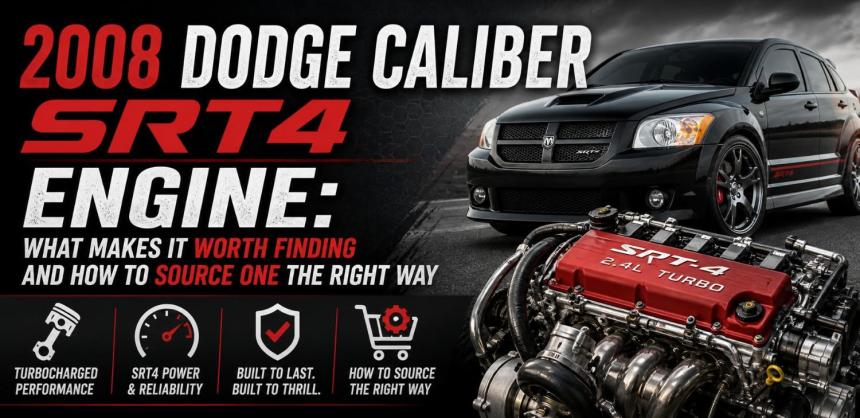
The SRT4 turbocharged engine in the 2008 Caliber is not the same unit as the earlier Neon SRT4's engine that built Dodge's performance compact credentials in the early 2000s. The Caliber SRT4 used the 2.4-liter World Gas Engine — a collaboration between Chrysler, Mitsubishi, and Hyundai that produced a modern, high-output four-cylinder architecture from which Chrysler's Street and Racing Technology division extracted genuinely impressive performance numbers through aggressive turbocharger specification, upgraded fuel delivery, and a supporting cast of reinforced internal components designed to handle the additional stress of forced induction at the output level SRT was targeting.
The Caliber SRT4 2.4L World Gas Engine in SRT tune produces 285 horsepower and 265 pound-feet of torque from the factory — figures that gave the Caliber SRT4 a 0-60 time in the low-six-second range, which was competitive with the Subaru WRX and quicker than most buyers expected when they looked at the Caliber's relatively ordinary exterior. The turbocharger specification is the primary differentiator between the SRT4 engine and the base Caliber's more modest application of similar architecture — a larger, more aggressive turbocharger with a higher boost target and a wastegate calibrated to hold that boost through a broader RPM range than the standard application.
The World Gas Engine SRT4 uses a 420A-derived cylinder block that was shared across several Chrysler compact applications but with internal reinforcements in the SRT version — upgraded connecting rods and revised piston specification that allowed the engine to handle the additional combustion pressure and thermal load of its performance tune without the reliability concerns that affect lightly modified standard engines running beyond their design parameters.
Why the 2008 SRT4 Is Worth Keeping Running
The Caliber SRT4 was produced for only two model years — 2008 and 2009 — in production numbers modest enough to make surviving examples increasingly uncommon. The performance delivered by the Dodge SRT4 motor in its original specification represents a genuine achievement in the affordable performance segment: comparable lateral dynamics to purpose-built sport compacts at a significantly lower acquisition cost, front-wheel drive that was managed with enough torque sensitivity through the throttle to make spirited driving genuinely rewarding, and a factory warranty that gave first owners confidence in a performance package that looked too good to be true on paper.
Today, a Caliber SRT4 in good overall condition with a functioning, healthy engine is a vehicle that occupies a small but devoted performance enthusiast market. The combination of relative rarity, genuine performance credentials, and the parts availability that the 2.4L World Gas Engine architecture provides through its multi-brand lineage makes the SRT4 a vehicle worth maintaining rather than abandoning when engine trouble arrives.
Understanding the Engine's Specific Failure Modes
The turbocharged Caliber engine in SRT4 specification has a set of known failure modes that reflect both its performance orientation and the demands that turbocharged operation places on supporting systems. The turbocharger itself is the primary wear component in any high-output turbocharged engine — shaft bearing wear, compressor wheel damage from foreign object ingestion, and seal failure from oil degradation all represent failure modes that accelerate in proportion to maintenance neglect. Any used SRT4 engine evaluation should begin with a turbocharger condition assessment that specifically looks for shaft play, clean compressor and turbine wheel surfaces, and absence of oil contamination in the inlet and outlet connections.
The cooling system in the SRT4 application manages a significantly higher heat load than the base Caliber's equivalent displacement engine, and cooling system maintenance history is accordingly more consequential. A used SRT4 engine with a clean cooling system history — consistent coolant color, no evidence of previous overheating events — is a fundamentally better prospect than one with ambiguous thermal history. The head gasket in turbocharged four-cylinder applications of this era is a specific component worth investigating, since the combination of high cylinder pressures and elevated operating temperatures makes the head gasket the first component to show stress from cooling system neglect.
The crankshaft and rod bearing condition in any used SRT4 engine reflects the quality of oil maintenance most directly. Oil changes at appropriate intervals with quality oil are the primary input that determines bearing clearance integrity in a high-output turbocharged engine. A cold-start compression test showing balanced readings across all four cylinders provides meaningful confirmation that internal wear is within acceptable limits for a replacement candidate.
Sourcing and What to Expect From the Market
Finding a quality used SRT4 engine requires navigating a more specialized market than mainstream performance engines. The Caliber SRT4's modest production volume means the supply of donor engines is limited, and the performance-community awareness of the SRT4's capabilities means that quality examples are appropriately valued. Patience in the search, combined with thorough evaluation standards when a candidate is found, is the combination that produces a successful sourcing outcome for this particular engine.
🔧 Turbo Auto Parts — Performance Engine Sourcing Backed by Three-Year Coverage
Turbo Auto Parts carries SRT4 engines and performance four-cylinder applications with the inspection depth that forced-induction powerplants require. Every turbocharged engine is assessed for turbocharger condition, cooling system integrity, and internal health before shipping, and every sale is backed by a 3-year parts warranty that gives performance-oriented buyers genuine long-term protection. With free shipping anywhere in the continental United States, sourcing the Caliber SRT4 engine is handled without additional logistics cost. Find your SRT4 engine from a supplier who respects what the car was built to do.
READ MORE : - 2008 Suzuki SX4 Engine Replacement: Cost-Benefit Analysis
Ultralight London and the Art of Effortless Styling
Ultralight London and the Art of Effortless Styling


How to File DBA Registration Correctly: The Costly Mistakes New Owners...


اینی بیسنٹ کا کتابچہ: "محمد (صلی اللہ علیہ وآلہ وسلم) کی حیات اور تعلی...