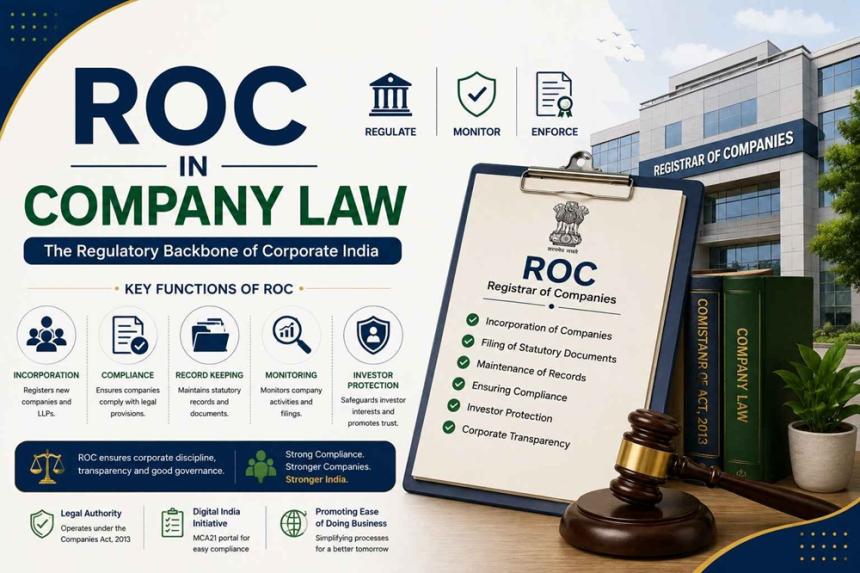

What Is the Full Form of ROC in Company Law?
From incorporation to annual filing and even company closure, ROC involvement remains constant. What this really means is that businesses cannot afford to ignore ROC requirements.
If you are dealing with company registration, annual filings, director compliance, or legal documentation in India, you have probably come across the term ROC multiple times. Many business owners hear this term during incorporation but do not fully understand what it actually means or why it matters so much under the Companies Act.
Let’s break it down in a simple way.
The ROC full form is Registrar of Companies. The registrar of companies refers to the government authority responsible for regulating companies and ensuring compliance under the Companies Act, 2013. In simple words, the ROC acts as the official authority that keeps records of companies registered in India and monitors whether those companies are following legal requirements.
Understanding the ROC is important because almost every company-related activity passes through the Registrar of Companies at some stage. Whether you are starting a private limited company, filing annual returns, changing directors, shifting a registered office, or closing a company, the ROC plays a central role.
Understanding the ROC Under the Companies Act, 2013Under the Companies Act, 2013, the Ministry of Corporate Affairs manages company regulation in India through different ROC offices located across various states and union territories.
The ROC is directly linked to the administration of companies in India. Each ROC office has jurisdiction over specific states and keeps complete records of all registered companies and LLPs operating in those regions.
The registrar of companies becomes relevant during every major compliance event because companies are legally required to submit forms, disclosures, and reports to the ROC within prescribed timelines.
When people search for the ROC's meaning, they are usually trying to understand why this authority is so important in business operations. The answer is simple. Without ROC approval and compliance, a company cannot legally function under Indian company law.
What Does the Registrar of Companies Do?The role of ROC is much bigger than just maintaining company records. The Registrar of Companies ensures transparency, accountability, and legal compliance in corporate operations.
Here are the major functions performed by ROC under the Companies Act:
Company IncorporationOne of the primary responsibilities associated with the ROC is company incorporation. When promoters apply for registration of a company, the ROC verifies all documents before issuing the Certificate of Incorporation.
The registrar of companies becomes important here because the ROC checks whether the proposed company name, MOA, AOA, director details, and registered office documents comply with the law.
Without ROC approval, a company legally does not exist.
Maintaining Company RecordsThe ROC also includes maintenance of public records. Every company registered in India has a file maintained with the ROC containing important information such as:
- Incorporation documents
- Director details
- Annual returns
- Financial statements
- Charges and loans
- Shareholding information
- Registered office address
This information is available on the MCA portal for public inspection in many cases.
Monitoring ComplianceThe ROC is closely connected with corporate compliance. ROC monitors whether companies are filing required forms and returns on time.
If a company fails to comply with filing requirements, the ROC can impose penalties, issue notices, or even initiate prosecution in serious cases.
The registrar of companies, therefore, represents not only a registration authority but also a regulatory body ensuring compliance discipline.
Approval of Corporate ChangesWhenever companies make structural or administrative changes, ROC approval is usually required.
These changes may include:
- Change in company name
- Appointment or resignation of directors
- Increase in authorized capital
- Change in registered office
- Alteration in MOA or AOA
- Conversion of company type
The ROC extends to supervising all such modifications through prescribed e forms.
Why Is ROC Important for Companies?Many entrepreneurs think ROC matters only during company incorporation. That is not true.
The ROC remains relevant throughout the life cycle of a company. From the day a company is incorporated until its closure, ROC compliance continues.
Here’s why ROC is important:
1. Legal RecognitionA company receives legal recognition only after approval from ROC. The Certificate of Incorporation issued by ROC acts as proof of company existence.
This makes the registrar of companies extremely significant for business owners.
2. Regulatory ComplianceThe ROC includes regulatory supervision. ROC ensures that companies maintain statutory compliance and transparency.
This protects shareholders, creditors, investors, and the public from fraudulent business practices.
3. Public TransparencyThe ROC is associated with transparency because financial statements and annual filings submitted to ROC can often be inspected publicly.
This helps stakeholders verify the legitimacy and financial status of companies.
4. Corporate GovernanceThe registrar of companies also reflects the government’s effort to improve corporate governance standards in India.
ROC monitoring helps reduce illegal activities such as fake companies, shell entities, and fraudulent incorporations.
ROC and MCA RelationshipA common confusion people have while understanding the ROC is the difference between ROC and MCA.
Let’s simplify this.
- MCA stands for Ministry of Corporate Affairs
- ROC stands for Registrar of Companies
The Ministry of Corporate Affairs is the central government ministry responsible for corporate regulation in India. ROC offices function under the MCA.
In simple terms, MCA is the parent authority while ROC acts as the implementing authority at the regional level.
The ROC therefore represents the operational authority handling company filings and registrations under MCA supervision.
Forms Commonly Filed With ROCTo fully understand the registrar of companies, it helps to know the forms companies regularly file with ROC.
Some commonly used ROC forms include:
1. SPICe+ FormUsed for company incorporation.
2. AOC 4Filed for submission of financial statements.
3. MGT 7Filed as annual return.
4. DIR 12Used for appointment or resignation of directors.
3. INC 22Filed for change in registered office.
4. ADT 1Filed for auditor appointment.
5. PAS 3- Filed for allotment of shares.
- These forms are submitted electronically through the MCA portal.
- The ROC becomes practical when businesses regularly interact with ROC through these filings.
One major reason why businesses must understand the ROC is that non-compliance can lead to serious penalties.
Under the Companies Act, 2013, ROC has authority to take action against defaulting companies.
Consequences may include:
- Late filing fees
- Monetary penalties
- Director disqualification
- Company strike off
- Legal notices
- Prosecution in severe cases
The registrar of companies therefore represents a regulatory authority with enforcement powers.
Many companies ignore annual filing requirements assuming their business is inactive. However, ROC compliance remains mandatory even for dormant companies unless legally closed.
That is an important aspect of the ROC many entrepreneurs fail to understand.
Difference Between ROC and Stock ExchangePeople sometimes confuse ROC with stock exchanges like NSE or BSE. They are completely different.
The ROC refers to a government authority regulating all registered companies.
A stock exchange deals only with listed companies and securities trading.
Even private limited companies that are not listed on any stock exchange still fall under ROC jurisdiction.
That is why understanding the registrar of companies is essential for every company owner, not just listed businesses.
ROC Jurisdiction in IndiaIndia has multiple ROC offices operating across states and union territories.
Each ROC office handles companies registered within its territorial jurisdiction.
For example:
- ROC Delhi
- ROC Mumbai
- ROC Chennai
- ROC Kolkata
- ROC Bangalore
The ROC also includes this regional administrative structure.
Companies must file forms with the ROC office having jurisdiction over their registered office location.
ROC Filing ProcessThe filing process under ROC has become largely digital through the MCA portal.
Here’s how it generally works:
- Preparation of forms
- Attachment of supporting documents
- DSC signing
- Professional certification where required
- Upload on MCA portal
- Payment of government fees
- ROC verification and approval
The ROC is therefore closely associated with digital corporate compliance in modern India.
Most filings today are completed online through authorized professionals such as Chartered Accountants, Company Secretaries, or Cost Accountants.
Role of Professionals in ROC ComplianceSince ROC filings involve technical legal procedures, businesses often hire professionals for compliance management.
Professionals help with:
- Company incorporation
- Annual ROC filings
- Drafting resolutions
- Director compliance
- Share allotment filings
- Strike off procedures
- Charge registration
The registrar of companies is highly relevant for practicing professionals because ROC compliance forms a major part of corporate advisory services.
ROC and LLPsAlthough the ROC mainly refers to company regulation, ROC also handles LLP registration and compliance under the LLP Act. Limited Liability Partnerships must also file annual returns and statements with ROC. This expands the practical scope of the ROC beyond traditional companies.
How ROC Helps Business TransparencyOne underrated aspect of the registrar of companies is its contribution to public trust.
Because ROC maintains official company records, investors and stakeholders can verify important information before dealing with businesses. This creates accountability and discourages fraudulent corporate practices. The ROC full form therefore supports a safer business environment in India.
ConclusionFrom incorporation to annual filing and even company closure, ROC involvement remains constant. What this really means is that businesses cannot afford to ignore ROC requirements. Timely filings, accurate disclosures, and proper compliance management help companies avoid penalties and maintain legal credibility. Whether you are running a small private limited company or managing a growing corporate entity, understanding the ROC gives you a stronger grasp of how Indian corporate regulation actually works.

Top 03 Wibesite to Buy GitHub Accounts for Secure



Cisco Partner UAE for Dependable Routers Switches and Firewalls
Need networking products that can support serious business growth? GenX helps companies so...


Valley of Flowers Trek: Discover the Blooming Paradise of the Himalaya...


Top 03 Wibesite to Buy Verified Go2Bank Accounts for Secure