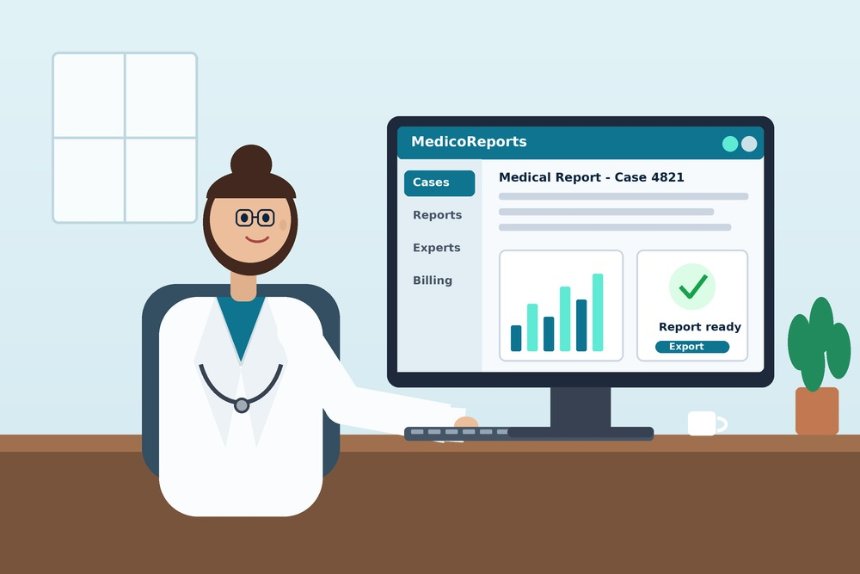

What Is Medical Legal Software Used for in the UK?
Medical legal software helps UK experts, MROs and solicitors manage instructions, records, reports and billing securely. See what it does and how to choose.
A solicitor sends an instruction on Monday. The records arrive in three batches, the draft sits in someone’s inbox, and the deadline slips past unnoticed. Many medico-legal teams still run their work this way.
Medical legal software fixes that. It manages every stage of a medico-legal case, from the first instruction to the final invoice, in one secure system.
This guide explains what the software does, who uses it, what it costs, and how to choose the right option.
The Short Answer
Medical legal software is a platform that manages the work behind independent medical reports in the UK. It handles instructions, records, deadlines, drafting, sign-off, scheduling, billing, and secure delivery. The expert still examines the claimant and writes the opinion.
Medical legal software supports the production of expert medical evidence for legal matters. Typical examples include personal injury claims, clinical negligence claims and insurance disputes.
It is not a clinical system. It does not hold patient treatment records or support day-to-day care. It also differs from general legal practice software, which tracks client matters, time, and billing.
You may also see it called medico-legal software, medical reporting software, or medico-legal case management software. The terms overlap, and most describe the same type of platform.
A typical platform covers seven areas.
- Instructions. It records the instructing party, report type, questions, deadline, and agreed fee.
- Allocation and scheduling. It matches cases to experts and books examinations.
- Records and evidence. It stores medical records and documents in a secure file area with role-based access.
- Chronologies. It lists events by date and links each entry to its source page.
- Drafting and review. It offers templates, version control and a quality review step.
- Delivery and follow-up. It sends reports through a secure portal and keeps any written questions and answers with the case.
- Invoicing and reporting. It raises invoices, tracks payment and shows workload and turnaround.
A Practical Example
A solicitor instructs a Medical Reporting Organisation (MRO) for a personal injury report. The MRO allocates a consultant orthopaedic surgeon and books the examination.
The surgeon reviews the records through a source-linked chronology and drafts the report from a template. A reviewer checks it, the surgeon signs it off and the platform delivers it. The invoice follows automatically.
Medical Experts
GPs, orthopaedic surgeons, psychiatrists and psychologists use it to organise records, drafts and invoices. Individual experts need fewer features than an MRO, but they still gain from one record per case.
Medical Reporting Organisations (MROs)
MROs coordinate many experts and cases at once. They rely most on allocation, scheduling, quality review and management reporting.
Solicitors and Insurers
These users usually work through a portal. They send instructions, track progress and receive reports securely.
Other Compliance-Heavy Organisations
Healthcare, insurance and regulatory teams that handle high volumes of sensitive documents often need the same controls. Audit trails, access permissions and secure delivery apply well beyond medico-legal reporting.
Benefits
- One controlled record for every case
- Fewer missed deadlines and duplicate invoices
- Clear version history and audit trail
- Secure storage and delivery of sensitive health information
- Better visibility of workload and turnaround
Drawbacks and Limits
Software does not replace the expert. It cannot examine a claimant, form a clinical opinion or decide what a report should conclude.
It also does not make an organisation compliant with data protection law on its own. Policies, contracts and staff training still matter.
AI features need particular care. A summary can miss a detail or misstate a date. The expert must check every AI-generated statement against the source record before signing.
Pricing varies by vendor, number of users, case volume, and integrations. Common models include per-user subscriptions, per-case fees, volume tiers, and bespoke contracts for larger MROs.
Ask each vendor whether set-up, data migration, training, and support cost extra. These add-ons often decide the true cost.
Alternatives Compared
OptionStrengthWeaknessEmail, Word and spreadsheetsLow cost, familiarWeak audit trail, easy to lose trackGeneric CRM or legal practice softwareFlexible, widely usedNot built for expert instructions or report versionsDedicated medical legal softwareBuilt for the workflowCosts more, needs set-up and trainingSmall practices with few cases may manage with simple tools. Higher volumes and greater risk push most teams towards a dedicated platform.
- Map your current workflow and note where work stalls.
- List who needs access and what each role should see.
- Check security features, including encryption, access controls, and audit logs.
- Test the templates with a real report type.
- Ask how the vendor handles AI features and your data.
- Confirm migration, training, and support terms before you sign.
Best Practices
- Use templates for structure, never for pre-written opinions.
- Set role-based access from day one.
- Review every AI output against the source record.
- Train every user before go-live.
- Review reports on turnaround and workload each month.
Common Mistakes
- Buying on features alone. Choose against your real workflow, not a demo.
- Treating software as compliance. Tools support compliance. People and policies deliver it.
- Pre-filling clinical content. The opinion must be the expert’s own.
- Skipping training. Poor adoption brings the spreadsheets back.
- Ignoring retention. Keep records only as long as you need them.
What is medical legal software?
It is a platform that manages the work behind independent medical reports in the UK. It covers instructions, records, drafting, sign-off, scheduling, invoicing and secure delivery.
Who uses medical legal software in the UK?
Medical experts, MROs, solicitors and insurers use it. Experts and MROs use the full workflow, while solicitors and insurers usually use a portal.
Is it the same as legal case management software?
No. Legal practice software tracks client matters, time and billing. Medical legal software tracks expert instructions, examinations, report versions and expert fees.
Can it replace an expert’s judgement?
No. The expert examines the claimant, reviews the evidence and signs the final opinion.
Can AI write a medico-legal report?
Some platforms offer AI summaries or suggested wording. The expert must verify every statement, because the expert owns the opinion.
Is it suitable for individual experts?
Yes. Individual experts use it to organise records, drafts and invoices without needing an MRO’s full feature set.
How much does it cost?
Pricing depends on users, case volume and integrations. Common models include per-user subscriptions, per-case fees and bespoke contracts.
Medical legal software gives UK medico-legal teams one controlled record for every case. It brings instructions, evidence, drafting, sign-off, billing and delivery into a single workflow, and it saves time on administration.
It does not replace the expert or guarantee compliance. Start with your own caseload, then compare platforms on security, audit trails, templates, and AI controls.

Move Beyond Borders with Confidence: Protect Every Shipment with Singl...

The Strategic Importance of Nuclear Fuel in the Global Energy Transiti...
Energy pricing intelligence covers primary energy and secondary energy commodities.


AUM Growth Through WhatsApp? India’s First MF Transactions Meet Mutual...


Katlanır Merdiven Modelleri
Katlanır özelliği bulunan tüm merdiven modelleri https://fakrocatimerdivenleri.com/ adresi...
