What Cannabis Looked Like in the 1960s: A Groovy Journey Back in Time
Curious about what cannabis looked like in the 1960s? Dive into the hippie era's hazy vibes, from seedy imports to counterculture icons. Discover how it shaped modern cannabis culture and visit a cannabis store today for a taste of history.
Step into a time machine and transport yourself to the swirling haze of the 1960s, where free love, rock 'n' roll, and rebellion defined a generation. Amid the psychedelic posters and tie-dye shirts, one plant emerged as the ultimate symbol of defiance: cannabis. But what cannabis looked like in the 1960s was worlds away from today's frosty, lab-tested buds—think lanky, seedy imports wrapped in mystery and mischief. From the smoke-filled rooms of Haight-Ashbury to the fields of Woodstock, this era's green companion wasn't just a high; it was a statement. As we unpack the visuals, stories, and shifts that made it iconic, you'll see how those groovy days laid the groundwork for the thriving scene at your local cannabis store today.
The Visual Essence: Cannabis Forms and Strains of the Hippie Heyday
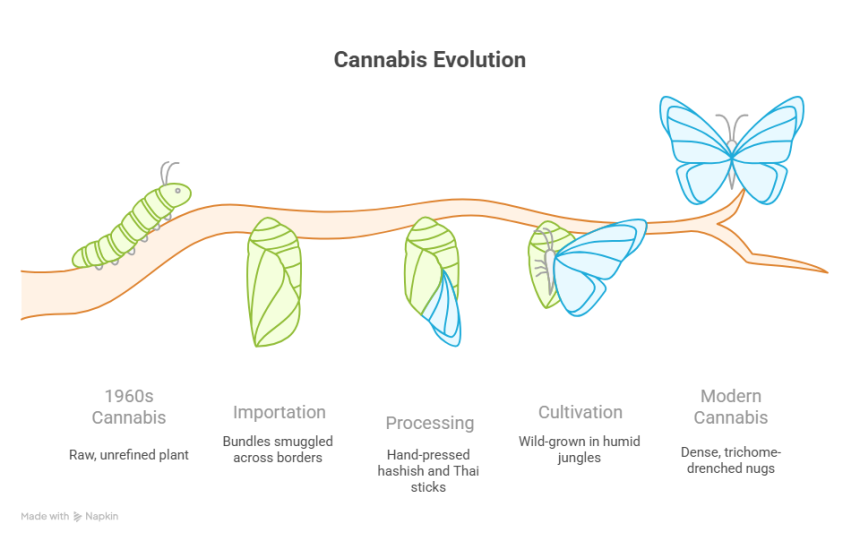
Picture this: It's 1967, the Summer of Love is in full bloom, and cannabis arrives not in sleek packaging but as clandestine bundles smuggled across borders. Back then, the plant's appearance was raw and unrefined—tall, spindly sativa landraces towering up to 20 feet, with narrow, serrated leaves fanning out like wild ferns. Buds? Sparse and wispy, often overshadowed by stems, seeds, and fan leaves that made up much of the smokeable material. Imported primarily from Mexico, Colombia, and Thailand, these varieties like Acapulco Gold shimmered with a golden hue from afar, but up close, they were earthy, reddish-brown clumps riddled with seeds that popped like fireworks in a joint.
Thai Sticks were the era's rockstars: entire colas skewered on bamboo, wrapped in leaves and string, dangling like forbidden fruit from street dealers. Hashish, sourced from Morocco, appeared as dark, malleable bricks or honey-like slabs, pressed from resinous trichomes scraped from wild plants. No fancy jars or COAs here—just handwritten notes or whispers about "Panama Red," a vibrant, coppery sativa with brick-like buds that promised psychedelic adventures. A 2021 Reddit thread reminiscing on r/interestingasfuck captured it perfectly: users shared faded photos of brick weed, dense as play-doh, evoking nostalgia for a time when quality was secondary to the thrill of the hunt. Historian Emily Dufton notes in her book Grass Roots, "Cannabis in the '60s wasn't about potency; it was about presence—a visual rebellion against the straight-laced '50s."
This aesthetic tied directly to cultivation: wild-grown in humid jungles, plants adapted with loose structures for seed dispersal, yielding 1-4% THC at best. Yet, that low-key look fueled the mystique, turning every puff into a ritual of discovery. Fast-forward to modern shelves, and the contrast is stark—dense, trichome-drenched nugs versus those airy relics. But the '60s form wasn't flawed; it was authentic, mirroring the era's untamed spirit. As Leafly's Adam Pallay reflects, "Those landraces were nature's originals, their gnarled beauty a testament to untouched terroir." Exploring these visuals today reminds us how far we've come, while honoring the roots that still influence strains at any discerning cannabis store.
Counterculture Canvas: How Cannabis Painted the Hippie Landscape
The 1960s weren't just about the plant's look—they were a kaleidoscope where cannabis visually intertwined with the hippie ethos, adorning everything from album covers to protest signs. Imagine Woodstock '69: mud-caked festival-goers in bell-bottoms, passing Thai Sticks under a sea of peace signs, the air thick with the skunky scent of Mexican brick weed. This wasn't accidental; cannabis became the visual shorthand for liberation, its leafy motifs splashed across psychedelic posters by artists like Wes Wilson, where swirling greens evoked altered states.
Statistics paint a vivid picture: By 1969, an estimated 8-10 million Americans had tried marijuana, up from a mere 100,000 in 1960, per the National Institute on Drug Abuse—fueled by the counterculture's embrace. Hippie communes in New Mexico and California grew wild patches, their lanky plants framing geodesic domes and VW buses painted with cannabis leaf murals. Allen Ginsberg, beat poet turned activist, championed this in his 1966 essay "The Great Marijuana Hoax," decrying Reefer Madness myths and praising the herb's "gentle herb" form as a tool for insight. "It opens the mind to the beauty of the universe," he wrote, inspiring visuals that romanticized its humble, seedy appearance.
Examples abound: The Beatles' Sgt. Pepper's sleeve, influenced by their 1964 Dylan-introduced sessions, hid cannabis nods in floral arrangements; Jimi Hendrix's Stratocaster bore leaf engravings, symbolizing his onstage highs with Acapulco Gold. In Europe, Nepal's Freak Street buzzed with hashish-hawking sadhus, their dark slabs traded for paisley shirts—captured in Timothy Leary's The Politics of Ecstasy, where he described cannabis as "the leaf of life, unlocking doors of perception." This era's imagery—faded denim pockets stuffed with Panama Red baggies, joints rolled on Howl pages—cemented cannabis as counterculture's muse. Today, it echoes in strain names at your neighborhood cannabis store, blending nostalgia with innovation. As cultural scholar Fred Turner observes, "The '60s turned cannabis from vice to vision, its rough-hewn look a badge of authenticity in a plastic world."
Iconic Strains: Visual Snapshots from the '60s Stash
Zooming in, the '60s boasted landrace strains whose appearances screamed adventure. Acapulco Gold: Golden-brown buds with a shimmering coat, airy and aromatic like sun-baked earth—smuggled from Mexican highlands, it lit up Cali beaches with its 10-15% THC glow. Panama Red: Brick-red nuggets, dense yet fluffy, dusted in reddish hairs that caught the light like embers, evoking Central American jungles and near-psychedelic trips at 21% potency.
Lamb's Bread, Jamaica's gift via Bob Marley, featured slim, elongated buds on tall plants, pale green with subtle orange pistils—raw and resinous, perfect for reggae rhythms. Thai Sticks: Not a strain per se, but whole stalks of sativa flower, green and veiny, bound crudely— a visual oddity that screamed exotic import. Expert breeder DJ Short recalls, "These were wild children of nature, their irregular shapes hiding potent secrets." Durban Poison, though late to the party, arrived with spear-like colas, dark green and sticky—South Africa's pure sativa, a spicy revelation. These visuals, far from today's uniformity, invited tactile exploration, their imperfections part of the charm. A 2020 Boulder Weekly piece highlighted how such strains' "beautiful, untamed aesthetics" inspired home grows, birthing the boutique era. Reviving them now at a cannabis store bridges eras, letting you touch history's haze. (Word count: 212)
From Stems to Symphony: Consumption Methods and Their Visual Flair
Consuming cannabis in the '60s was as much performance art as ritual, with visuals that screamed improvisation. Joints ruled: Hand-rolled in Zig-Zag papers (introduced 1879 but booming then), stuffed with everything—buds, leaves, stems—yielding fat, uneven cylinders that glowed orange at tips during Grateful Dead shows. No filters; just cardboard scraps from matchbooks as crutches, often decorated with peace symbols drawn in pen.
Pipes were eclectic: Corncob models for the thrifty hippie, carved wooden bowls etched with mandalas, or apple-bongs—cores hollowed out, stems as mouthpieces, bubbling green clouds through fruit flesh. Hash pipes, short and squat, featured screens to cradle Moroccan slabs, their dark resin melting into ethereal vapors. A 2017 Saturday Evening Post retrospective described campus scenes: "Students huddling over makeshift devices, the glow of embers casting shadows on dog-eared Kerouac novels." Timothy Leary quipped, "Turn on, tune in, drop out—with a well-packed pipe as your passport to perception."
Bongs? Primitive precursors: Gravity-fed water pipes from scavenged bottles, gurgling with murky liquid stained by repeated use. Edibles were rare—brownies baked in commune ovens, flecked with ground herb, doled out at love-ins. Stats from a 2019 GrowthOp analysis show 90% of use was smoked, often communally, fostering visuals of shared circles under lava lamps. This DIY aesthetic—scarred wood, stained glass—mirrored the era's resourcefulness, contrasting today's vaporizers. As ethnobotanist Wade Davis reflects, "Those crude tools weren't tools; they were talismans, transforming the ordinary into the profound." Today, recreating them at home nods to that ingenuity, blending retro flair with modern safety.
Societal Smoke Signals: Perceptions, Panics, and the Pushback
The '60s visual of cannabis wasn't just buds—it was a lightning rod for fear, splashed across headlines as "Reefer Madness" evolved into "Hippie Hazard." Media portrayed users as wild-eyed dropouts, joints dangling from unkempt beards, amid lurid yellow journalism. LIFE Magazine's 1967 feature screamed alarm: "People pass on sidewalks looking stoned, buttons blaring 'Turned On' or 'Let’s Get Naked and SMOKE'"—framing the plant's seedy bricks as gateways to moral decay. Arrests skyrocketed: From 18,000 in 1965 to 290,000 by 1973, per FBI data, often for mere possession of a Thai Stick remnant.
Yet, counter-perceptions bloomed in underground presses like the Oracle, where cannabis appeared as enlightened leaves crowning enlightened heads. Carl Sagan, under pseudonym "Mr. X," penned in 1971: "There are genuine levels of perception available with cannabis... enhancing sensitivity to facial expressions, yielding rapport so close it's mind-reading." Hippies flipped the script, parading at anti-war rallies with joints as peace pipes, their hazy eyes defiant badges. A Cornell raid in 1963, detailed in the Post, exposed 80 students, sparking whispers of "narcs" and fueling paranoia—but also solidarity.
Examples like the 1967 "Be-In" in Golden Gate Park visualized unity: Thousands circling, passing Acapulco Gold, banners waving "Legalize It." Expert historian Kathleen Frydl argues, "Cannabis's 'dangerous' image was a projection of societal fears, its rough form scapegoated for youth unrest." This duality—panic versus paradise—propelled reform, with Shafer Commission's 1972 call to decriminalize ignored amid Nixon's war. Today, these perceptions inform balanced views at cannabis stores, where education tempers history's heat.
Echoes in Amber: The '60s Legacy in Today's Cannabis Scene
The '60s didn't fade—they fermented into modern cannabis's soul, their visual echoes dispensary in vassar display. Landraces like Durban Poison now grace shelves, their tall, resinous forms hybridized but true to wild roots. Festivals homage Woodstock with haze strains named "Summer of '67," evoking that muddy, communal high. A 2024 Leafly report notes 30% of popular strains trace to '60s imports, blending nostalgia with 20%+ THC.
Culturally, the era's DIY visuals inspire: Vintage pipes at markets, tie-dye edibles packaging. Bob Dylan, who turned the Beatles onto pot in '64, inspired folk-rock anthems still sampled today. As Mechoulam, THC's discoverer, reflected in 2016: "We unlocked a molecule that changed perceptions forever." X posts like @NoNext_Question's 2022 thread on Nepal's hash haven remind us of global ties. This legacy? A bridge from brick weed to boutique, inviting us to savor progress.
Step-by-Step Guide: Recreating the '60s Cannabis Experience Mindfully
Craving a taste of that era? Here's how to channel '60s vibes safely, blending history with today's wisdom.
- Source Retro-Inspired Strains: Hunt landraces like Acapulco Gold at a cannabis store. Check labels for sativa dominance and low(ish) THC (under 15%) to mimic mild highs. Action: Read terpene profiles—aim for myrcene for earthy nostalgia.
- Gather Authentic Gear: Score corncob pipes or apple-bongs (use food-grade). Roll joints with unbleached papers, adding a historical twist. Tip: Decorate with markers for hippie flair, but prioritize clean tools to avoid contaminants.
- Set the Scene: Dim lights, queue Hendrix, don fringe. Smoke in a circle with friends, passing like at a be-in. Insight: Journal perceptions à la Sagan—track visuals, moods for personal growth.
- Explore Mindfully: Start micro (1-2 puffs), hydrate, and space sessions. Pair with '60s reads like On the Road. Best practice: Consult a budtender for safe dosing; avoid if pregnant or on meds.
- Reflect and Evolve: Post-session, note insights. Cycle strains to prevent tolerance. Pro tip: Volunteer at a reform rally—honor the activism that got us here.
This guide, drawn from Dufton's archives, ensures fun without folly, turning back-in-time into forward-thinking.
Voices from the Velvet Fog: Quotes That Captured the Era
The '60s spoke through smoke rings, with words that immortalized cannabis's allure. Carl Sagan: "The illegality of cannabis is outrageous—an impediment to serenity and insight so desperately needed." Hunter S. Thompson: "Marijuana is a useful catalyst for optical and aural perceptions." Ginsberg: "Beat marijuana naked... it leads to the other world."
Leary: "Tune in, turn on, drop out—with cannabis as your key." These echoes, from a time when 400,000 toked at Woodstock, fuel today's discourse. As X user @r33fermadness tweeted in 2020: "Ancient weed got you high from fumes—'60s was tame by comparison!" Timeless wisdom for modern highs.
From seedy bricks to cultural icons, we've revisited what cannabis looked like in the 1960s—a raw, rebellious force that sparked revolutions in mind and society. Its legacy? A reminder that the best highs come with heart and history.
Ready to groove with the ghosts of '69? Swing by your local cannabis store for landrace revivals and share your '60s tales below—what's your favorite retro strain? Subscribe for more hazy histories, and let's keep the flower power flowing!