
Top AI Cybersecurity Companies: How to Compare
Discover the top AI cybersecurity companies in 2025. Compare products, AI roles, and best fits with our buying checklist to choose the right vendor for your business.
Worried your security team is missing AI blind spots? Confused about which small AI security vendor to pick? AI is changing security fast.
About 30% of security teams already use AI tools in production, and the AI-enabled cybersecurity market is projected to grow sharply over this decade.
This post cuts straight to the practical: we will compare ten mid-sized AI cybersecurity companies, show what each does best, and give a clear buying checklist you can use today.
Top 10 AI Cybersecurity Companies You Should Look Out For
- Credo AI — Enterprise AI governance platform for risk management, policy, and compliance across the AI lifecycle.
- Quokka Labs — AI-native engineering firm now offering security-focused AI services and integrations.
- Monitaur — AI governance and risk/compliance software with “policy-to-proof” workflows and monitoring.
- Protect AI — MLSecOps for the AI/ML stack: model supply chain scanning, AI BOM, and policy-driven guardrails.
- HiddenLayer — Model threat detection and response with anti-tamper defenses and adversarial attack monitoring.
- Robust Intelligence — Continuous AI risk testing and runtime protections to block prompt injection and data leakage.
- CalypsoAI — Model evaluation, red-teaming, and secure gateways to control prompts, outputs, and tool access.
- Cranium — AI security posture management with asset inventory, AIBOMs, and integrations into enterprise security tools.
- Trustible — AI governance platform to operationalize responsible AI and compliance.
- ValidMind — Model & AI risk management and governance for regulated industries.
Each of these companies focused on practical AI security problems, and is suitable when you don’t want a 1000-person vendor taking months to onboard.
How To Compare The Top 10 AI Cybersecurity Companies
- Product focus — what core problem do they solve?
- AI role — detection, prevention, governance, or remediation?
- Deployment & integration — cloud, agent, API, or hybrid?
- Maturity & traction — funding, customers, or team size.
- Best fit — who should consider them (SMB, mid-market, regulated org)?
Keep this method handy; you can repeat it for any small AI security vendor you evaluate.
Now let's see a company-by-company breakdown with a simple comparison table.
Also, one quick note on web protection: a good Web application firewall reduces noise and blocks bulk attacks so your AI detection can focus on real threats.
1)Credo AI — Enterprise AI governance & risk
What they do
Credo AI provides a governance platform to operationalize AI risk management and compliance. It centralizes policies, controls, assessments, and evidence across the AI lifecycle, helping security, risk, and compliance teams prove and enforce responsible AI usage.
AI role
Policy- and control-aware evaluators that score model and LLM app risk against internal and external standards. Automated evidence collection, reporting, and audit trails for approvals and ongoing oversight.
Deployment
SaaS with APIs and integrations into data catalogs, model registries, identity, and ticketing systems.
Maturity & size
US-based, venture-backed; small-to-mid team focused on enterprise rollouts.
Best fit
Regulated organizations need measurable AI governance, defensible documentation, and control enforcement.
2) Quokka Labs — AI-Native Engineering with Security Integrations
What they do
Quokka Labs is best known as an AI-native engineering and product company that builds apps and integrations. Recently, they’ve expanded into security-centered engineering and custom AI security integrations for apps and tooling. They are around the small-to-mid company size (150–200 employees).
AI role
- Custom models and integrations: embedding detection models, secure pipelines for AI features.
- Advisory and build for security teams that want to embed AI into their own applications.
Deployment
Custom work, typically cloud-native and tailored to the buyer’s architecture.
Maturity & size
Known as a product and services firm with a medium-sized team. Good fit for bespoke projects and integrations.
Best fit
Companies that need a partner to build secure AI features or to wrap AI controls into existing products.
3)Monitaur — AI governance & compliance monitoring
What they do
Monitaur focuses on turning AI policy into evidence: model documentation, approvals, monitoring, and audit workflows that connect risk, compliance, and ML teams.
AI role
Model behavior monitoring and documentation automation to track performance, bias, drift, and compliance status. “Policy-to-proof” workflows that map controls to continuous evidence.
Deployment
SaaS platform with connectors to MLOps tools and enterprise systems; APIs for custom data feeds.
Maturity & size
US-based, focused, product-led team working with risk/compliance-heavy industries.
Best fit
Enterprises that must demonstrate continuous compliance of AI systems to auditors and regulators.
4)Protect AI — securing the ML supply chain
What they do
MLSecOps platform covering model/code/data provenance, AI bills of materials (AI/ML SBOMs), scanner tooling for pipelines, and policy-driven guardrails across the ML lifecycle.
AI role
Automated scanning and classification of model artifacts, datasets, and pipeline components for vulnerabilities and misconfigurations. Risk correlation and policy reasoning to block unsafe deploys before they reach production.
Deployment
APIs, CLIs, and CI/CD integrations; connects with MLOps stacks (e.g., model registries, experiment trackers) and common cloud providers; deployable SaaS or private.
Maturity & size
US-based, venture-backed, mid-stage with a compact team (sub-200), expanding with enterprise customers.
Best fit
Enterprises running multiple ML pipelines that need artifact provenance, model/AI BOMs, and enforceable supply-chain policies.
5) HiddenLayer — model threat detection & response
What they do
Protects live models from adversarial abuse with telemetry, detections, and response playbooks; focuses on model integrity and inference-layer security.
AI role
Anomaly detection on model inputs/outputs to spot adversarial patterns, data poisoning, and model theft attempts. Adaptive signatures and heuristics to flag tampering and drift.
Deployment
Lightweight sensors at inference endpoints, SDKs for model hosts, and integrations into SIEM/SOAR for triage.
Maturity & size
US-based, venture-backed, compact mid-stage team (double-digit to low triple-digit headcount).
Best fit
Organizations serving high-value models in production that need runtime protections without ripping and replacing their stack.
6) Robust Intelligence - continuous AI risk testing
What they do
Pre-deployment and runtime testing of models and LLM apps to catch failures, regressions, and security/privacy risks; includes an “AI unit test” framework.
AI role
Automated adversarial input generation, eval suites, and guardrails to detect prompt injection, leakage, bias, and safety gaps. Ongoing monitoring to maintain model quality as data and prompts evolve.
Deployment
CI/CD gate for pre-prod, plus a runtime “firewall”/proxy for inference; SDKs and connectors to model registries and data pipelines.
Maturity & size
US-based, later seed-to-growth stage with a focused team (sub-200) and large-enterprise rollouts.
Best fit
Teams that treat AI like software—wanting testable, enforceable quality bars before and after release.
7) CalypsoAI - secure AI gateway & governance
What they do
Controls how employees and apps interact with LLMs via a secure gateway: policy enforcement, auditing, content filters, and tool-use permissions.
AI role
Prompt/output classification, PII/redaction detection, and policy reasoning to block risky prompts and responses. Evaluator pipelines for model comparison and red-teaming.
Deployment
Gateway/proxy (network or SaaS), browser extension, and SDKs; integrates with identity, DLP, and SIEM tools for logging and control.
Maturity & size
US-based, mid-stage with public-sector and enterprise traction; compact team scaling responsibly.
Best fit
Organizations rolling out multiple LLMs to the workforce who need centralized control, audit trails, and guardrails.
8) Cranium — AI security posture management (AISPM)
What they do
Cranium builds an inventory of AI assets, creates AIBOMs, and maps risks and controls to frameworks, bridging AI systems with enterprise security and GRC programs.
AI role
Entity resolution and classification for models, datasets, and apps; automated risk scoring and control checks. Recommendations tied to standards and internal policies.
Deployment
Agentless connectors to clouds, data catalogs, MLOps, and collaboration tools; dashboards and APIs for SecOps/GRC.
Maturity & size
US-based, venture-backed; emerging mid-stage with Fortune-500 pilots.
Best fit
CISOs and platform teams seeking end-to-end visibility and governance over growing AI estates.
9) Trustible — responsible AI governance & compliance ops
What they do
Trustible helps enterprises operationalize responsible AI with policy libraries, assessments, and evidence capture aligned to regulations and internal standards.
AI role
Risk assessments and evaluators are mapped to policy controls for LLMs and ML systems. Automated reporting to create auditor-ready documentation.
Deployment
SaaS with workflows, APIs, and integrations into identity, ticketing, and data/model systems.
Maturity & size
US-based, early-to-mid stage, with a compact team focused on compliance-heavy buyers.
Best fit
Teams need a lightweight, fast-start governance layer to standardize AI risk reviews across projects.
10) ValidMind — model & AI risk management for regulated industries
What they do
ValidMind streamlines model documentation, validation, and governance—especially for financial services—covering both traditional models and LLM/ML systems.
AI role
Automated documentation and testing harnesses to validate models against risk and compliance criteria. Evidence generation and change tracking for approvals and audits.
Deployment
SaaS platform with connectors to code repos, data sources, and validation pipelines; APIs for custom workflows.
Maturity & size
US-based, seed-to-growth stage; focused team with traction in highly regulated sectors.
Best fit
Banks, fintechs, and other regulated orgs that need rigorous model validation and auditable governance.
Quick Comparison Table
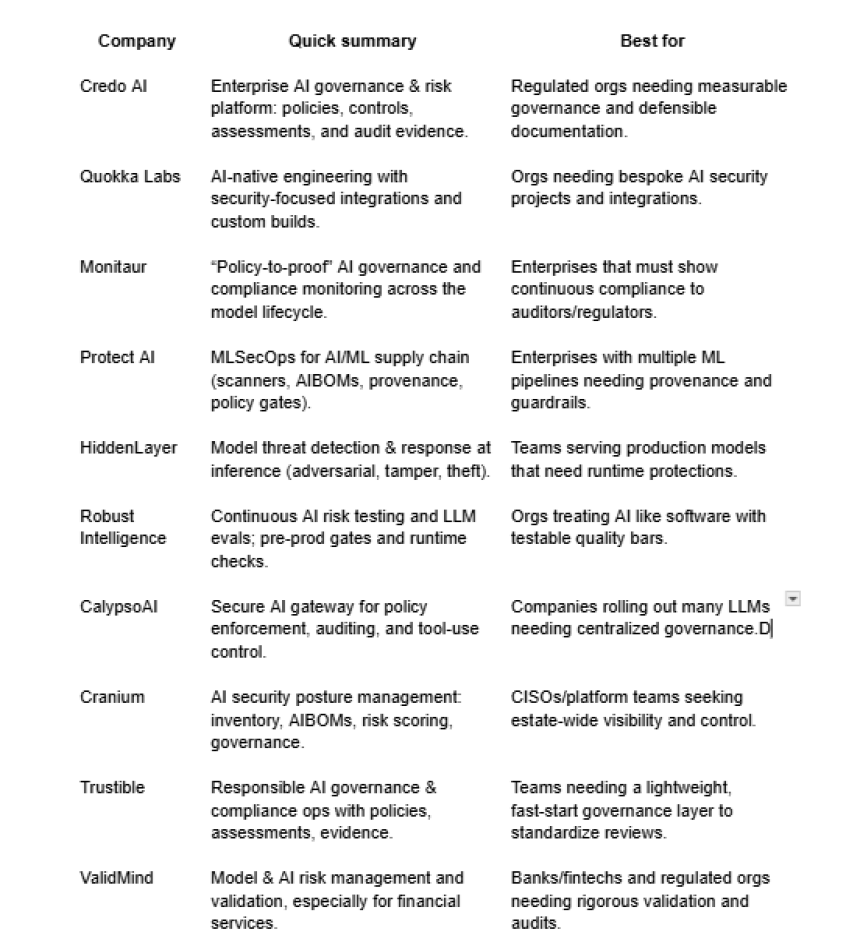
Now, practical buying signals - what to ask and what to measure.
Buying Checklist: What To Ask Every Vendor (And Why)
- What problem do you solve in one sentence? If they can’t say it simply, proceed carefully.
- How does your AI make decisions? Ask for examples of false positives and how they tune models.
- Integration time — ask for a realistic timeline and a list of required sources.
- Support & SLAs — small vendors often have fast support but limited global coverage. Confirm hours and escalation.
- Data handling — where does customer data live and who can see it? This is vital for GenAI and data governance.
- Proof of concept — insist on a short POC that measures detection rate and time-to-remediate.
- Pricing model — per seat, per endpoint, or per data ingestion? Understand how costs scale.
If you want external help early in the process, consider an AI consulting services partner to frame requirements and manage the vendor POC.
How To Pick The Right AI Security Vendor For Your Organization
Match the problem → vendor shortlist
- Enterprise AI governance (policies, evidence, compliance): Credo AI
- Policy-to-proof governance & monitoring: Monitaur
- ML/AI supply-chain security (AIBOMs, pipeline gates): Protect AI
- Runtime model threat detection & response (TDR): HiddenLayer
- Continuous AI risk testing & LLM evals: Robust Intelligence
- Secure AI gateway (policy, audit, tool-use controls): CalypsoAI
- AI security posture mgmt (inventory, risk, governance): Cranium
- Responsible-AI governance ops (lightweight rollout): Trustible
- Model & AI risk mgmt for regulated industries: ValidMind
- Bespoke AI security engineering/integrations: Quokka Labs
Run a tight PoC (4–6 weeks) with clear success metrics
Core KPIs: detection rate, false-positive rate, MTTR, latency overhead (if inline), total cost of ownership.
Category-specific adds:
- Credo AI: control/policy coverage; time-to-evidence; % models/apps governed; audit readiness score.
- Monitaur: “policy-to-proof” closure time; drift/bias issues detected; % models with continuous monitoring enabled.
- Protect AI: % pipelines gated; AIBOM completeness; supply-chain findings resolved per sprint.
- HiddenLayer: attacks detected during PoC; p95/p99 inference overhead; integrity/tamper alerts with confirmed TPR/FPR.
- Robust Intelligence: gate pass/fail rates; injection/leakage caught pre-release; regression catch rate over time.
- CalypsoAI: risky prompt block rate; redaction/PII accuracy; audit log completeness; user adoption without bypass.
- Cranium: % AI assets discovered in 30 days; entity de-dup quality; control mapping coverage to frameworks.
- Trustible: assessment cycle time; policy adoption across teams; evidence package completeness.
- ValidMind: validation coverage for high-risk models; documentation time saved; audit exceptions reduced.
- Quokka Labs: integration velocity; custom control coverage delivered; time-to-first signal in your stack.
Measure team impact (prove it reduces manual work)
Baseline and then show before/after SOC metrics: alerts per analyst, triage minutes per alert, # auto-remediations, incidents averted, and governance tasks automated.
Check references that mirror your reality
Same size, industry, and stack (clouds, data types, model hosts). Smaller vendors can excel—verify SLA adherence, roadmap delivery, and support quality with named references.
Plan for scale from day one
Know your trigger points for multi-model, multi-cloud, or regulated workloads. Confirm RBAC depth, SSO/SCIM, API/webhook breadth, data residency/keys, and evaluator/signature update cadence.
Decide on services vs. product
If you need outcomes fast, ensure the vendor (or Quokka Labs for bespoke work) offers managed detection, red-teaming, validation, or remediation runbooks so the tool turns into an operational capability quickly.
If you want to explore vendor-led services after a trial, look at their AI security services offerings for managed detection or remediation. These can convert a tool into an operational capability quickly.
Final thoughtsSmall and mid-size AI security vendors can be the fastest path to practical defenses if you pick the right match. Use the simple framework above: map problem → pick vendor → run a short measurable POC → measure impact.
That will save you months and help the team adopt AI securely.



Guide complet des traitements en France : médicaments, conseils médica...

