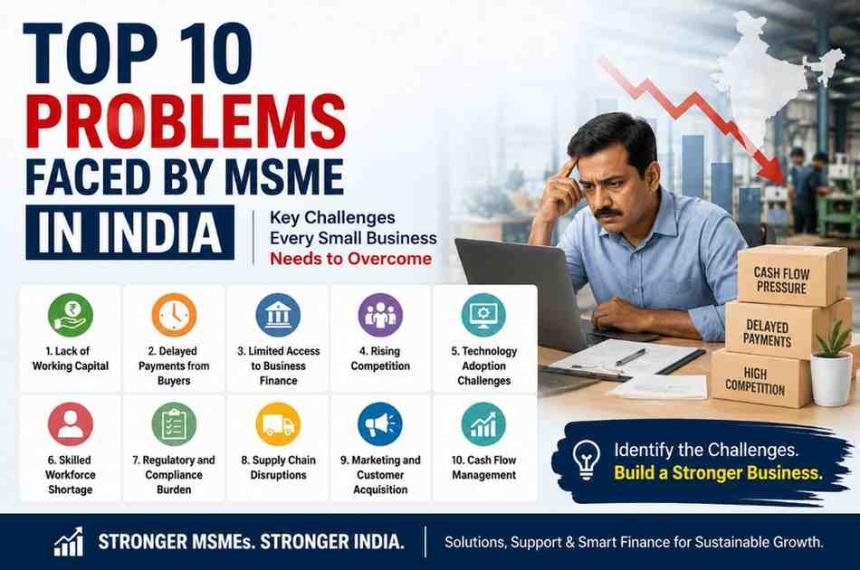

Top 10 Problems Faced by MSMEs in India
Top 10 problems faced by MSMEs in India include lack of working capital, delayed payments, limited access to finance, cash flow issues, compliance challenges, and more
Micro, Small, and Medium Enterprises (MSMEs) are one of the biggest contributors to India's economy. They generate employment, support exports, and help local industries grow. Today, millions of businesses across manufacturing, trading, and services come under the MSME category.
Even though the sector has grown over the years, running an MSME is not easy. Business owners face many challenges every day. Limited funds, delayed customer payments, rising competition, changing technology, and compliance requirements make it difficult for many businesses to grow at the desired pace.
The good part is that many of these problems have practical solutions. Government initiatives, digital tools, and financing platforms are helping MSMEs manage their day-to-day business more efficiently.
In this article, let's look at the top 10 problems faced by MSMEs in India and understand how businesses can overcome them.
1. Lack of Working Capital
One of the biggest problems faced by MSMEs is the shortage of working capital.
Every business needs money to purchase raw materials, pay salaries, manage inventory, transport goods, and handle daily expenses. However, many MSMEs struggle because a large part of their money remains blocked in unpaid invoices.
Without enough working capital, businesses often miss new opportunities or delay production.
Some common reasons include:
- Customers paying after 30 to 90 days
- High operating costs
- Seasonal business fluctuations
- Limited access to short-term finance
Many MSMEs now use invoice financing through RBI-approved TReDS platforms like RXIL to unlock funds against approved invoices instead of waiting for customer payments.
2. Delayed Payments from Buyers
Late payments continue to affect thousands of MSMEs across India.
Large buyers often negotiate longer payment cycles. While this may work for big companies, it creates serious cash flow issues for small businesses.
Delayed payments can result in:
- Difficulty paying suppliers
- Salary delays
- Reduced production
- Increased dependence on loans
The Government has introduced initiatives like the Trade Receivables Discounting System (TReDS) to help MSMEs receive faster payments by discounting invoices through financiers.
Reducing payment delays allows businesses to maintain smoother operations.
3. Limited Access to Business Finance
Although several loan schemes are available, many MSMEs still find it difficult to obtain timely financing.
Traditional banks usually require:
- Collateral
- Strong financial records
- Good credit history
- Lengthy documentation
New businesses and small manufacturers often fail to meet these requirements.
As a result, many owners depend on personal savings or informal borrowing, which can become expensive.
Today, businesses can also explore:
- Invoice discounting
- Supply chain finance
- Government-backed MSME loan schemes
- Digital lending platforms
These alternatives provide quicker access to working capital without affecting business continuity.
4. Rising Competition
Competition has increased significantly over the past few years.
MSMEs are no longer competing only with nearby businesses. They now compete with:
- Large national brands
- Imported products
- Online sellers
- Global manufacturers
Customers compare prices, reviews, delivery speed, and product quality before making purchases.
Small businesses often struggle because larger companies have bigger marketing budgets and stronger distribution networks.
To stay competitive, MSMEs need to focus on:
- Better customer service
- Product quality
- Faster delivery
- Digital marketing
- Building long-term customer relationships
5. Technology Adoption Challenges
Many MSMEs still operate using manual systems.
Paper-based accounting, offline inventory management, and traditional sales methods reduce efficiency and increase operational errors.
However, adopting technology requires investment, training, and time, which many small businesses cannot afford immediately.
Some useful digital solutions include:
- Cloud accounting software
- GST billing software
- Inventory management systems
- CRM software
- Digital payment solutions
Even small technology upgrades can improve productivity and reduce costs over time.
6. Skilled Workforce Shortage
Finding and retaining skilled employees is another major challenge.
Many MSMEs lose trained workers to larger companies offering higher salaries and better benefits.
Common workforce challenges include:
- High employee turnover
- Limited technical skills
- Lack of training
- Difficulty hiring experienced professionals
A shortage of skilled labour affects production quality, customer service, and overall business growth.
Businesses can reduce this challenge by investing in employee training, creating better work environments, and offering career development opportunities.
7. Regulatory and Compliance Burden
Running a business involves complying with several legal and tax requirements.
MSMEs often need to manage:
- GST filings
- Income tax compliance
- Labour laws
- Factory regulations
- Environmental approvals
- Business registrations
For small businesses with limited staff, keeping up with changing regulations can be difficult.
Missing deadlines or filing incorrect information may lead to penalties.
Using accounting software or consulting professional advisors can simplify compliance management.
8. Supply Chain Disruptions
Many MSMEs depend heavily on suppliers for raw materials and logistics.
Any disruption in the supply chain can directly affect production schedules and customer deliveries.
Some common causes include:
- Transportation delays
- Rising fuel costs
- Raw material shortages
- Global economic uncertainty
- Natural disasters
Supply chain disruptions increase operating costs and reduce customer satisfaction.
Businesses can minimise risk by maintaining multiple suppliers, planning inventory efficiently, and improving supplier relationships.
9. Marketing and Customer Acquisition
Many MSMEs manufacture good products but struggle to reach new customers.
Traditional marketing methods alone are no longer enough.
Today's buyers search online before making purchase decisions.
Businesses without a digital presence often lose opportunities.
Effective marketing strategies include:
- Business website
- Search engine optimisation (SEO)
- Social media marketing
- Google Business Profile
- Email marketing
- Online marketplaces
Digital marketing helps MSMEs generate leads at a relatively lower cost compared to traditional advertising.
10. Cash Flow Management
Cash flow problems remain one of the biggest reasons why many small businesses struggle.
Profit does not always mean cash is available.
A company may have large sales but still face financial stress if customer payments are delayed.
Poor cash flow management can lead to:
- Missed supplier payments
- Delayed salaries
- Reduced inventory
- Loan repayment issues
- Business expansion delays
Business owners should regularly monitor:
- Incoming payments
- Outstanding invoices
- Monthly expenses
- Inventory levels
- Credit terms
Invoice financing solutions offered through platforms like RXIL help businesses convert approved invoices into immediate working capital, improving overall cash flow without waiting for payment due dates.
How MSMEs Can Overcome These Challenges
Although these challenges are common, they can be managed with proper planning and the right financial support.
Here are a few practical steps:
- Maintain proper financial records.
- Improve cash flow planning.
- Adopt digital accounting and inventory software.
- Register as an MSME under Udyam Registration.
- Explore government support schemes.
- Build strong customer and supplier relationships.
- Invest in employee training.
- Diversify your customer base.
- Use invoice financing to improve liquidity.
- Regularly review business expenses and profitability.
Small improvements made consistently can significantly strengthen business operations over time.
The Role of TReDS in Solving MSME Cash Flow Problems
One of the biggest issues discussed above is delayed payments.
The Reserve Bank of India introduced the Trade Receivables Discounting System (TReDS) to help MSMEs receive faster payments against approved invoices.
On platforms like RXIL, MSME sellers can upload approved invoices, financiers bid to finance them, and businesses receive funds much earlier than the buyer's payment due date.
This offers several benefits:
- Faster access to working capital
- Better cash flow
- Lower dependence on traditional loans
- Competitive financing rates
- Improved financial stability
For MSMEs supplying to large corporates or government buyers, TReDS has become an effective way to manage liquidity without taking additional term loans.
Conclusion
MSMEs play a vital role in India's economic development, but they continue to face several operational and financial challenges. Lack of working capital, delayed payments, limited financing options, technology gaps, compliance requirements, and increasing competition can slow business growth if not managed properly.
The good news is that businesses today have access to more solutions than ever before. Digital tools, government initiatives, and financing platforms like TReDS are helping MSMEs overcome many traditional challenges.
By improving financial planning, adopting technology, and using smarter financing options such as invoice discounting through RXIL, MSMEs can build stronger cash flow, improve business stability, and focus on long-term growth.
Frequently Asked Questions1. What are the biggest problems faced by MSMEs in India?
Some of the biggest challenges include lack of working capital, delayed payments, limited access to finance, rising competition, technology adoption, skilled labour shortages, compliance requirements, supply chain issues, marketing challenges, and poor cash flow management.
2. Why do MSMEs face cash flow problems?
Cash flow problems usually occur because customer payments are delayed while businesses must continue paying salaries, suppliers, rent, and other operating expenses.
3. How can MSMEs improve working capital?
MSMEs can improve working capital by reducing payment cycles, managing inventory efficiently, controlling expenses, and using invoice financing through TReDS platforms like RXIL.
4. What government initiatives support MSMEs?
The Government of India supports MSMEs through initiatives such as Udyam Registration, CGTMSE, MUDRA loans, Emergency Credit Line schemes (when applicable), and the Trade Receivables Discounting System (TReDS).
5. How does RXIL help MSMEs?
RXIL is an RBI-authorised TReDS platform that enables MSMEs to receive faster payments by discounting approved invoices through multiple financiers, helping businesses improve liquidity and manage working capital more efficiently.
How to Connect ChatGPT to Your Business Systems: A Step-by-Step Guide
Learn how to connect ChatGPT to business apps, databases, and workflows using connected ap...


Shop 10K 14K Diamond Gold Ring for Women in Texas USA–10 Karat Gold
10 Karat Gold offers a beautiful collection of stylish and elegant diamond gold rings for...


Professional Window Film Installation in Huntsville, AL: Benefits, Typ...