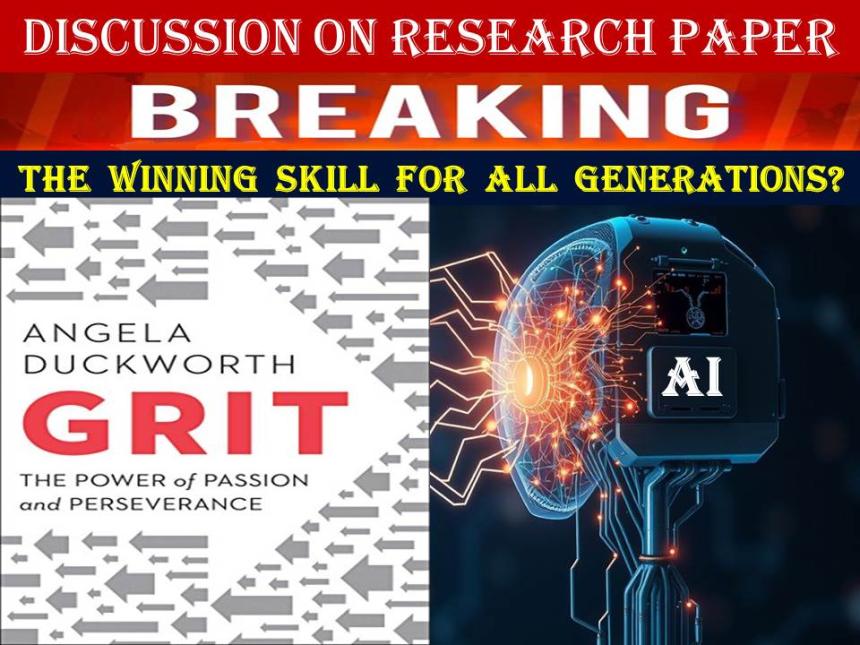

The Winning Skill for All Generations?
Grit—defined as a combination of passion, perseverance, and resilience in pursuing long-term goals. Angela Duckworth a prominent American psychologist and author is best known for her research on grit. This write up is a discussion on "The Winning Skill for All Generations?" suggesting "gen z" attaining necessary skill by employing efforts for success in life.
أَعُوذُ بِاللّٰهِ مِنَ الشَّيْطَانِ الرَّجِيمِ۔
بِسۡمِ ٱللهِ ٱلرَّحۡمَـٰنِ ٱلرَّحِيمِ
اللہ کے نام سے شروع جو بڑا مہربان نہایت رحم کرنے والا ہے
In the name of ALLAH, the Most Gracious, the Most Merciful
The Winning Skill for All Generation?
Angela Duckworth (born 1970) is a prominent American psychologist, professor at the University of Pennsylvania, and author best known for her research on grit—the combination of passion and perseverance for long-term goals. A 2013 MacArthur Fellow, she has authored the #1 New York Times bestseller "Grit: The Power of Passion and Perseverance" and co-hosts the podcast "No Stupid Questions".
Angela Duckworth got the motivation for research on human achievement with a simple query; Why do some kids succeed and others don't?
Angela Duckworth’s research on human achievement indicates that the primary reason some children succeed while others do not is "GRIT"—a combination of long-term passion and perseverance. While intelligence (IQ), talent, and privilege are often considered the main drivers of success, Duckworth's research shows that grit is often a better predictor of success across challenging settings, including academic achievement, spelling bee success, and retention in military training.
Duckworth's research work focuses on identifying what drives individuals to succeed when talent is equal, discovering that high achievers are not merely "talented" but are "gritty". Duckworth argues that talent is how quickly skills improve, but achievement is the result of using those skills. Effort must be invested to build skills, and then applied again to use them. The formula is:
Talent x Effort = Skill
Skill x Effort = Achievement
Success is not just a burst of motivation; it is consistency over years. Gritty kids have a long-term goal they care about deeply and maintain "stamina" in pursuing it. Gritty children view setbacks not as a permanent condition or a reason to quit, but as a reason to try harder. Gritty students are more likely to finish what they start—whether that is graduating from high school, staying in college, or mastering a skill—because they refuse to stay down after falling. The research suggests that while raw talent may provide a head start, persistence in the face of adversity determines long-term success.
Building skills requires investing effort strategically— through focused, purposeful, and consistent action. Effective skill-building involves deliberate practice and fostering a growth mindset to turn effort into expertise.
Deeply caring about a pursuit and maintaining stamina requires a blend of mental, physical, and emotional strategies that focus on sustainability rather than short-term intensity. Stamina in any pursuit is essentially the ability to sustain prolonged effort, and it is cultivated through consistent habits.
Duckworth identifies four psychological assets that contribute to grit, which can be grown from the inside out:-
Interest: Enjoying what you are doing. Passion begins with intrinsically enjoying the pursuit.
Practice: Dedication to improving specific weaknesses—deliberate practice.
Purpose: The conviction that your work matters—that it is personally meaningful and connected to the well-being of others.
Hope: A resilient form of hope that believes our own efforts can improve our future, regardless of luck.
The Role of Mindset and Environment
Growth Mindset: Gritty kids believe in the ability to grow and learn, rather than believing their talents are fixed (a concept developed by Carol Dweck).
Supportive Environments: Grit is contagious; it lives in culture. Schools and families that set high standards while providing a warm, supportive atmosphere help build grit in children.
The Details to Research Output
Angela Duckworth focused on a famous experiment from the late 1960s. A Stanford psychologist named Walter Mischel brought four-year-olds into a small room one at a time, placed a marshmallow in front of them, and told them, he had to leave. If they waited until he returned, they'd get two marshmallows. If they couldn't wait, they could ring a bell and eat the one in front of them right now.
Most kids lasted about thirty seconds.
But what happened over the next decade, is what made Mischel's study famous. When he tracked those same children down years later, the ones who had waited the longest, had SAT scores 210 points higher on average, than the ones who rang the bell immediately. Self-control at age four predicted academic outcomes, that most educators couldn't explain even after years of watching the kids up close.
Duckworth was fascinated, but she was after something deeper. Self-control explained part of the picture. It didn't explain everything. She thought about her own career early, scattered, unfocused by her own admission and compared it to people she knew who had found a mission at twenty-two and never let go of it. They weren't smarter than her. They weren't working harder than her in any obvious sense. They had something else. She called it "grit". And the definition matters, because the word has been diluted into a motivational poster cliché that misses the point entirely.
Grit, in Duckworth's framework, is not toughness. It is not working long hours. It is not refusing to quit when things get hard, although that is part of it. Grit is the combination of passion and persistence aimed at a single long-term goal over years and sometimes decades. The passion part is often misunderstood. She does not mean excitement or enthusiasm. She means the sustained fascination with a specific problem. The thing you keep returning to even when you don't have to.
She built a twelve-question test to measure it; the “Grit Scale”. And then she took it into the field.
At the University of Pennsylvania, students with high grit scores earned higher GPAs than their peers, even when those peers had entered college with stronger test scores. The finding that stopped the room every time she presented it came from West Point (US Military Academy). Every year, West Point runs thousands of incoming cadets through a brutal summer training course called Beast Barracks. The military had developed its own complex evaluation tool called the whole candidate score to predict who would make it through. It factored in academic grades, physical fitness, and leadership potential.
Duckworth gave her twelve-question grit test to over twelve hundred cadets as they arrived. Her test out predicted the whole candidate score. The cadets who dropped out weren't the weakest physically or the least intelligent academically. They were the ones who scored lowest on passion and persistence toward a long-term goal. The ones who made it through were the ones who had a reason to be there that was bigger than any single difficult day.
Lessons to be Learnt
The finding that most people miss when they hear about this research is the distinction Duckworth draws between motivation and volition.
Motivation is about wanting something. Volition is the ability to keep moving toward it when the wanting isn't strong enough to carry you on its own. You can be extremely motivated to build something and still quit at the first serious obstacle because you never developed the second thing. The marshmallow kids who waited the longest weren't the ones who wanted two marshmallows more desperately. They were the ones who had learned to redirect their attention, to think abstractly about the goal, to make the immediate discomfort feel smaller than the long-term payoff.
Duckworth's research shows grit is only faintly related to IQ. There are brilliant people with almost no grit and ordinary people with extraordinary amounts of it. The raw intelligence gets you to the starting line. What happens after that is almost entirely determined by whether you have the combination of a goal worth caring about for years and the discipline to keep working toward it on the days when nothing is going well.
The marshmallow test did not sort brave children from cowardly ones. It sorted children who had already learned that discomfort is temporary from children who hadn't learned that yet. Every gritty person you have ever admired figured out one thing the rest of the room hadn't: the goal on the other side of the hard stretch is more real to them than the discomfort standing between them and it.
How "Grit" is Important for Gen Z?
The skill called "grit" is trainable. Grit—defined as passion and perseverance for long-term goals—is not an innate trait but a trainable skill that can be developed through specific habits, mindset shifts, and consistent effort.
The Four Pillars of Training Grit
According to research, grit is built on four psychological assets that can be improved:
Interest: Cultivate a deep, genuine interest in what you are doing. Passion often starts with curiosity, which is then nurtured.
Practice: Engage in deliberate practice—focused, goal-oriented improvement—to refine skills and overcome weaknesses.
Purpose: Connect your daily efforts to a higher purpose or a goal that matters to you and potentially benefits others.
Hope: Develop a "growth mindset" (believing abilities can improve) to maintain hope that your efforts can overcome obstacles and improve your future.
Practical Strategies to Build Grit
Adopting a "Growth Mindset": Believing that your talents and capabilities can be developed through hard work, allows you to view failures as temporary setbacks, rather than permanent limitations.
The "Hard Thing" Rule: Implement a rule where you (or your children) must do one "hard thing"—an activity requiring daily deliberate practice—that you cannot quit at the first sign of struggle.
Seeking Controlled Discomfort: Voluntarily put yourself in challenging situations to build resilience, such as taking on difficult projects or rigorous physical training.
Reflecting After Adversity: Instead of just pushing through, take time to reflect on difficult experiences. Journaling or discussing what was learned from a setback helps turn challenges into growth.
Building Community: Surround yourself with gritty, persistent people, as grit can be contagious.
The Neuroscience Behind It
Neuroscience indicates that grit is wired into the brain and can be strengthened like a muscle. Studies suggest that regularly pushing through exhaustion, fatigue, or self-doubt strengthens the anterior mid-cingulate cortex (aMCC), a brain region involved in motivation, willpower, and physical perseverance.
Our Kids (Gen Z) has less cognitive capability than their parents. Cognitive capability refers to the brain-based mental processes required to acquire knowledge, manipulate information, and reason. These essential skills—including attention, memory, logic, and processing speed—enable humans to perceive their environment, solve problems, and execute complex tasks.
Conclusion
Gen Z may have lost on the count of cognitive capability but still can be grittier than predecessors. The experts suggest this shift does not necessarily indicate a decline in intelligence, but rather a change in cognitive processing, with many in Gen Z displaying strong resilience, grit, and alternative "digital" intelligence.
The one skill called “grit” will have no competition with AI as well. Grit—defined as a combination of passion, perseverance, and resilience in pursuing long-term goals—is widely recognized as a "human edge" that artificial intelligence (AI) cannot easily replicate. While AI excels at speed, pattern recognition, and efficiency, it cannot substitute for the sustained human commitment required to overcome setbacks and navigate complex, messy, real-world problems.
Therefore, Gen Z may gain "mental toughness" and show better performance skill with required training, and can improve their capacity to stick with long-term goals and achieve greater success.

Halal Burger or Smash Burger? Understanding the Difference Before You...

Casino Senza Documenti: Guida Completa ai Vantaggi, al Funzionamento e...
Casino Senza Documenti: Guida Completa ai Vantaggi, al Funzionamento e agli Aspetti da Con...

Looking for Shops for Sale in Ahmedabad? Start Here ⭐
Ahmedabad has always been a city that's comfortable growing. Not loudly. Not all at once...